
The event was moderated by Ann Syauta, Chief, Intergovernmental Affairs, Communications and Outreach Section at OHCHR, and introduced by UN Assistant Secretary-General (ASG) Claudia Fuentes Julio, who highlighted how it supports greater transparency in the Council elections.
Mentimeter poll on 3 September 2026
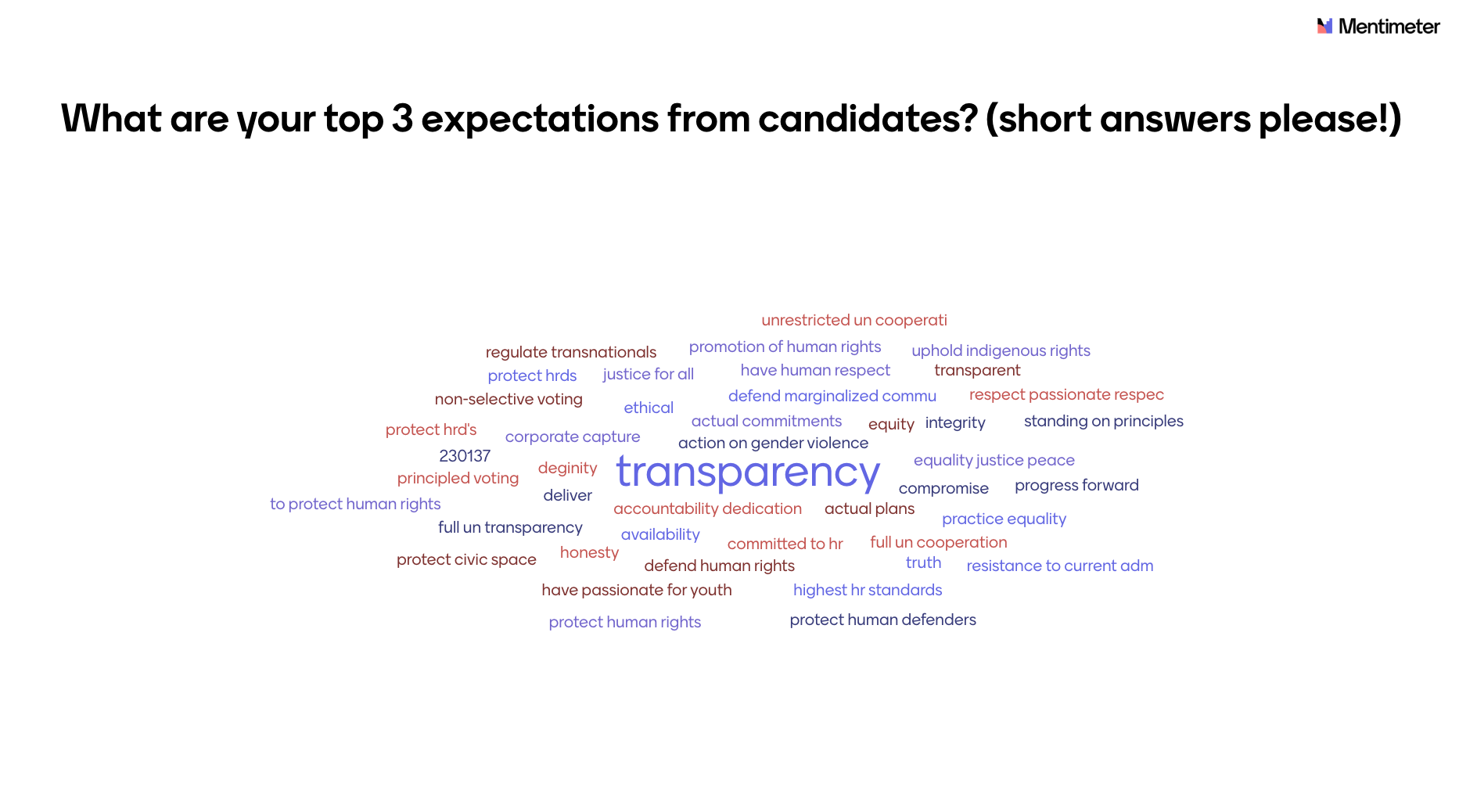
HRC elections 2026: Candidates share their pledges and answer civil society questions
State candidates to the Human Rights Council presented their pledges and responded to questions by civil society and other stakeholders on their human rights records, while elaborating on their vision to improve the work of the Council at ISHR’s and Amnesty International’s 16th annual event.
On 3 September 2026, State candidates to the Human Rights Council (HRC, or the Council) joined an online event during which they were asked to outline their commitments and vision, should they be elected.
Of 14 States that have announced candidacy, 9 candidates from all regional groups participated in the event: Brazil, Germany, Ireland, Japan, Moldova, Nepal, Ukraine, Uruguay, Zambia, and 5 declined, did not reply to the invitation or did not attend the event: Dominican Republic, Ghana, Jordan, Kuwait, and Nigeria.
Elections to the Human Rights Council are often not as competitive as we would hope. All too often closed slates are the norm, as is the case again this year. We strongly encourage all regional groups to allow for competition among their candidates. This is how we ensure the best possible membership.Sherine Tadros, Deputy Director of Advocacy and Head of New York (UN) Office at Amnesty International
2026 marks the 20th anniversary of the Human Rights Council. Over the past two decades, the Council has advanced human rights standards and provided a platform for dialogue.Claudia Fuentes Julio, UN Assistant Secretary-General
Candidate States’ pledges
Brazil’s representative emphasised the State’s commitment to multilateralism even in a challenging context. If elected, Brazil would prioritise dismantling systemic racism and inequality, continue to combat feminicide, and defend the rights of human rights defenders and historically marginalised communities, including LGBTIQ+ people and homeless persons.
Germany’s representative highlighted the importance of protecting human rights as part of the State’s foreign policy and as a foundation for peace and security. As a HRC member, Germany would focus on translating principles into action in four key areas: accountability and protection of defenders, rule of law, equality, and the abolition of the death penalty. Germany would further combat transnational repression and promote the achievement of economic, social and cultural rights.
Ireland’s representative pointed out five thematic priorities: civil society space and human rights defenders, right to food, women’s rights and gender equality, rights of LGBTIQ+ people and rights of people living with disabilities in conflict contexts. Ireland pledged to be a key partner for human rights at the domestic and international levels.
Japan’s representative recalled the six terms already spent as a HRC member and pledged to engage with civil society to achieve the fulfilment of human rights both globally and nationally – focusing on gender equality, people living with disabilities, children’s rights, artificial intelligence and human rights, business and human rights. Japan would also work on mandates’ rationalisation.
Moldova’s representative recalled the State’s previous term and the related human rights improvements achieved nationally, including the prevention of violence against women, ill-treatment and human trafficking, and the strengthening of anti-discrimination legislation. Building on this experience, Moldova would focus on advancing equality and freedom of expression, fighting discrimination and disinformation, promoting the rights of children and people living with disabilities, and digital technologies.
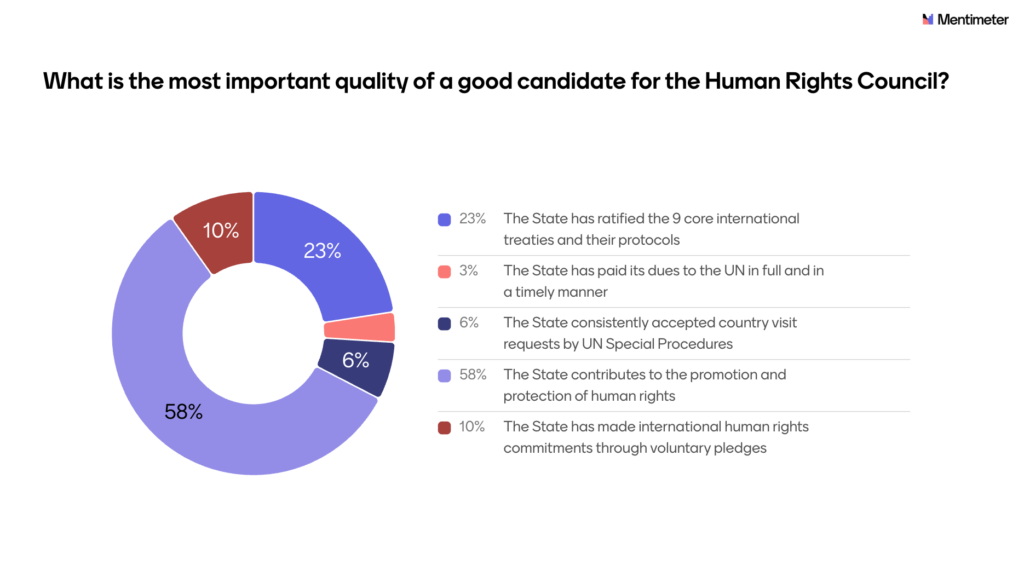
Mentimeter poll on 3 September 2026
Nepal’s representative emphasised the State’s commitment to the protection and promotion of human rights, as engraved in Nepal’s constitution. The representative also recalled the State’s two consecutive terms as HRC member and expressed its renewed pledge to work for the universality of human rights, conflict resolution, peace building and constructive engagement with all stakeholders.
Ukraine shared its pledge to strengthen global accountability mechanisms and protect vulnerable groups, particularly in contexts of war and armed conflicts. Having submitted its candidacy since 2020, Ukraine remains committed to international human rights law including in relation to refugees and unlawful deportation.
Uruguay seeks to join the Council once more because the protection of multilateralism and human rights guides its public policies and foreign policy. The State’s representative emphasised the belief in the universality, interdependence, and interrelation of human rights. If elected, Uruguay would promote dialogue and consensus, work to avoid retrogression of rights, and focus on children’s rights, gender equality and new technologies and human rights.
Zambia sees its potential membership as an opportunity to bring the HRC closer to the Zambian people and to bring regional realities into the HRC. The State representative stated that Zambia has demonstrated that human rights commitments can translate into concrete actions, such as abolishing the death penalty. If elected, Zambia would commit to championing human rights, building bridges in moments of polarisation, and focusing on sustainable development and responsible technological innovation.
Discussion
Brazil was questioned about the protection of the rights of migrant workers and their families. The State representative mentioned that migrant people have access to heath, education and social programmes. He further stated that Brazil remains committed to work with UN bodies. Brazil was also questioned about initiatives it would take to advance the rights of people of African descent internationally, and how it would strengthen its engagement with UN mechanisms to monitor and evaluate the implementation of recommendations and decisions issued, including by EMLER, in a context of police violence and fatalities across the Americas. The State representative affirmed Brazil’s firm support for EMLER and other antiracism mechanisms, Brazil being one of the few countries that have advocated for the preservation of all mandates that make up the antiracism agenda, and being at the forefront on the issue of historical reparations including harm in the present.
Germany was questioned about deportations to Afghanistan, where the Taliban have entrenched one of the worst human rights crises, dismantling the rights of women and girls. The State representative condemned the systemic violence against women and girls that might amount to gender persecution under the ICC and highlighted Germany’s pledge of 500,000 Euros for the mechanism on Afghanistan, and the fact that 97% of the 450,000 Afghan people living in Germany have the right to stay there. Germany also affirmed that it does not deport women nor girls to Afghanistan. Germany was further asked about its pledge for ‘substantial financial support’ for the HRC and Special Procedures. The State representative replied that Germany strongly supports the UN system, being the 4th largest donor paying its dues on time. Germany also defends the human rights budget by raising its voice at the GA 5th Committee and financing OHCHR (2nd largest donor).
Ireland was questioned about its carbon budgets and 2030 emissions targets and whether it would pledge to protect the rights of communities disproportionately affected by climate change. The State was further asked whether it would commit to deep, sustained cuts in methane emissions from its livestock sector. The State representative replied that energy efficiency being a priority for Ireland, this issue is already included in the State’s budget and that the government looks forward to the recommendations by the Special Rapporteur on the right to a clean and healthy environment. Ireland commits to ensure that voices of civil society are considered on this issue. Last but not least, the representative ensured that food would be one of Ireland’s priorities at the HRC.
Japan received a question on the protection of the rights of all migrant workers and their families, to which the State representative responded that Japan is considering various aspects that this may require in domestic law. A second question posed to Japan asked how it can protect Japanese, Chinese, Hong Kong people and other people living in Japan and abroad from China’s transnational repression, to which Japan replied that all States must respect human rights and refrain from transnational repression, and that the pattern of control displayed by China is a serious concern. In Japan, when transnational repression occurs, an investigation is carried out and measures are taken under the criminal justice system.
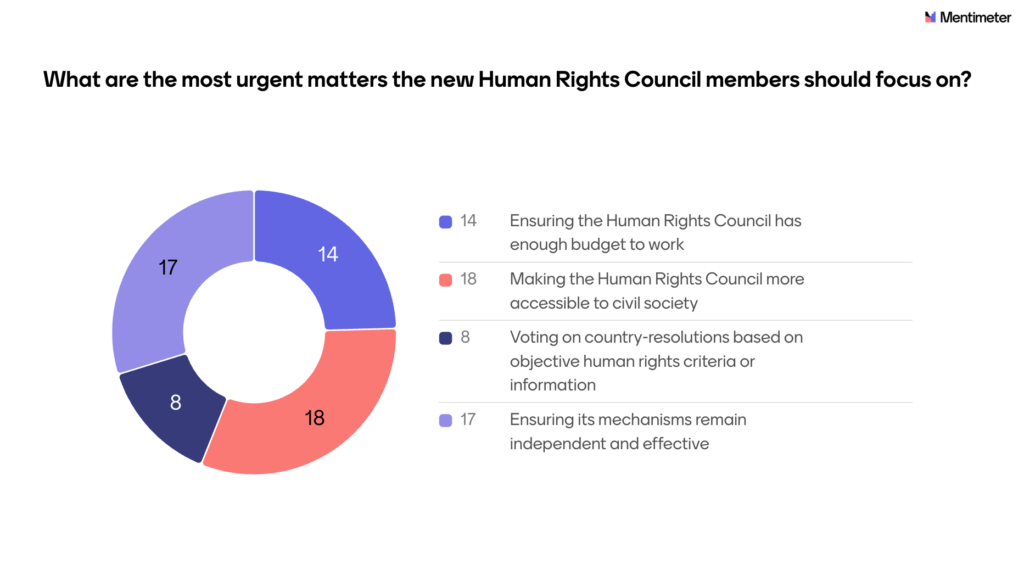
Mentimeter poll on 3 September 2026
Moldova was questioned about the implementation of the 2025 human rights recommendations of the Venice Commission in relation to media outlets, journalists and civil society. A second question revolved around the adoption of a law establishing an independent, adequately resourced and rapid-response protection mechanism for defenders at risk. The State representative highlighted Moldova’s cooperation with the EU, showing that the country has good practices in consulting civil society. Regarding journalists, Moldova adopted an action plan 26-27 to protect them. Internationally, Moldova is paying attention to freedom of expression, which is one of their priorities. If elected, Moldova would push for more participation of civil society at the UN.
Nepal was questioned about how it would implement its ambitious legal framework to ensure equality, dignity, self-determination, legal identity, and non-discrimination for transgender and gender-diverse people. The State was also asked whether it would amend its Constitution and citizenship laws so Nepali women can confer nationality on their children and spouses, and whether it would introduce safeguards for children who would otherwise be stateless. The State representative affirmed that Nepal recognises gender equality as a fundamental right and that its citizenship law shows no discrimination but some reservation on dual nationality. He also mentioned Nepal’s commitment for legal and constitutional arrangements to ensure the capacity of mothers to secure nationality for their children, and that no child will be stateless in Nepal. Its ministry was renamed Ministry of women, children, gender and sex minorities and social security, demonstrating the government’s effort to prioritise the issue of sex and gender minority.
Ukraine was questioned about its prosecution under anti-collaboration laws for work that international humanitarian law permits under occupation. The State was further asked about safeguards to ensure that restrictions imposed domestically remain lawful, necessary, proportionate and subject to independent oversight. Last but not least, Ukraine was asked about its commitment to protecting independent media, human rights defenders and anti-corruption actors. The State representative replied that Ukraine remains fully committed to human rights, dialogue and international law in the context of Russia’s war of aggression, that the implementation of recommendations by the Commission of Inquiry is an ongoing process, and that potential abuses by the military are being investigated.
Uruguay received a question about its reported negotiations with the US to receive deportees, and how it would ensure that any such move complies with international refugee and non-refoulement obligations. Uruguay was further asked about its commitments towards the rights of older persons, including how it would engage in the Intergovernmental Working Group on the rights of older persons. The State representative mentioned that ensuring the protection of refugees is the responsibility of the State where the individuals arrive, and that Uruguay currently has 27,000 refugee applications. Uruguay further commits to the legally binding instrument for the human rights of older persons with their participation throughout the process.
Zambia was questioned about the protection of all migrant workers and their families, as well as what it would do, including repealing provisions of its Cyber Security Act & Cyber Crimes Act, to allow access to and heed recommendations by UN mechanisms. The answer to the first question focused on Zambia’s national labour migration strategy, which protects migrant workers against exploitation, and the modernisation of Zambia’s legal framework around migration. The State representative further stated that Zambia remains committed to the ratification of the Convention and that, consistent with the recommendations received in the 4th UPR cycle, the procedure to ratify it has started and should finish by 2028. With respect to the Cyber Crimes Act it is important to situate it into the context and necessity of effective cybersecurity. Interception is done based on principles of legality, necessity and proportionality. The representative reaffirmed the State’s commitment to due process and the rule of law as well as to defenders’ protection and political participation.
Candidate States who did not attend the event also received questions
The Dominican Republic was asked about the sharp increase in deportations of Haitians and Dominicans of Haitian descendants despite Haiti’s severe human rights and humanitarian crises, and the steps it would take to ensure its migration and deportation policies comply with international human rights standards, and what specific measures it would take to prevent racial profiling against Haitians and Dominicans of Haitian descent. The State was also asked about the steps it had taken to return to the Inter-American Court of Human Rights’ jurisdiction.
Ghana received a question on its recently passed ‘Human Sexual Rights and Family Values Bill’ and how it would ensure that its commitment to human rights is reflected in its domestic legal framework, including by safeguarding the rights of LGBTIQ+ people and the broader civil society. A second question addressed to Ghana focused on how the government would ensure that children, including girls, can meaningfully participate in the work of the Human Rights Council and other UN mechanisms.
Jordan was asked about freedom of expression, freedom of peaceful assembly, and protection of human rights defenders as many citizens were imprisoned, or targeted by the Pegasus spyware, solely because of their peaceful activism on and offline. A second question asked what progress Jordan had made with regards to the Human Rights Committee’s call to ‘ensure that domestic laws, including those based on sharia law, are interpreted and applied in conformity with the State Party’s obligations under the covenant’, specifically regarding the freedom to change religion or belief.
Kuwait received a question on government policies that perpetuate statelessness and citizenship stripping, and the steps it would take to halt all citizenship revocations that violate international law and restore nationality of those who have been arbitrarily deprived from it. A second question raised concerns about limited trade union rights for migrant workers, and asked when Kuwait would pass a legislation recognising all migrant workers’ rights to freely associate, organise, collectively bargain and form a trade union in line with ILO Conventions No.87 and 98.
Nigeria was asked whether it would accommodate pending country visit requests by all UN Special Procedures including those related to freedom of expression, peaceful assembly, and counter-terrorism. A second question to Nigeria asked whether it would commit to measurable targets for investigating and prosecuting sexual and gender-based violence, protecting survivors and human rights defenders, and commit to implementing concrete legislative and policy guarantees to protect defenders, journalists, and peaceful demonstrators from arbitrary arrest, harassment, or criminalisation.
At the time of writing, these are the 14 candidates announced seeking election:
- African States: Ghana, Nigeria and Zambia (3 candidates so far for 4 seats: closed list)
- Asia-Pacific States: Japan, Jordan, Kuwait and Nepal (4 candidates for 4 seats: closed list)
- Latin American and Caribbean States: Brazil, Dominican Republic and Uruguay (3 candidates for 3 seats: closed list)
- Western European and Other States: Germany and Ireland (2 candidates for 2 seats: closed list)
- Eastern European States: Moldova and Ukraine (2 candidates for 2 seats: closed list)
The event recording is available in English, French and Spanish.
This event was kindly sponsored by the Republic of Chile and the Republic of Estonia.
The illustrations included in this article are screenshots from an online poll that ran during the event.
Watch the event recording here!