
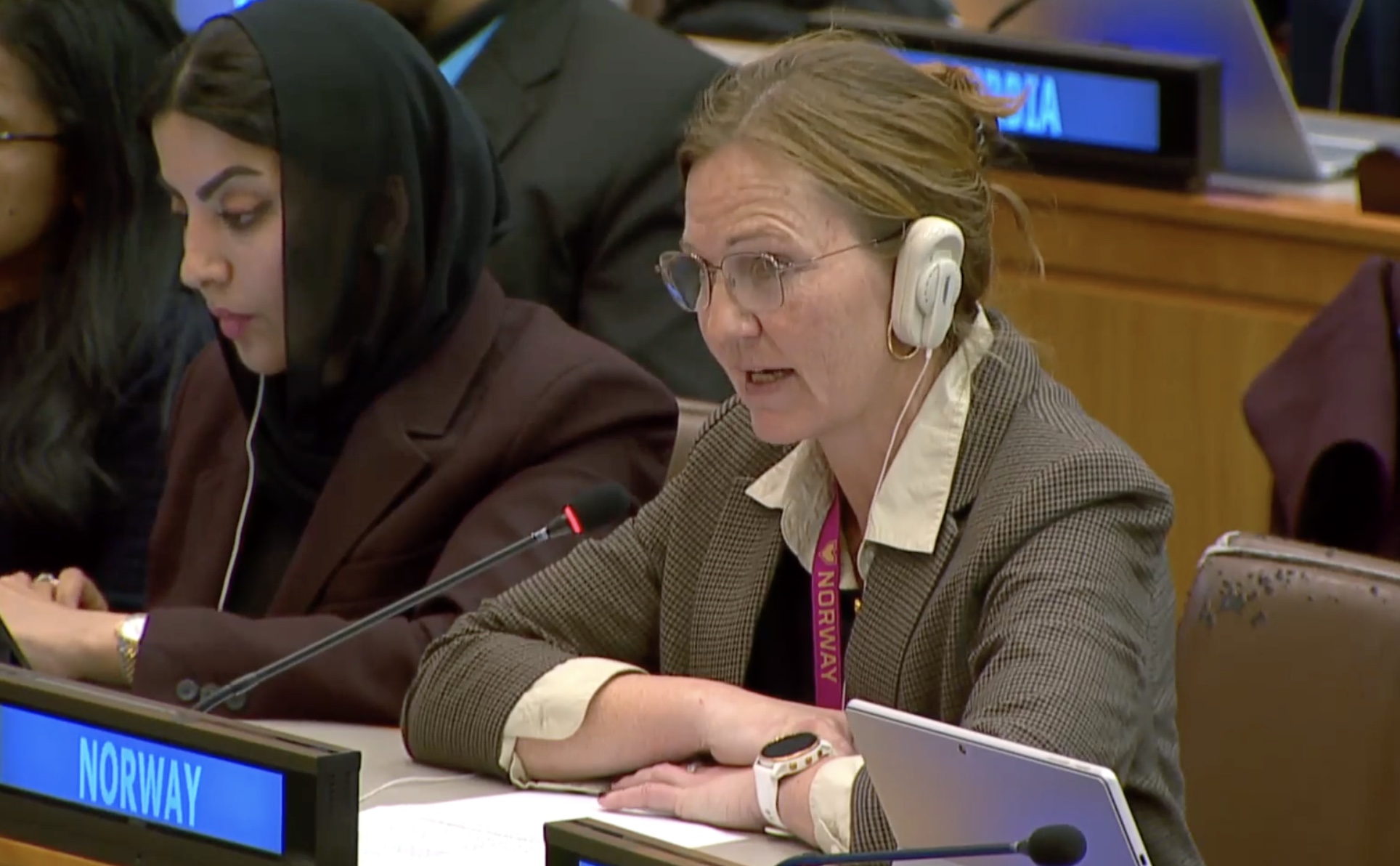
Norway Ambassador introduces resolution at the 46th Plenary meeting of Third Committee of the UNGA’s 76 Session. Credit: Screen capture from UN Web TV.
UNGA81: UN adopts landmark resolution strengthening protections for human rights defenders in the digital age
Adopted by 167 States, the resolution strengthens protections for human rights defenders against unlawful surveillance, technology-facilitated violence and repression across borders, while calling for greater accountability by States and technology companies.
Following weeks of negotiation, Member States of the United Nations adopted a resolution (A/C.3/81/L.36/Rev.1) led by Norway focusing on human rights defenders in the context of new and emerging technologies by a vote of 167 in favour, 4 against and 8 abstentions. The resolution follows the General Assembly’s most recently adopted resolution on human rights defenders (A/RES/78/216) in 2023 and has traditionally had a long record of broad support.
The theme of this year’s resolution is informed by the latest thematic resolution of the Human Rights Council on human rights defenders (HRC/RES/58/23), passed in 2025, as well as the 2026 resolution-mandated report assessing risks to human rights defenders arising from the use of digital technologies, and initiatives to improve their protection from these risks.
Nearly 28 years after the General Assembly adopted the Declaration on Human Rights Defenders by consensus, human rights defenders remain essential to achieving the goals at the heart of the UN’s work: sustainable development, peace, security, gender equality, accountability and the rule of law. Yet around the world, defenders continue to face killings, enforced disappearance, arbitrary detention, criminalisation, smear campaigns and reprisals for engaging with the UN. As civic space comes under increasing pressure in many regions, emerging threats — including spyware, technology-facilitated violence and repression across borders — are placing defenders at risk wherever they are.
We welcome this resolution for maintaining important previously agreed protections while advancing protections for human rights defenders in the digital sphere and responding to new and emerging challenges facing human rights defenders. In particular, we welcome its:
- Recognition of repression across borders, expressing grave concern at repressive activities conducted abroad by States to silence, intimidate and harm human rights defenders, and calling for effective measures to prevent and address such violations, protect those affected and ensure accountability and access to remedies.
- Greater attention to unlawful or arbitrary surveillance and emerging technologies, including spyware, biometric surveillance and artificial intelligence, and the need for human rights safeguards, accountability and effective remedies.
- Strengthened protection against online attacks and technology-facilitated violence, including gender-based violence, doxxing, deepfakes, cyberstalking and other forms of digital harassment and abuse, which disproportionately affect women human rights defenders.
- Recognition of the responsibilities of technology companies, including those operating in the private surveillance industry, to conduct human rights due diligence and prevent adverse impacts on human rights defenders.
- Call for action against strategic lawsuits against public participation, which are increasingly used to judicially harass, intimidate and silence human rights defenders.
- Call for strengthened national disaggregated data collection, analysis and reporting on the number of verified cases of killing, kidnapping, enforced disappearance, arbitrary detention, torture and other harmful acts against human rights advocates, as reflected in Sustainable Development Goal indicator 16.10.1.
“We commend Norway’s leadership at this critical juncture where human rights defenders are subjected to severe threats and attacks in spite of their invaluable contributions in advancing human rights. We welcome the strong support of 167 Member States including 67 resolution cosponsors* and regret that a small number of states chose to vote against recognising the critical role of human rights defenders and the threats posed to them by new and emerging technologies.”
– Madeleine Sinclair, New York Office Director of International Service for Human Rights.
*Andorra, Armenia, Australia, Austria, Belgium, Bosnia and Herzegovina, Brazil, Bulgaria, Cabo Verde, Canada, Chile, Colombia, Costa Rica, Croatia, Cyprus, Czechia, Denmark, the Dominican Republic, Ecuador, El Salvador, Estonia, Finland, France, Georgia, Germany, Greece, Guatemala, Honduras, Hungary, Iceland, Ireland, Italy, Japan, Latvia, Lebanon, Liechtenstein, Lithuania, Luxembourg, Malta, the Marshall Islands, Mexico, the Federated States of Micronesia, Monaco, Mongolia, Montenegro, Morocco, Myanmar, the Netherlands (Kingdom of the), New Zealand, North Macedonia, Norway, Poland, Portugal, the Republic of Korea, the Republic of Moldova, Romania, San Marino, Serbia, Slovakia, Slovenia, Spain, Sweden, Switzerland, Timor-Leste, Ukraine, the United Kingdom, and Uruguay.