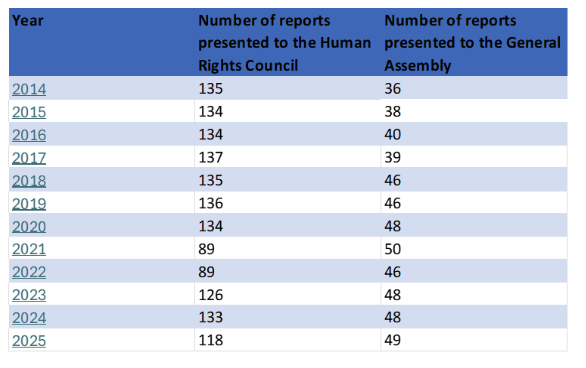
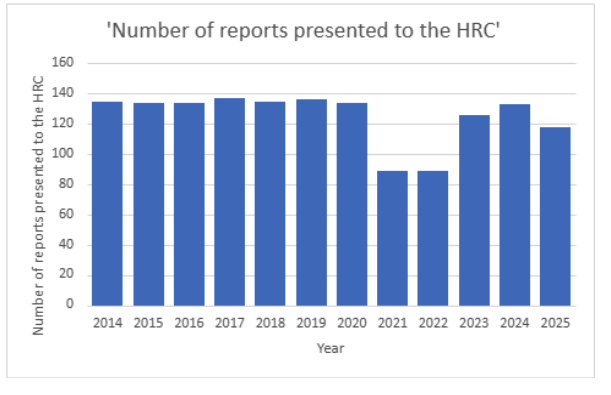
In 2025, the General Assembly adopted resolution 79/192 on the working methods of the Third Committee, with the objective of ‘achiev[ing] a manageable workload for the Committee and ensur[ing] the high quality of its deliberations’. The document, ‘Implementation of General Assembly Resolution 79/192 – Elements for a Roadmap’, requested in operative paragraph 3 of the resolution, was presented and discussed, but the General Assembly never formally adopted it¹.
Nevertheless, the Roadmap discussions established a set of guiding principles aimed at progressively reducing the number of mandates reporting to each session of the General Assembly’s Third Committee by an indicative 3 to 5 mandates per year, until the Committee’s 84th session. This would amount to a total reduction of approximately 9 to 15 reports over the course of the 81st, 82nd, and 83rd sessions of the General Assembly.
At the same time, successive efficiency initiatives, the UN’s ongoing budgetary constraints, and the UN80 reform process have further prompted Member States to advance proposals to reduce the reporting periodicity of Special Procedures to the General Assembly.
As highlighted by civil society organisations, without a strategic approach that includes meaningful consultation with relevant actors and a case-by-case assessment that highlights the extraordinary nature of these measures, these developments risk diminishing the visibility of key human rights issues in New York, widening the institutional gap between the General Assembly and the Human Rights Council, and normalising this practice over the long term. Reductions in reporting are accompanied by corresponding reductions in resources allocated from the Regular Budget to Special Procedures, which are exacerbated by reductions in extra-budgetary contributions to Special Procedures mandates.
The analysis below provides an overview of reductions in reporting implemented so far within the time-frame proposed by the Roadmap: General Assembly sessions 81 to 83 (2026–2028), and it considers the reductions adopted by the Council since its 60th session in September 2025 until the 62nd session of the Council (HRC62), in June 2026.
Main findings
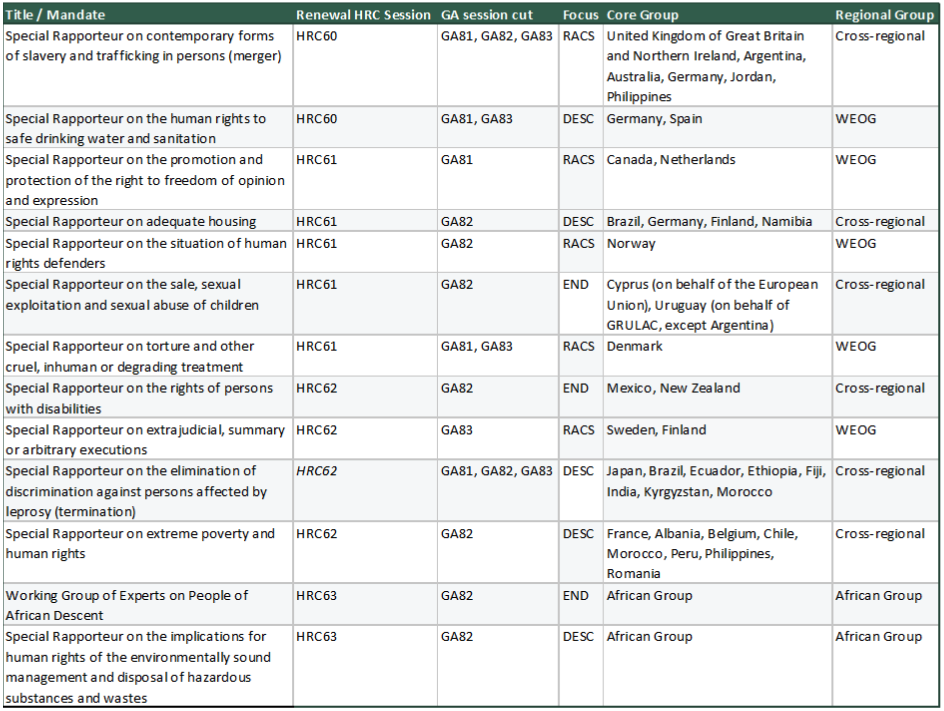
- The scale of reductions has already exceeded what was contemplated under the Roadmap. Resolutions adopted at HRC60-62 will result in 17 fewer reports to GA81-83, exceeding the Roadmap’s indicative cumulative range of 9-15 reports. The highest number of reductions will affect the General Assembly’s 82nd session (GA82 2027), with 7 fewer reports to be presented that session. There will be 5 fewer reports during GA81 (2026) and 5 fewer reports during GA83 (2028)².
- What began as a workload-management exercise risks becoming a structural change to Special Procedures reporting. Several resolutions do not merely omit reporting for a specified session but establish biennial reporting, potentially halving GA reporting over successive mandate renewals. There’s no uniform language around reporting reductions. Some resolutions state the specific sessions where mandate holders are meant to report to the GA, and others just vaguely state they should be reporting biennially to the General Assembly, only to be defined by the programme budget implications (PBI) arising from the resolution.
- Safeguards remain inconsistent. Some resolutions preserve alternative opportunities for GA engagement or redirect savings to substantive mandate activities, while others contain no equivalent protection.
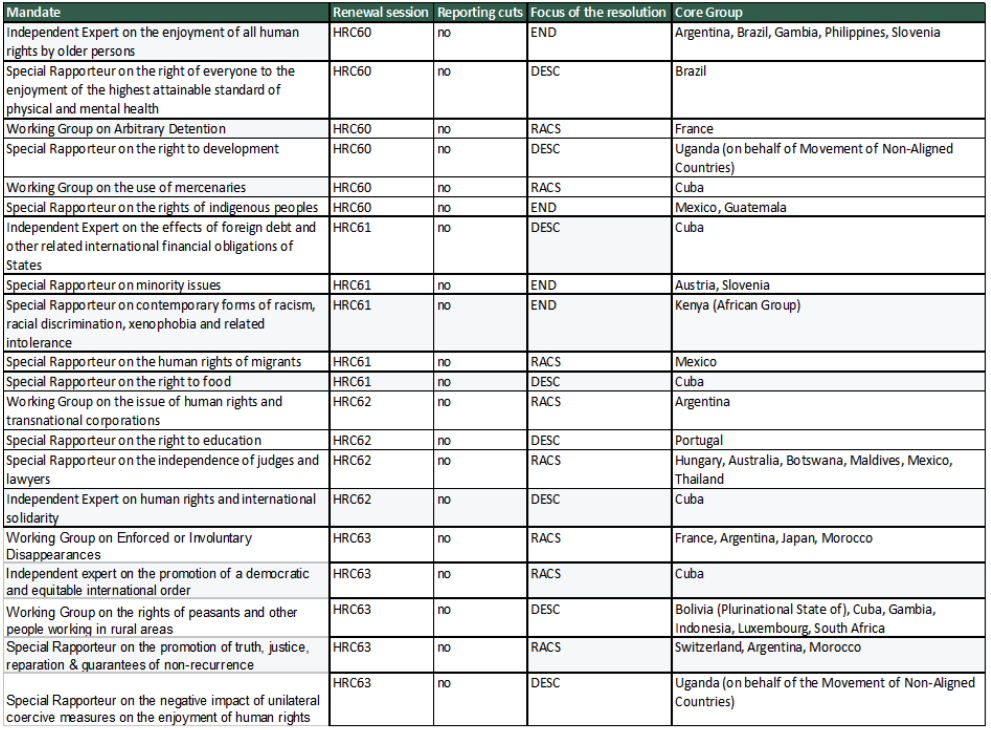
- Between the 60th and 62nd sessions of the Human Rights Council (HRC60–HRC62), the reporting periodicity of a significant number of Special Procedures³ mandates was reduced. During HRC61, 50% of the renewed mandates (5 of 10) experienced reductions in reporting periodicity. Similarly, during HRC62, 50% of the mandates that were up for renewal (4 of 8) had their reporting obligations reduced as well.
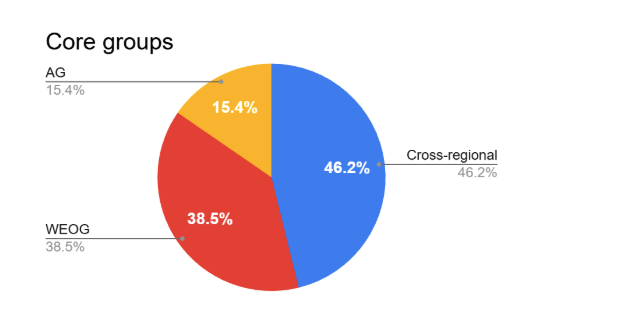
- States in the Western Europe and Others Group (WEOG) have led this reporting reduction process thus far, followed by cross-regional groups, the majority of which include one or more WEOG members.
- Approximately one in four thematic Special Procedures mandates with reporting obligations to the General Assembly have already been affected by the current initiatives to reduce reporting.
In depth analysis