
Scorecards 2025
HRC Elections 2025
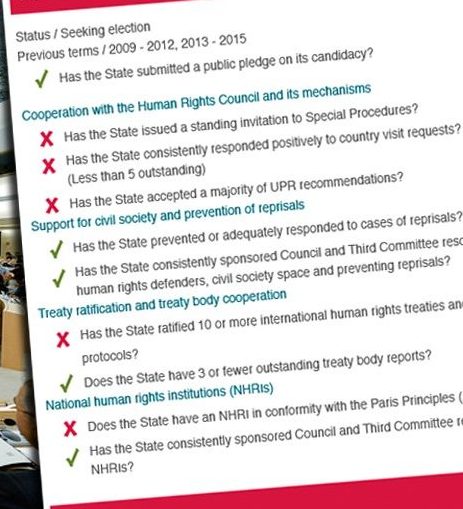
ISHR has published ‘scorecards’ for States seeking election to the UN Human Rights Council for 2027-2029 to help inform voting States’ decisions in the upcoming election.
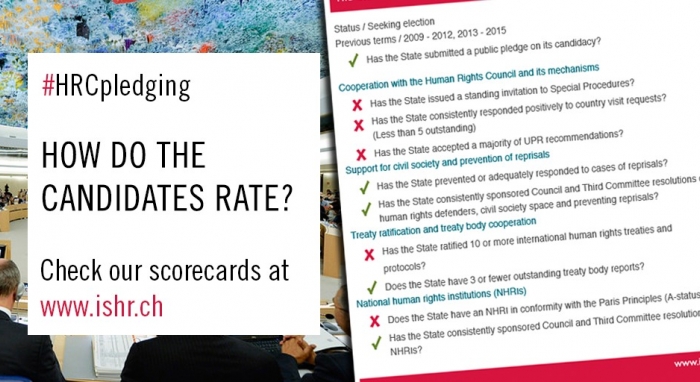
To coincide with the Human Rights Council Pledging Event hosted by ISHR and Amnesty International, ISHR publishes a ‘scorecard’ for each State seeking election to the Human Rights Council and regional cards comparing candidates States of every region.
The scorecards offer a quick ‘at-a-glance’ objective comparison of the human rights record of each candidate through criteria such as focusing on their cooperation with human rights bodies such as the Council, their support for civil society, their engagement with UN Treaty Bodies and Special Procedures, among others.
Candidates are also expected to put forward voluntary pledges and commitments on what they will achieve as members – at both domestic and international level. Together, both should inform voting States’ decisions of whether to support them in the election.
Through Council membership, States commit themselves to ‘uphold the highest standards in the promotion and protection of human rights,’ and to fully cooperate with the Council and its mechanisms. Voting States must treat human rights considerations as paramount in electing members to the Council, and prioritise human rights over political or economic interests.
This year 15 countries are running for 15 seats. To date, these are the candidates, and their scorecards are available for download:
To date, the following country has published voluntary pledges:Brazil, Germany, Ireland, Japan, Jordan, Kuwait, Moldova and its Annex, Ukraine, Uruguay
The sources and criteria for the scorecards are set out below:
|
ELEMENT |
SOURCE |
|
Previous terms |
OHCHR website, List of past members of the Human Rights Council |
|
Has the State submitted a public pledge on its candidacy? |
United Nations Documents Search |
|
Has the State submitted a public pledge on its candidacy in a timely manner? |
United Nations Documents Search or ISHR Web site if the candidate State provides it, by June 2026. |
|
Has the State supported all country-specific resolutions at the HRC or GA? |
The State did not vote against any country-specific resolution that is consistent with the objective human rights criteria and the promotion and protection of human rights at the HRC during its current or last term; or at the General Assembly in the last year. |
|
Has the State played a leadership role on country situations at the Council? |
Fulfilled commitments set out in the joint statement at the 32nd Council session presented by Ireland, resulting in significant attention on at least two country situations, by leading (pen holder) or delivering a joint statement dedicated fully or substantially to a country situation, or leading a resolution (pen holder or member of core group) or a request for a special session (initiating the request as a sponsor). *This includes any country situation in respect of which the State has played a non-public leadership role resulting in collective action at the Council. |
|
Has the State opposed all attempts to defund HRC mandates at the Fifth Committee?
|
In the past 6 years, the State did not lead or support or refrain from opposing (abstention) a resolution or amendment aiming at defunding a HRC mandate at the 5th Committee. Report of the Fifth Committee; ISHR landing page with analysis of votes at the Fifth Committee |
|
Has the State consistently accepted country visit requests? |
OHCHR website, Country visits and special procedures *Country visits requests made more than 3 years ago without a reminder sent by the special procedures are not counted. |
|
Has the State consistently sent a substantive reply to communications received from Special Procedures? |
OHCHR database, Communications sent and replies received *Communications received more than 3 years ago are not counted. |
|
Has the State developed and published an action plan for implementation of the UPR recommendations? |
Information provided and published by the State. |
|
Has the State submitted a voluntary UPR mid-term report? |
OHCHR mid-term report page |
|
Has the State ratified the 9 Core international human rights treaties and the related optional protocols? |
Ratification status of the 9 core international human rights treaties and optional protocols: ICCPR, ICESCR, ICERD, CEDAW, CRC, CAT, CED, CPRD, ICMW. Optional Protocols: ICCPR-OP2, CRC-OP-AC, CRC OPSC, OP-CAT. |
|
Has the State accepted all individual complaint mechanisms? |
Individual complaints mechanisms of 9 core international human rights treaties: ICCPR-OP1, CAT (art 22), CERD (art 14), CEDAW-OP, CRPD-OP, CED (art 31), CMW (art 77), ICESR-OP, CRC-OPIC. |
|
Does the State have no outstanding treaty body reports? |
OHCHR website, Reporting Status [as of 31.12.2025] |
|
Does the State have no case of unresolved reprisals high-lighted in Secretary-General reports (2014-2025)? |
OHCHR website – Acts of intimidation and reprisal for cooperation with the United Nations in the field of human rights. |
|
Has the State spoken out expressing concern about particular victims of reprisals by name at the HRC or GA? |
Publicly expressed concern about victims of reprisals by name during debates at the GA or the HRC including the annual interactive dialogue with the Assistant Secretary-General on reprisals or UPR. |
|
Has the State sponsored the last HRC and Third Committee resolutions on human rights defenders, civil society space and reprisals? |
HRC58 human rights defenders, HRC59 civil society space, HRC60 reprisals, GA78 human rights defenders |
|
Does the State have an NHRI in conformity with the Paris Principles (A-status)? |
GANHRI (as of December 2025) |
|
Has the State paid its UN contributions in a timely manner? |
Paid its contributions for the year 2025 in full within the first three quarters of 2025 (i.e. by end of September 2025), UN Committee on Contributions UN Committee on Contributions |
Acknowledging the limitations of objective criteria in providing a complete picture, we encourage these ‘at-a-glance’ objective scorecards to be read in conjunction with the more in-depth reporting on country situations and human rights records such as the world reports produced by Amnesty International and Human Rights Watch.
HRC Elections 2025
HRC Elections 2024
HRC Elections 2023
HRC Elections 2022
HRC Elections 2021
HRC elections 2020
HRC elections 2019
HRC elections 2018
HRC elections 2017