
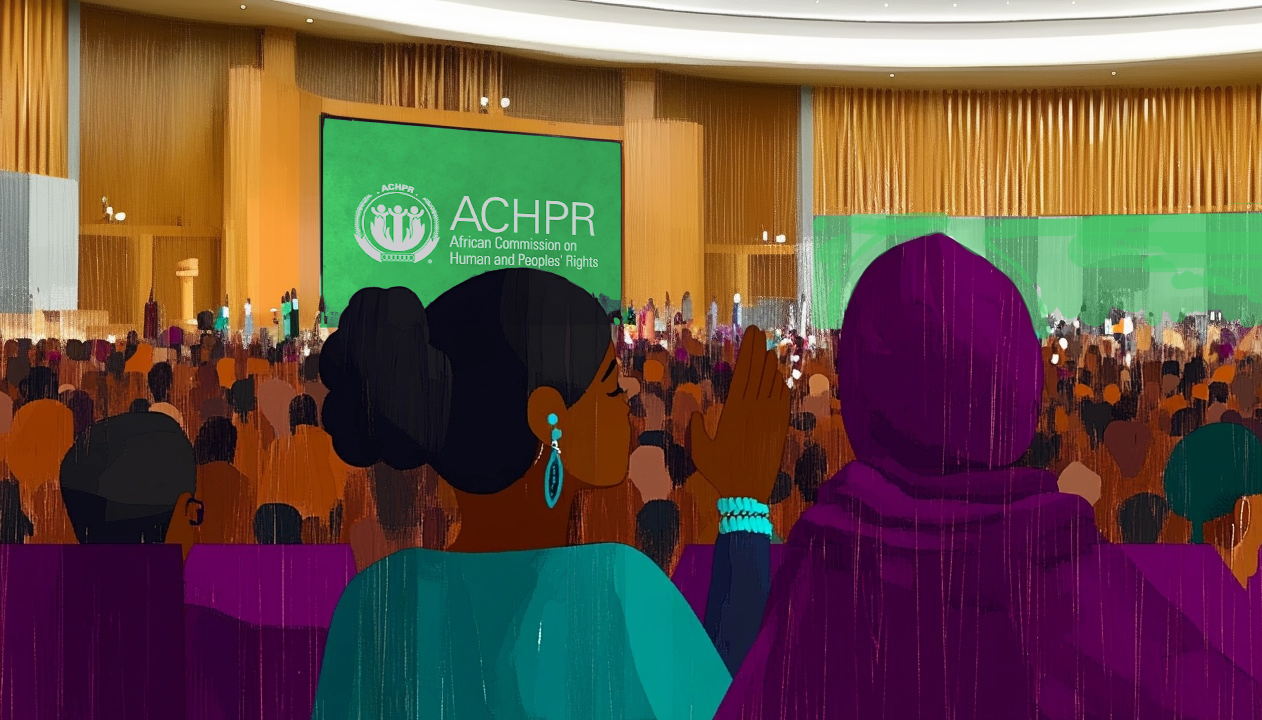
AtticMedia for ISHR, with the use of MidJourney
Civil society calls for revision of the draft declaration on human rights defenders in Africa
Civil society continues to call for a fundamental revision of the Draft Declaration on the Promotion of the Role of Human and Peoples’ Rights Defenders and Their Protection in Africa, under consideration by the African Commission on Human and Peoples’ Rights.
This call forms part of sustained civil society engagement on the proposed instrument, including a joint submission made by civil society organisations to the African Commission on Human and Peoples’ Rights (ACHPR) on 20 May 2026, followed by a Civil Society Dialogue convened on 25 September 2026 by members of the civil society working group. These engagements reflect ongoing efforts to ensure that the proposed Declaration is firmly grounded in existing African human rights standards and effectively strengthens the protection of human rights defenders across the continent.
The September dialogue brought together over 80 participants, including human rights defenders, lawyers, civil society organisations, academics and former ACHPR Commissioners, to examine the Draft Declaration and its implications for the protection of human rights defenders across Africa.
The discussions highlighted fundamental concerns about the Draft Declaration’s framing of who qualifies as a human rights defender, the inclusion of State institutions as defenders, the extensive duties imposed on defenders, and the repeated reliance on undefined concepts such as African values, morality, social cohesion and the values of the Republic. Participants stressed that these are not merely drafting concerns. Taken together, they risk altering the established understanding of human rights defenders as independent actors recognised for their work to promote and protect human rights, including when they challenge State conduct, prevailing norms and systems of power.
Participants were particularly concerned that provisions relating to State affairs, politics, institutional stability, national security and external influence mirror narratives already used to restrict civic space across the continent. In practice, such language could be used to suppress legitimate protest, advocacy, strategic litigation, independent reporting and other forms of human rights work. The discussions also identified significant gaps in the protection of women human rights defenders, defenders facing intersecting risks, environmental and land defenders, young defenders, and those exposed to surveillance, criminalisation, reprisals and digital threats.
The dialogue underscored the need for fundamental revision of the Draft Declaration, rather than limited amendments to individual provisions. Participants called for a revised text firmly grounded in the African Charter on Human and Peoples’ Rights and existing African human rights standards, which preserves the distinction between State duty bearers and human rights defenders and responds to the realities in which defenders carry out their work.
The concerns raised through these civil society engagements remain critical to ensuring that the proposed Declaration strengthens, rather than undermines, the protection and independence of human rights defenders across Africa. Any revision of the Draft must be informed by a meaningful, inclusive and transparent consultation process, allowing human rights defenders and affected constituencies to genuinely shape the instrument.
Civil society remains committed to coordinated advocacy and continued engagement with the African Commission on Human and Peoples’ Rights and the Special Rapporteur on Human Rights Defenders towards the development of a Declaration that effectively safeguards civic space, upholds existing human rights standards and strengthens protections for all human rights defenders across the continent.
This article was originally published on ISLA’s website and it was reproduced with permission. The Initiative for Strategic Litigation in Africa (ISLA) is a Pan-African and feminist initiative, of which ISHR is a member. It was founded in 2014 to strengthen strategic human rights litigation across the African continent.