
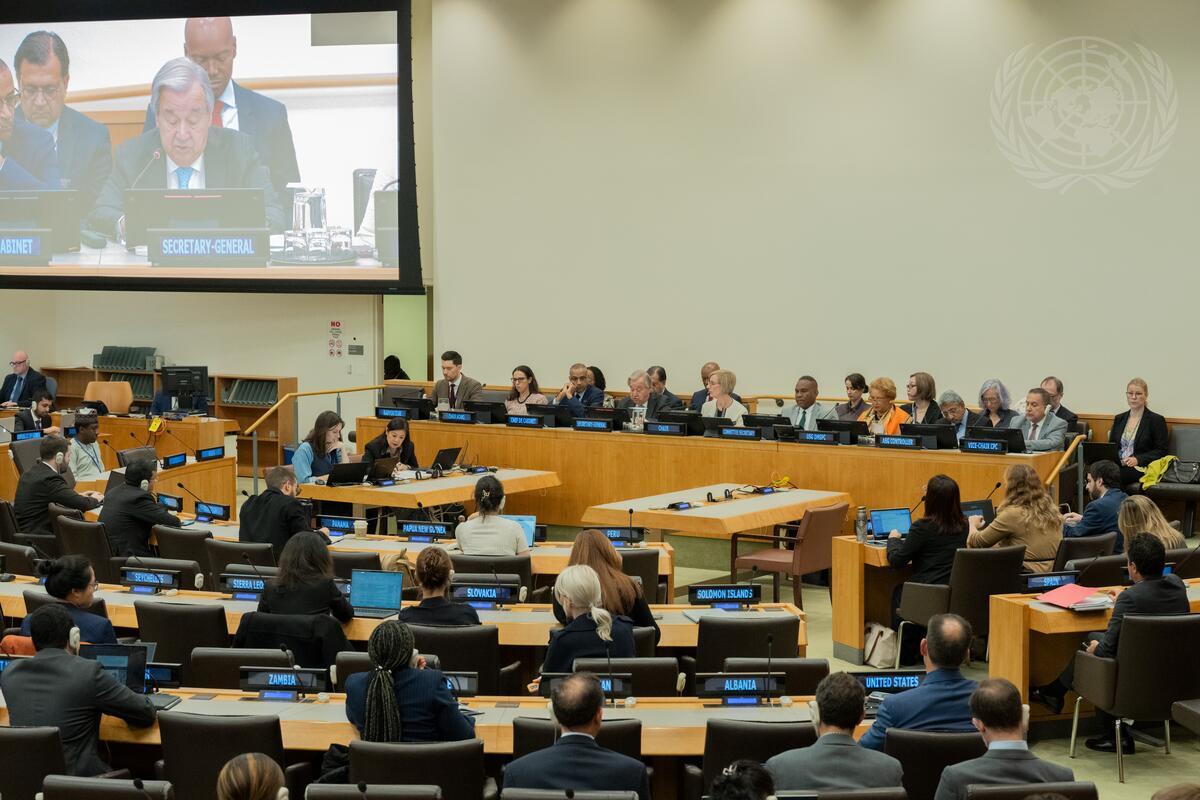
© UN Photo/Evan Schneider
General Assembly reporting cuts to Special Procedures mandates: an analysis
Current efforts to achieve ‘efficiency’ across the UN in the wake of the organisation’s financial crisis have resulted in a reduction in both reporting expectations and available resources for Special Procedures mandates.
Update: ISHR delivered an oral statement during the 63rd session of the Human Rights Council, raising the main finding of the analysis on reporting cuts.
Read the full statement here.
In 2025, the General Assembly adopted resolution 79/192 on the working methods of the Third Committee, with the objective of ‘achiev[ing] a manageable workload for the Committee and ensur[ing] the high quality of its deliberations’. The document, ‘Implementation of General Assembly Resolution 79/192 – Elements for a Roadmap’, requested in operative paragraph 3 of the resolution, was presented and discussed, but the General Assembly never formally adopted it¹.
Nevertheless, the Roadmap discussions established a set of guiding principles aimed at progressively reducing the number of mandates reporting to each session of the General Assembly’s Third Committee by an indicative 3 to 5 mandates per year, until the Committee’s 84th session. This would amount to a total reduction of approximately 9 to 15 reports over the course of the 81st, 82nd, and 83rd sessions of the General Assembly.
At the same time, successive efficiency initiatives, the UN’s ongoing budgetary constraints, and the UN80 reform process have further prompted Member States to advance proposals to reduce the reporting periodicity of Special Procedures to the General Assembly.
As highlighted by civil society organisations, without a strategic approach that includes meaningful consultation with relevant actors and a case-by-case assessment that highlights the extraordinary nature of these measures, these developments risk diminishing the visibility of key human rights issues in New York, widening the institutional gap between the General Assembly and the Human Rights Council, and normalising this practice over the long term. Reductions in reporting are accompanied by corresponding reductions in resources allocated from the Regular Budget to Special Procedures, which are exacerbated by reductions in extra-budgetary contributions to Special Procedures mandates.
The analysis below provides an overview of reductions in reporting implemented so far within the time-frame proposed by the Roadmap: General Assembly sessions 81 to 83 (2026–2028), and it considers the reductions adopted by the Council since its 60th session in September 2025 until the 62nd session of the Council (HRC62), in June 2026.
Main findings
- The scale of reductions has already exceeded what was contemplated under the Roadmap. Resolutions adopted at HRC60-62 will result in 17 fewer reports to GA81-83, exceeding the Roadmap’s indicative cumulative range of 9-15 reports. The highest number of reductions will affect the General Assembly’s 82nd session (GA82 2027), with 7 fewer reports to be presented that session. There will be 5 fewer reports during GA81 (2026) and 5 fewer reports during GA83 (2028)².
- What began as a workload-management exercise risks becoming a structural change to Special Procedures reporting. Several resolutions do not merely omit reporting for a specified session but establish biennial reporting, potentially halving GA reporting over successive mandate renewals. There’s no uniform language around reporting reductions. Some resolutions state the specific sessions where mandate holders are meant to report to the GA, and others just vaguely state they should be reporting biennially to the General Assembly, only to be defined by the programme budget implications (PBI) arising from the resolution.
- Safeguards remain inconsistent. Some resolutions preserve alternative opportunities for GA engagement or redirect savings to substantive mandate activities, while others contain no equivalent protection.
- Between the 60th and 62nd sessions of the Human Rights Council (HRC60–HRC62), the reporting periodicity of a significant number of Special Procedures³ mandates was reduced. During HRC61, 50% of the renewed mandates (5 of 10) experienced reductions in reporting periodicity. Similarly, during HRC62, 50% of the mandates that were up for renewal (4 of 8) had their reporting obligations reduced as well.
- States in the Western Europe and Others Group (WEOG) have led this reporting reduction process thus far, followed by cross-regional groups, the majority of which include one or more WEOG members.
- Approximately one in four thematic Special Procedures mandates with reporting obligations to the General Assembly have already been affected by the current initiatives to reduce reporting.
Overview of Special Procedures Reporting to the General Assembly and the Human Rights Council since 2014.
Mandate creation throughout the years

There were 39 thematic mandates in 2014 and 46 thematic mandates in 2025.
In 2026, there will be 44 mandates (projected: 2 fewer mandates with the termination of the Special Rapporteur on Leprosy and the merging of the mandates on trafficking and slavery in 2025), a 12% increase in 12 years⁴.
New mandates, merged mandates and discontinued mandates since 2014: Nine new thematic mandates were established over the past 12 years. During the same period, one mandate was terminated, and two thematic mandates were merged.
2014:
- New: Special Rapporteur on the rights of persons with disabilities
- New: Special Rapporteur on the negative impact of unilateral coercive measures on the enjoyment of human rights
2015:
- New: Independent Expert on the enjoyment of human rights by persons with albinism
- New: Special Rapporteur on the right to privacy
2016:
- New: Special Rapporteur on the right to development
- New: Independent Expert on protection against violence and discrimination based on sexual orientation and gender identity
2017:
- New: Special Rapporteur on the elimination of discrimination against persons affected by leprosy (Hansen’s disease) and their family members (see below, terminated in 2026).
2021:
- New: Special Rapporteur on the promotion and protection of human rights in the context of climate change
2023:
- New: Working Group on the rights of peasants and other people working in rural areas
2025:
- Merger: Special Rapporteur on contemporary forms of slavery and trafficking in persons (merged mandate)
2026:
- Termination: Special Rapporteur on the elimination of discrimination against persons affected by leprosy (Hansen’s disease) and their family members terminated.
Overview of thematic reporting to the GA and the HRC since 2014
There has been a 36.1% increase in thematic reporting to the General Assembly, rising from 36 reports in 2014 to 49 reports in 2025. This increase reflects the growth in the number of mandates, as well as the fact that individual mandates may be required to present more than one report to the General Assembly in a given year.

It is important to highlight that the number of reports presented therefore varies depending on the reporting requirements of each mandate.
For example, the Special Rapporteur on contemporary forms of racism, racial discrimination, xenophobia and related intolerance presents both a thematic report and a report on the glorification of Nazism, neo-Nazism and other practices that contribute to fuelling contemporary forms of racism, racial discrimination, xenophobia and related intolerance.
Additionally, the Working Group on Arbitrary Detention is not required to report to the General Assembly, and the Working Group on Enforced or Involuntary Disappearances and the Working Group on Discrimination against Women and Girls also only present orally to the Assembly without a written report.
In addition, country visit reports are not presented to the General Assembly, which explains the difference between the number of reports presented to the General Assembly and those presented to the Human Rights Council.
Mandates affected by the reductions
The lists below identify all mandate renewals. The first list displays the mandates whose reporting requirements have been reduced to date. The second list displays the mandates that have maintained the original reporting obligations to the General Assembly and the Human Rights Council⁵.
Out of the 18 mandates renewed specifically during HRC61 and HRC62, 9 were affected by reductions in their reporting obligations. This means that half of the mandates renewed during HRC61 and HRC62 experienced reporting cuts.
In addition, at HRC60 in September 2025, as an efficiency measure, the Council decided to reduce the periodicity of the reporting of the Special Rapporteur on the human right to safe drinking water and sanitation.
However, in this instance, the reduction in reporting requirements was aligned with the participation of the mandate holder in the UN Water Conference, resulting in no reports to the General Assembly in 2026 and 2028 (when the Conference takes place), and reports being submitted in 2025 and 2027.
During the same session, the Council also merged the mandates of the Special Rapporteur on contemporary forms of slavery and the Special Rapporteur on trafficking in persons into a single mandate entitled ‘Special Rapporteur on contemporary forms of slavery and trafficking in persons’. For this analysis, this merger is treated as one fewer report for each of the three relevant General Assembly sessions, as reflected in the corresponding programme budget implications (PBI).
-
Mandates whose reporting obligations have been reduced:

- Mandates that have not suffered reductions in periodicity of reporting:

Although the Roadmap initially envisaged progressive reductions over three General Assembly sessions (GA81–GA83), resolutions adopted during the past three Human Rights Council sessions (HRC60-62) have already generated the full cumulative reduction of 17 reports, beyond the number originally contemplated, a maximum of 15 reports.
|
GA session |
Number of reports cut during HRC60 |
Number of reports cut during HRC61 |
Number of reports cut during HRC62 |
Total |
|
GA81 (2026) |
2 |
2 |
1 |
5 |
|
GA82 (2027) |
1 |
3 |
3 |
7 |
|
GA83 (2028) |
2 |
1 |
2 |
5 |
|
Total |
5 |
6 |
6 |
17 |
As the numbers show, for GA81, there will be 5 fewer reports; for GA82, 7 fewer reports; and for GA83, also 5 fewer reports, which makes a global total of 17 reports.
Thematic Balance and Visibility
One of the primary concerns raised by civil society organisations is the thematic balance and how it may negatively impact the visibility of certain issues at the General Assembly. Although reporting reductions were broadly distributed across the three thematic clusters, mandates relating to rule of law, accountability and civil space were somewhat more affected: they accounted for 45% of mandates facing cuts, though they made up only 38% of the mandates renewed, merged or terminated during HRC60-62
In addition, half of the renewed mandates in this cluster faced a reporting reduction, compared to one-third of the renewed mandates in the Equality and Non-Discrimination cluster and 40% of the renewed mandates in the Development, Economic, Social and Cultural Rights cluster.
|
Special Procedures cluster |
Mandates facing reporting cut in HRC60-62 |
Mandates renewed in HRC60-62 |
All thematic mandates |
|
Development, Economic, Social and Cultural Rights (DESC) |
4 (36%) |
10 (38%) |
17 (37%) |
|
Equality and Non-Discrimination (END) |
2 (18%) |
6 (23%) |
11 (24%) |
|
Rule of Law, Accountability and Civil Space (RACS) |
5 (45%) |
10 (38%) |
18 (39%) |
|
Total |
11 |
26 |
46 |
The thematic mandates are clustered according to the division used by OHCHR’s Special Procedures Branch.
Main actors
The main stakeholders taking part in changing reporting practices are WEOG States and cross-regional groups that include one or more WEOG countries as the main penholders. The exceptions include the termination of the mandate of the Special Rapporteur on the elimination of discrimination against persons affected by leprosy (core group: Japan, Brazil, Ecuador, Ethiopia, Fiji, India, Kyrgyzstan, Morocco).

Language used in the resolutions to reduce periodicity of reporting
There’s no uniform language around reporting reductions. Some reports state the specific sessions where mandate holders are meant to report to; others vaguely state they should be reporting biennially to the General Assembly. Still, others state they should report biennially and define from which session they should do so.
Examples:
- Requests the Special Rapporteur to continue to report, on an annual basis, to the Human Rights Council and, on a biennial basis, to the General Assembly, as of its 82nd session (Special Rapporteur on adequate housing as a component of the right to an adequate standard of living)
- Requests the Special Rapporteur to continue to report on an annual basis to the Human Rights Council and to the General Assembly at its 81st and 83rd sessions, and urges any financial efficiency savings made in relation to this change in reporting frequency to be used to support the wider activities of the mandate, in particular country visits (Special Rapporteur on human rights defenders)
- Requests the Special Rapporteur to present an annual report to the Human Rights Council and to present a report to the General Assembly at its 81st and 83rd sessions (Special Rapporteur on the rights of persons with disabilities)
- Also requests the Special Rapporteur to continue to report annually on the implementation of the mandate to the Human Rights Council and biennially to the General Assembly, in accordance with their respective programmes of work (Special Rapporteur on the sale, sexual exploitation and sexual abuse of children)
Language that biannualises reporting rather than cutting a specific session presents two risks: first, over a six-year period (i.e. two renewals), it would reduce reporting by half, compared with a one-third reduction if a single session were cut per three-year renewal period.
Second, it would remove flexibility in choosing which years are most appropriate for reducing reporting, such as following the appointment of a new mandate holder or when a mandate holder considers it strategically appropriate.
Overall reduction of thematic reporting to the General Assembly
There are currently 46 thematic Special Procedures mandates. Among these, the Working Group on Arbitrary Detention is only required to submit a written report annually to the Human Rights Council. On the other hand, the Working Group on Enforced or Involuntary Disappearances’ Chair engages in an interactive dialogue with the General Assembly every year without presenting a written report. Similarly, the Working Group on Discrimination against Women and Girls also only reports orally each year to the General Assembly.
Therefore, out of the 46 thematic Special Procedures mandates, 43 submit written reports to the General Assembly and two of them report orally.
To date, 11 mandates have had their General Assembly reporting periodicity reduced, been merged, or been terminated, representing 24% of all thematic mandates that normally engage with the General Assembly. This means that approximately one in four thematic mandates with General Assembly reporting obligations has already been affected by the current rationalisation process.
Implications and recommendations
This analysis demonstrates the need for a more strategic and coordinated approach to any further consideration of changes to Special Procedures reporting.
Reporting reductions should not be treated as an automatic or purely numerical means of reducing the Third Committee’s workload, but assessed individually and cumulatively in light of their impact on mandate implementation, the visibility of human rights issues at the General Assembly, and opportunities for engagement with mandate holders.
In considering any future changes to reporting requirements, States should:
- Undertake a case-by-case assessment and meaningfully consult mandate holders before modifying reporting requirements, taking into account the substantive needs of the mandate and when engagement with the General Assembly is most strategically important.
- Prefer targeted, time-limited changes over permanent reductions in reporting periodicity. Where a reduction is considered necessary, identifying specific sessions in which reporting will not take place preserves greater flexibility than establishing indefinite biennial reporting. Any change should be reviewed at the mandate’s next renewal rather than automatically becoming the new baseline.
- Preserve meaningful engagement with the General Assembly. Where written reporting is reduced, alternative opportunities for substantive interaction between mandate holders, Member States and civil society in New York should be maintained where possible.
- Ensure that efficiencies strengthen mandate implementation. Savings resulting from reduced reporting should, to the greatest extent possible, be retained for other substantive mandate activities, including country visits, communications and engagement with affected communities and civil society. The approach adopted for the Special Rapporteur on the human right to safe drinking water and sanitation, which aligned the reduction in reporting with the participation of the mandate holder in the UN Water Conference, provides a useful precedent.
- Assess the cumulative and thematic impact before pursuing further reductions. States should consider the effects of changes across the Special Procedures system as a whole, including whether they disproportionately reduce the visibility of particular rights or groups at the General Assembly.
Efforts to improve the efficiency and working methods of the Third Committee should ultimately preserve the effectiveness and independence of Special Procedures and meaningful engagement between the human rights system in Geneva and the General Assembly in New York.
The complete version of the analysis is available here.
- ¹It is important to note here that both the resolution and the Roadmap reference all Human Rights Council’s reporting mandates, not only Special Procedures.
- ²For the purpose of this analysis, the merger or termination of a mandate is counted as one fewer report for each of the General Assembly sessions under consideration, in accordance with the relevant PBI.
- ³This analysis centres on thematic Special Procedures reports that have been affected by reductions in periodicity of reporting, and does not include other Human Rights Council mechanisms that also present reports to the General Assembly.
- ⁴ According to the Special Procedures annual reports presented to the HRC.
- ⁵The current list includes all mandates affected by reductions, including mandates that have been merged and terminated, as well as mandates whose reporting obligations remain unchanged. For this analysis, the mandate of the Special Rapporteur on leprosy, which was discontinued in June 2026, is also treated as a reduction in reporting, equivalent to one fewer report for each of the next three General Assembly sessions taking place in the next three years.