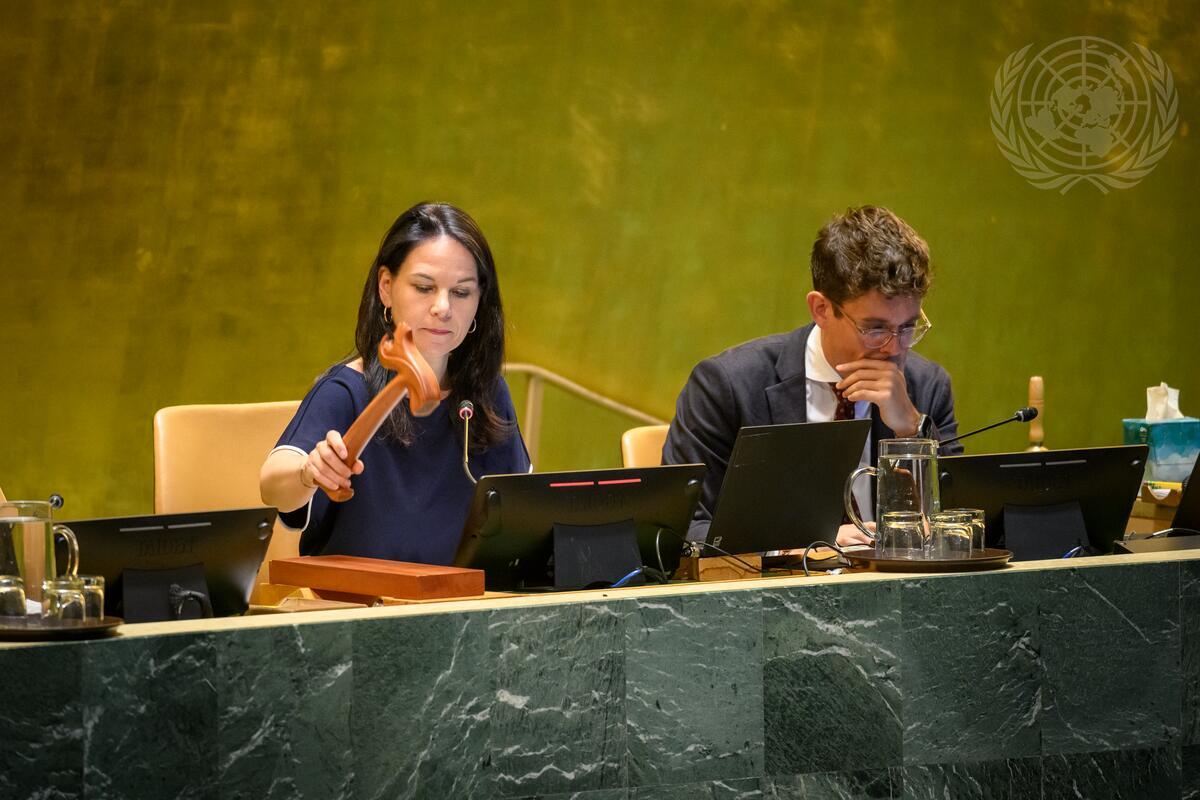
The Fifth Committee, the UN General Assembly’s budget committee, has approved an important reform to the UN’s financial rules, marking a significant step towards addressing the cash crisis that has disrupted the organisation’s work, and starved its human rights system of the funds necessary to effectively function.
In the past years, the UN has faced steep cash shortages, mostly as a result of non-payment by the United States of their mandatory contribution to the UN’s budget, and late payment by China, leading Secretary-General António Guterres to twice warn of the ‘imminent financial collapse’ of the organisation.
The resolution unanimously adopted by the General Assembly changes the way the UN calculates and returns so-called ‘credits’ to Member States. Under the previous rules, the UN was required to return funds unspent by year-end back to Member States in the form of credits to their future contributions to the budget.
While this rule intended to address underspending, in practice this meant the UN started each year by returning cash from previous years it received too late to be able to fully expend.
The UN was previously expected to return such credits to Member States on the basis of the approved budget rather than the cash actually received from Member States’ mandatory contributions. As Secretary-General António Guterres observed, this created the paradox of the UN being expected to return money that it had never collected, exacerbating the UN’s cash shortages and jeopardising its ability to implement mandates approved by States themselves.
The new rules provide that credits can now only be returned to Member States when ‘backed by cash’ – that is, on the basis of the cash actually received. They also confirm an earlier decision that credits returned are deducted from any arrears that Member States may have.
ISHR has actively campaigned for the suspension of the return credits as a key measure to mitigate the human rights impact of the UN’s financial crisis, a call echoed by the Secretary General and a range of experts. In October 2025, ISHR released a major report documenting long-term, coordinated tactics of certain States to defund the UN’s human rights work, including through the late or non-payment by Member States of their share of the budget.
According to the UN’s Controller, this reform decreases the volume of cash to be returned over the next one-year period by USD 1.1 billion.
A structural problem years in the making
While the decision will not resolve the core of the UN’s current liquidity crisis – namely the US Government’s refusal to fully pay outstanding dues in the sum of USD 2 billion as of 7 May -, it removes one of the structural features that has made the problem significantly worse, and is expected to strengthen the UN’s financial resilience.
The UN’s liquidity crisis has been driven primarily by the chronic late payment and non-payment of mandatory contributions by Member States, assessed on the basis of each country’s capacity to pay.
According to an ISHR analysis, only about 21% of the UN’s membership pays within the required 30-day period and 23% by the end of June, while 22% often pay by the end of September, and 32% often or always fail to pay by year-end.
As of the UN’s last public update on 30 June, only 119 Member States – 62% of the UN’s membership – have paid their yearly dues in full.
This does not include the US and China, which together account for 42% of the UN’s regular budget, but also important contributors such as Mexico.
A disproportionate impact on human rights
These challenges have affected the UN’s ability to deliver across all three pillars of its work: Peace and security, sustainable development, and human rights.
The human rights pillar, despite representing only an unfairly small fraction of the UN’s regular budget, has faced particularly significant pressure through chronic budget reductions, most recently under the UN80 reform initiative, now compounded by the impact of the cash crisis.
In recent years, the UN Secretariat has been forced to freeze recruitment, preventing human rights mandates from being fully operational, such as an inquiry into atrocity crimes in eastern Democratic Republic of the Congo.
The UN has also delayed expenditure, adopted severe cash-saving measures that reduce space for civil society to engage at the UN, and been forced to scale back various activities to promote and protect human rights.
ISHR has compiled public information about the impact of the UN’s cash crisis and budget cuts on the UN’s vital human rights work. This includes:
-
- UN Special Procedures experts cutting their country visits by half, depriving them of rare opportunities to engage with national authorities and civil society to improve laws and policies and raise awareness on rights issues on the ground;
- UN Treaty Bodies reducing their sessions by nearly a third, delaying many critical reviews of countries’ human rights records under international treaties;
- Human Rights Council inquiries into atrocity crimes in specific countries reducing their monitoring and reporting capacities by half, including in Palestine, Venezuela or Ukraine, denying victims of a voice and extending impunity for perpetrators;
- The Office of the High Commissioner for Human Rights (OHCHR) delaying reports and scaling down assistance to governments in key areas such as climate change, socio-economic rights, and gender equality.
A pressing need for renewed commitment to increase human rights funding
In a 2025 report, ISHR examined how budgetary and financial procedures have increasingly become political battlegrounds, and stressed the need for reforms that address the structural causes behind the underfunding of the UN’s human rights work and strengthen the UN’s financial resilience.
As the High Commissioner for Human Rights said in his recent global update, ‘the funding needed by my Office across this entire year is less than what the world spends on weapons and soldiers in two hours’.
Countries like China and Russia have long coordinated efforts to defund Human Rights Council mandates at the Fifth Committee and through its advisory body, the Advisory Committee on Administrative and Budgetary Questions (ACABQ), and deprive OHCHR of increased capacity to fulfil its global mandate, in line with commitments under the Pact for the Future (Action 46) agreed by all Member States in 2024.
In last year’s negotiations on UN80 budget cuts, China pushed to cut positions covering the human rights impact of sea-level rise, the rights of older persons, and atrocity crimes in Afghanistan, according to a draft text seen by ISHR.
China and Russia jointly pushed another unsuccessful yet dangerous vote to try defunding all Human Rights Council country investigations targeting their allies. Most recently, Beijing sought to oppose funding to ensure human rights compliance during gang suppression operations in Haiti.
As the ACABQ currently reviews the Secretary-General’s proposed budget for 2027, which covers part of the UN’s human rights needs, Member States from all regions must redouble efforts ahead of the October session of the Fifth Committee to ensure that budgets are not weaponised for political goals, and that the UN is financially capable of delivering on its human rights mission.