
AtticMedia for ISHR, with the use of MidJourney
Alert to the NGO Forum and 87th session of the African Commission
The 87th session of the African Commission on Human and Peoples’ Rights (ACHPR) will be held in Banjul, The Gambia, from 11 to 20 May. The public session will be preceded by the NGO Forum, also in Banjul, from 7 to 9 May.
NGO Forum (7-9 May)
The Forum on the Participation of NGOs in ordinary sessions of the African Commission, also known as the ‘NGO Forum’, is an advocacy platform coordinated by the African Centre for Democracy and Human Rights Studies (ACDHRS) to promote advocacy and networking among human rights NGOs on one hand, and on the other hand between NGOs and Commissioners – attending some of the sessions – for the promotion and protection of human rights in Africa.
The NGO Forum provides an opportunity for local and international NGOs to share updates on the human rights situation on the continent.
At the opening ceremony of the public session of the African Commission, a representative of the NGO Forum shares the outcomes of the sessions of the Forum, the situation of human rights in Africa, and the resolutions adopted at the NGO Forum.
Discussions at this Forum will cover, among others, the African Union’s theme of the year: ‘Assuring Sustainable Water Availability and Safe Sanitation Systems to Achieve the Goals of Agenda 2063‘.
© African Union
Participants will also tackle three main thematic areas:
- Status of human rights and democracy in Africa: updates from sub-regional focal points on the general situation.
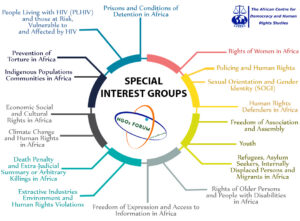
- Special interest group discussions, which will allow participants to identify recommendations to address challenges raised in panel discussions.
© ACDHRS
- Networking for human rights in Africa: Sharing experiences, best practices and lessons learnt towards durable solutions for forced displacement in Africa.
The Forum will deliberate on the following sub-themes:
- Water, sanitation, and the right to development: Anchored in the AU Theme of the Year 2026, this sub-theme emphasises water and sanitation as fundamental human rights and essential for achieving Agenda 2063. It highlights the intersection of water insecurity with poverty, education, health, and gender inequality, while underscoring the role of NGOs in advocating for equitable access, accountability, and community-driven solutions.
- Civic space, governance, and democratic integrity: This sub-theme combines civic space, freedom of expression, digital rights, and unconstitutional changes of government. It addresses how restrictions on civic freedoms, corrupt elections, and shrinking digital rights undermine democracy and weaken civil society’s ability to demand accountability. NGOs are called to defend civic space, monitor elections, and ensure that governance structures uphold human rights and democratic integrity.
- Natural resources, environmental justice, and climate-induced migration: Here, the focus is on Africa’s wealth of natural resources and the environmental challenges tied to their mismanagement. It integrates issues of ecological justice, climate change, and migration, showing how floods, droughts, and resource exploitation displace millions and threaten livelihoods. NGOs play a vital role in advocating for transparency, sustainable resource governance, and regional frameworks to protect displaced populations.
- Peace, security, and human rights: This sub-theme highlights the link between resource scarcity, governance failures, and conflict in regions such as the Sahel, Horn of Africa, and Great Lakes. It emphasises the need to integrate human rights into peace building strategies and to address root causes of insecurity, including climate stress and migration. NGOs are positioned as key actors in promoting preventive measures, resilience, and inclusive peace processes.
- Social inclusion: Gender, youth, and cultural rights: This sub-theme brings together gender justice, youth empowerment, and Indigenous knowledge. It underscores how women and youth are disproportionately affected by water scarcity, unemployment, and civic restrictions, while also recognising the value of cultural rights and traditional practices in resource management. NGOs can showcase inclusive, community-led approaches that empower marginalised groups and integrate Indigenous knowledge into sustainable development strategies.
What will the NGO Forum achieve?
The expected outcomes of the NGO Forum are the following:
- A common civil society declaration (NGO statement): A unified statement reflecting NGO perspectives on water, sanitation, governance, and human rights, to be presented to the African Commission.
- Strengthened networks: Enhanced collaboration among NGOs across regions, fostering solidarity and joint advocacy on shared challenges such as climate change, civic space, and governance.
- Capacity building: Improved knowledge and strategies among NGOs for addressing complex issues like climate-induced migration, gendered impacts of water scarcity, and digital rights.
- Visibility of human rights issues: Greater awareness of ongoing violations from restrictions on civic space to unconstitutional changes of government and their intersection with resource governance.
- Resolutions, recommendations, and documentation: A comprehensive report summarising the discussions, key findings, and recommendations from the forums, including the adoption of resolutions and recommendations for onward submission to the African Commission for consideration during its 87th session.
87th Session Ordinary Session of the African Commission on Human and Peoples’ Rights
When:
- Private session, virtual and closed to the public: from 24 April to 4 May
- Public session, in-person and open to the public: from 11 to 20 May
Ceremonies:
Events are scheduled as per The Gambia time, GMT + 0.
- Opening: (In-person) Monday, 11 May, 09:00 – 11: 00
- Closing: (In-person) Wednesday 20 May 10:00 – 11:30
Where: Sir Dawda Kairaba Jawara International Conference Centre, Kololi, The Gambia (for the Public & Open Session).
Who: The commissioners and the secretariat of the ACHPR, all States Parties, organs of the African Union, National Human Rights Institutions (NHRI), international organisations, non-governmental organisations, and any other interested persons.
All public session documents of the 87th Ordinary Session are available here.
How can you follow the session?
Live streams of the public sessions will be available on the ACHPR’s YouTube page.
ISHR will monitor and report on key developments at the 87th ordinary session of the African Commission. Follow us on X/Twitter at @ISHRglobal, or at @ISHR_fr for French content using #ACHPR87. Our staff can also be followed at @Lidawh-weD .
Find us on Bluesky at @ishr.ch, @lidawh-wed.bsky.social.
What advocacy opportunities does the African Commission offer?
Human Rights Situation in Africa
Civil society organisations with observer status can make a statement highlighting specific issues relating to human rights enshrined in the African Charter.
This opportunity can be used to call the attention of the Commission to specific issues or even update commissioners on an issue brought to their attention previously.
- Key Outcomes of the Forums of NHRI and NGOs
- Statements on Human Rights Situation in Africa:
- Statements by State delegates
- Statement by African Union organs with a human rights mandate
- Statements by intergovernmental and international organisations
- Statements by national human rights institutions
- Statements by non-governmental organisations
Panel discussions
This is an opportunity for constructive dialogue between members of the Commission and representatives of human rights organisations on issues that are not only timely but also essential to the effectiveness of human rights on the continent.
- Panel on Commitment to Compliance: Lifting reservations to realise the full promise of the Maputo Protocol & launch of the Framework on lifting reservations of some provisions of the Maputo Protocol (11 May 2026, 16:30-17:30)
- Joint panel on the ACHPR and UN Independent Fact-Finding Missions on Sudan (12 May 2026, 09:00-10:00)
- Panel on the AU Theme of the Year 2026: Assuring sustainable water availability and safe sanitation systems in Africa (12 May 2026, 11:30-12:30)
- Panel on the promotion and protection of persons belonging to national or ethnic, religious and linguistic minorities in Africa: A recap (13 May 2026, 11:30-12:30)
- Panel on the African Declaration on the promotion of the role of human rights defenders and their protection in Africa (13 May 2026, 12:30-13:30)
- Panel on Article 59 of the African Charter on Human and Peoples’ Rights (14 May 2026, 12:30-13:30)
- Panel on climate change-induced displacement in Africa: Protection challenges and prospects for an African legal framework (14 May 2026, 16:30-17:30)
- Panel on sensitisation of the outcomes of the study on extractive industries and human and peoples’ rights in Africa (16 May 2026, 14:30-15:30)
Activity Reports of Commissioners and Special Mechanisms
Every commissioner’s mandate covers five countries in Africa. During the session, civil society organisations have the opportunity to meet with the commissioner whose mandate includes their country.
As a participant, it is important to seize this moment to update the mandate on the issues specific to your country and, more specifically, call commissioners’ attention to issues you want them to raise with the State directly or during the session.
All year long, it is recommended that civil society share information with Special Rapporteurs.
During sessions, civil society organisations can make statements during the presentation of each commissioner, including Special Rapporteurs, and activity reports highlighting important issues of interest.
- Chairperson of the ACHPR on their activities and those of the Chairperson of the Working Group on Death Penalty and Extrajudicial, Summary or Arbitrary Killings and Enforced Disappearances in Africa.
- Special Rapporteur on the Rights of Women in Africa.
- Special Rapporteur on Prisons, Conditions of Detention and Policing in Africa.
- Special Rapporteur on Freedom of Expression and Access to Information in Africa.
- Special Rapporteur on Refugees, Asylum Seekers, Internally Displaced Persons and Migrants in Africa.
- Special Rapporteur on Human Rights Defenders and Reprisals in Africa.
- Chairperson of the Committee on the Protection of the Rights of People Living with HIV and those at Risk, Vulnerable to and Affected by HIV.
- Chairperson of the Working Group on the Rights of Older Persons and People with Disabilities in Africa.
- Chairperson of the Committee for the Prevention of Torture in Africa.
- Chairperson of the Working Group on Economic, Social and Cultural Rights in Africa.
- Chairperson of the Working Group on Indigenous Populations/Communities in Africa.
- Chairperson of the Working Group on Extractive Industries, Environment and Human Rights Violations in Africa.
- Chairperson of the Working Group on Communications.
Consideration of State reports
Under article 62 of the African Charter, States are required to submit a report every two years on the legislative and other measures taken with a view to giving effect to the rights and freedoms recognised and guaranteed by the Charter.
During the examination process, civil society organisations can submit reports ahead of the session during which countries will be reviewed to inform the Commission’s recommendations and provide States with guidance on how they can better implement their obligations. Civil society organisations thus have the opportunity to constructively engage with the Commission and States on the realisation of human rights across the continent.
During this session, pursuant to Article 62 of the African Charter, the following countries will be reviewed:
- Republic of Mauritius: covering the period 2019-2024 (15 May, 10:00-13:30)
- Saharawi Arab Democratic Republic: covering the period 2013-2025 (16 May, 09:00-12:30)
- Republic of Kenya: covering the period 2022-2025 (18 May, 09:00-12:30)
For the full programme of the session, click here.
What will ISHR do during this session?
Statements
During this session, ISHR will deliver several statements under the following items:
- Human rights situation in Africa
- Activity reports
- Special Rapporteur on Human Rights Defenders and Focal Point on Reprisals in Africa
- Special Rapporteur on Freedom of Expression and Access to Information
Side event
- Protection of human rights in occupied territories: ending the silence on the protection of human rights defenders in Western Sahara, organised by ISHR.