
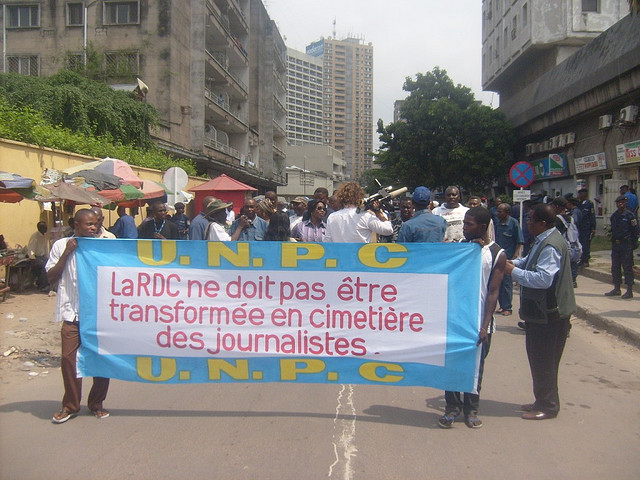
HRC37 | Congo must end repression and provide safe and enabling environment for defenders
ISHR urges the Government of the Democratic Republic of the Congo to put an end to repression of freedom of assembly, expression and association. We call on the Council to maintain high scrutiny on the human rights situation in DRC.
During the Human Rights Council’s Interactive Dialogue on the Democratic Republic of the Congo (DRC), ISHR delivered a statement condemning the attacks on freedom of expression, assembly and association including targeting of human rights defenders.
“The recent repression of the Catholic Church’s demonstrations in Kinshasa, which led to the killing of several people, illustrates the severity of the human rights situation,” said Salma El Hosseiny, ISHR’s Human Rights Council Advocate.
However, the targeting of human rights defenders is not limited to violently repressing freedom of speech and assembly. The government is also creating bureaucratic obstacles for human rights defenders. For example, it has become very complicated for journalists or defenders likely to expose the human rights situation in the country to be granted a visa to visit the Democratic Republic of the Congo.
In addition, ISHR expressed its concern regarding draft legislation before the parliament concerning the regulation of human rights defenders.
“The provisions of this draft law are incompatible with the UN Declaration on Human Rights Defenders and would severely restrict defenders’ rights”, El Hosseiny continued. “For example, articles 3 and 7 require activists to be at least 18 years old to be considered human rights defenders before the law, and to complete State-sponsored human rights trainings. There are also heavy restrictions and controls on NGOs”.
During the interactive dialogue, Assistant Secretary-General (ASG) Andrew Gilmour lamented the worsening human rights situation in the DRC. OHCHR recorded a 25% increase in human rights violations in 2017 as compared to 2016. Importantly, he then noted that human rights defenders and journalists were frequently targeted by government forces.
Switzerland echoed the ASG’s concern for human rights defenders in the DRC, stating that violence against human rights defenders makes achieving political reform difficult. In addition, Botswana, the United Kingdom, the United States, and Belgium, spoke about the importance of freedom of speech and freedom of assembly and the shrinking space for journalists and civil society actors in the DRC.
“As a new member of this Council, the government of the DRC should set an example by adopting a protective law which conforms with the UN Declaration and fulfills the expectations and protection needs of Congolese defenders. Such a law must also provide an effective protection mechanism to ensure its implementation” added el Hosseiny.
Watch the statement here:
Contact: Adelaide Etong at [email protected]
Photo: CommonsWikipedia