
Illustration: Camila Mallozzi for ISHR
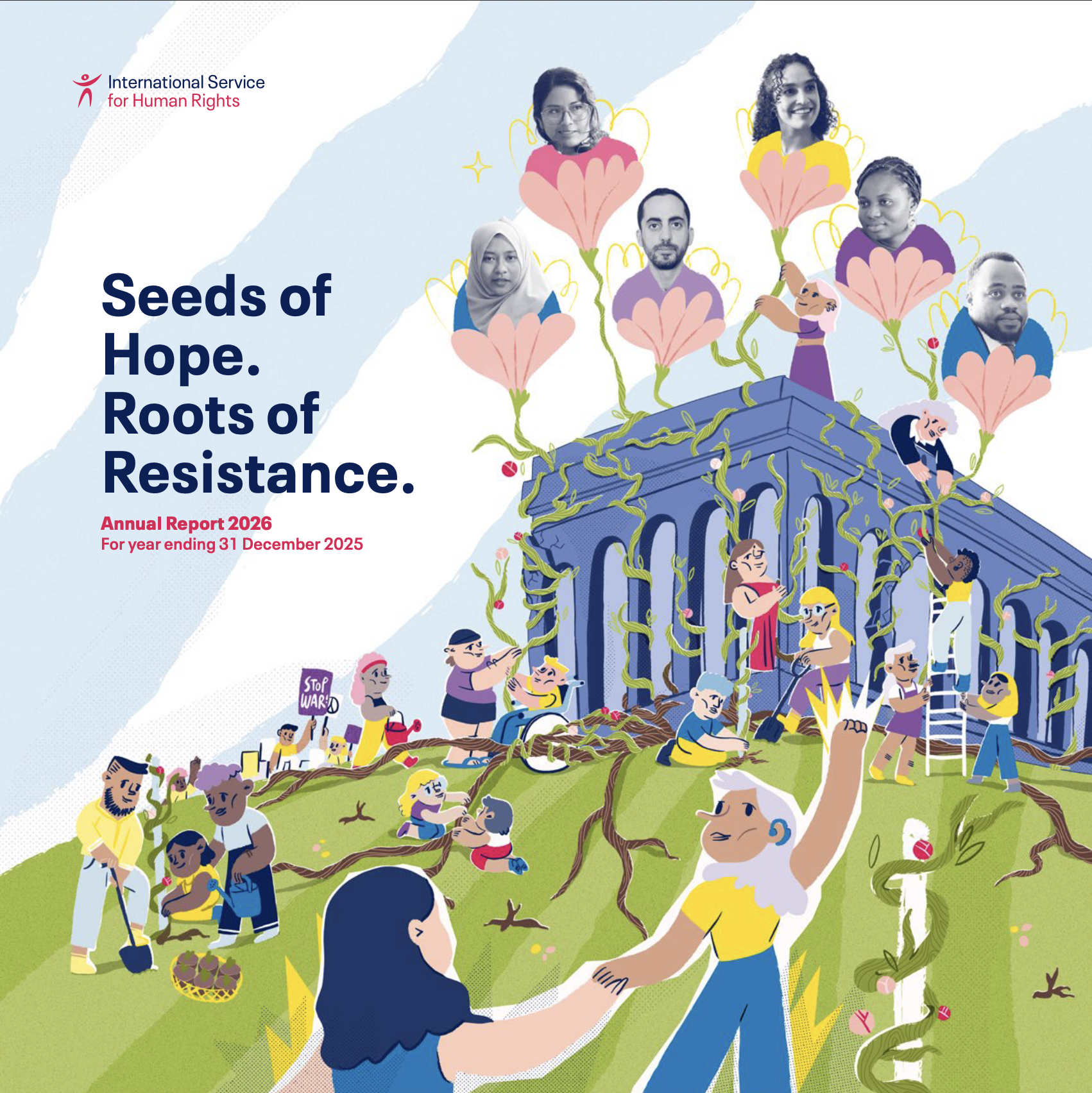
Seeds of hope, roots of resistance
In this piece opening ISHR's new Annual Report, Executive Director Phil Lynch and Board Chair Taaka Awori explore the metaphor of fire as both a destroying and regenerative element - and how it applies to the human rights movement and institutions.
In large parts of the Australian bushland and African savannah, fire is regenerative. It burns away much of the old growth. But while devastating, it does not destroy everything. The ash bed it leaves is full of nutrients, nourishing roots and germinating seeds, which flourish in the newly available sunlight. Thirty years ago, Black poet Sonia Sanchez invoked the metaphor of regenerative fire, urging readers to ‘catch the fire’ that fuels activism, protest and progress.
More recently, in his widely acclaimed speech at Davos this year, Canadian Prime Minister Mark Carney said that we are in the midst of a ‘rupture’ – an epochal period in which laws and institutions are being disregarded and dismantled, supplanted by the self-interested pursuit of territory, resources and power. This pathway, he said, will leave us ‘poorer, more fragile and less sustainable’. Carney’s response to this rupture, however, is not a reassertion of the old order. ‘Nostalgia is not a strategy,’ he said. Instead, from the fracture, we must ‘build something bigger, better, stronger, more just’ that is founded on values.
 There is a fire sweeping through the international human rights system, fueled by rising authoritarianism, militarism and disinformation, and accelerated by an acute funding crisis. The fire is causing devastation, reducing the capacity of the system to prevent, investigate or ensure accountability for gross human rights violations from Afghanistan, to Myanmar, to Sudan, to Venezuela. While extinguishing the fire may be beyond ISHR’s control, or even that of the global human rights movement, we can play a vital role in safeguarding the roots – core human rights principles and values – and feeding the seeds – human rights defenders – that are essential for post-fire regeneration.
In 2026 and beyond, there are a number of core values and principles that will guide and drive ISHR’s work for a more healthy, diverse and sustainable human rights ecosystem.
First, we are convinced that respect for human rights, the rule of law and multilateral cooperation are essential for peace, justice, security, good governance, sustainable development and a healthy planet. We have evidence establishing that strong, accessible and responsive laws, policies and mechanisms at the national, regional and international levels, de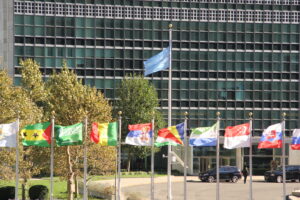 veloped and universally applied in conformity with international human rights principles, are essential to protect human rights defenders and enable their vital work. And we have documented how international mechanisms can be used by defenders to expose injustice, enhance protection, promote accountability, garner solidarity and increase pressure for national change. Despite this, human rights laws, policies and mechanisms face unprecedented threat and erosion. That is why we are working with partners and mobilising coalitions through processes such as UN80 to build and sustain an international human rights system that is credible, adequately resourced and responsive to defenders’ demands for justice. This is informed by and complements our work with defenders at the national level to develop and ensure the effective implementation of laws, policies and mechanisms for their recognition and protection.
Second, we know that the work of human rights defenders is essential for the realisation of all human rights, particularly those of people and communities subject to various and intersecting forms of discrimination. We understand that th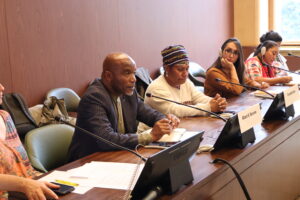 e participation of human rights defenders in policy development, decision-making and governance contributes to more fair, just, inclusive, equitable, accountable, sustainable and rights-respecting processes and outcomes. That is why we are working to ensure that human rights defenders have a safe seat at the table and have the tools, capacities, resources, platforms, networks and narratives they need to engage and influence key policy and decision-makers.
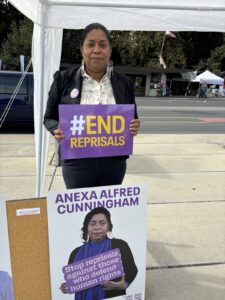
Third, we recognise and deplore that many human rights defenders face violence, risks and repression, whether in their home country or in exile, including from State, business and other non-State actors. We have witnessed the ways in which violations against defenders imperil the realisation of all human rights and are convinced that accountability for grave violations is necessary to protect defenders, provide justice for victims, and prevent and deter further violations. That is why we provide solidarity and support to defenders when they are subject to threats, attacks or restrictions, and advocate to ensure that States, business enterprises and other non-State actors are held accountable for grave violations and abuses, and that root causes are identified and addressed. That is also why we continue to campaign and develop effective narratives that build public and political support for defenders, contributing to their freedom and protection and, in so doing, the realisation of human rights for all.
Finally, we are convinced that the health of the human rights ecosystem requires support for, and coordination between, human rights defenders and organisations working on diverse issues at the local, national, regional and in ternational levels. That is why we develop partnerships with frontline defenders based on principles of equity, trust, learning and respect. It is why we identify opportunities for collaboration and coordination with other civil society partners that enhance efficiencies and leverage our distinctive but complementary capacities, networks and expertise. And that is why we build and mobilise strong, diverse, multisectoral and intersectional coalitions and networks that respect and promote the values of human rights and the rule of law.
Mark Carney’s Davos speech invoked Czech dissident and later president Václav Havel, who wrote in an essay titled ‘The Power of the Powerless’ about the indomitable human yearning for freedom and dignity, and our agency and responsibility to organise and resist injustice. Havel was also the inspiration for Sonia Sanchez’s ‘Poem for July 4, 1994’, dedicated to Havel, in which she tells us that ‘this is the time for the creative human being’. This is the time for the human being who decides to ‘save the earth from extinction’, to ‘live in peace’, and to strive for ‘racial and sexual justice’, she says. Invoking the preambular language of the UN Charter, Sanchez promises that after the fire ‘ it’ll get better’.
if we the people work, organize, resist,
come together for peace, racial, social
and sexual justice
it’ll get better
it’ll get better.
Now – as the fires of militarism, colonialism, populism and patriarchy burn – is the time for human rights and those who defend them. Human rights were elaborated for precisely this moment, this rupture. As a constraint on power. A bulwark against lawlessness. And a guarantor of our individual and collective aspirations for dignity, representation and self-determination.
Now is the time to come together for human rights – to organise, resist and invest. Now is the time to come together for a more inclusive and effective multilateralism – firmly rooted in values. And now is the time to come together for defenders – protecting, supporting and nourishing our seeds of hope.
Photos: ISHR