As the third anniversary of the conflict in Sudan approaches, civilians continue to endure unbearable conditions in Dillinj, South Kordofan, while thousands walk on foot for days in search of safety in the Blue Nile State. Also, two medical professionals were killed in drone attacks in the White Nile state.
Local responders and human rights defenders face vicious attacks as they work to save lives and document war crimes.
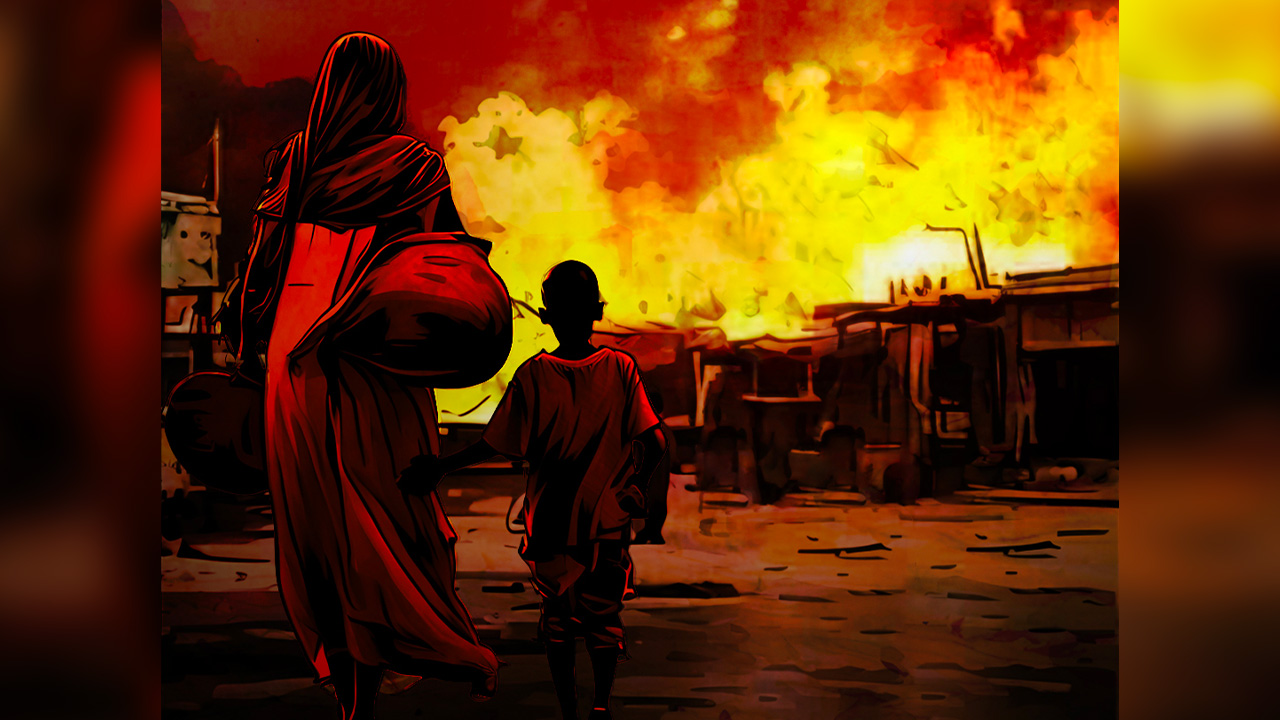
On 7 April 2026, at least 31 people were killed and 21 were injured in shelling and drone attacks on Dillinj city in South Kordofan by the Rapid Support Forces (RSF) and forces of the Sudan People’s Liberation Movement – North (SPLM/N). The non-stop shelling since early April has destroyed entire neighbourhoods, including Turuk and Al-Hila Al-Jadida, and has forced more than 1,500 families to flee from the western and northern areas to the eastern and southern parts of the city.
A family of eight living in the Turuk neighbourhood was killed when a drone missile struck their home on 7 April. Only one person survived.
‘We treated a three‑month‑old child with limited painkillers and scarce medical supplies, as both his legs were broken and severely damaged. He lost his mother in the shelling, and his father has fatal injuries’, said a medical professional from Dillinj.
The main hospitals in Dillinj were attacked a few weeks ago, causing major destruction and preventing most patients and injured civilians from remaining in the facility, as it continues to be a target for the RSF and the SPLM/N shelling.
Um Salma Mohamed, a volunteer in the Sudanese Red Crescent was killed on duty in shelling on Dillinj hospital on 7 March. The RSF and SPLM/N drone attacks and heavy artillery shelling intensified in Dillinj city of South Kordofan since early March.
Local responders reported 25 deaths between 4 and 10 March, and more than 75 civilians were injured in the attacks on the Dillinj market, Turok and Hilla Jadida neighborhoods, and Dillinj hospital.
These attacks resulted in the destruction of civilians’ homes, in addition to parts of the market and the emergency department of Dillinj hospital.
Since February, the Blue Nile State has experienced escalating conflict in Kurmuk, Silik, and Bao along the borders of South Sudan and Ethiopia. According to local responders, over 12,000 people have recently arrived in Aldamzein, the state capital.
Additionally, reports indicate that more than 5,000 individuals fled from Kurmuk to Ethiopia, but remain stranded at the border, lacking adequate services amid heightened political tensions between the Sudanese Army and the Ethiopian government due to allegations of support for RSF attacks.
Drone strikes have destroyed civilian homes and caused numerous injuries and fatalities among civilians over the past month.
On 11 March, in the White Nile state, a drone attack on a school in Shekeiry village killed nine students and a medical professional. Since early March, drone strikes in the area have destroyed schools, medical centres, and electricity stations.
Additionally, on 2 April at least two medical staff were killed, and 10 were injured, in a drone attack on Aljabalein hospital in the White Nile state. Another 20 civilians were injured inside the hospital.
Local responders in Sudan continue to face systematic targeting, including detention and torture, according to the latest Human Rights Watch report.
These responders operate with extremely limited resources to fill critical gaps in areas where international aid organisations cannot function, such as Dillinj. Ongoing shelling and the shutdown of communication networks have further restricted their ability to reach affected communities over the past month..
Skyrocketing prices—driven in part by rising global fuel costs—have severely constrained responders’ capacity to provide food assistance to thousands of families, with prices increasing by more than 15% in some areas.
A recent report by a group of international aid organisations emphasised that the majority of Sudanese people now survive on only one meal per day. Millions of those meals are supplied by community kitchens led and sustained by local responders.
The international community must act urgently to save lives in Sudan. The crimes against humanity and genocidal acts documented by the UN Independent Fact-Finding Mission in El Fasher risk being repeated in Dillinj and other regions if the international community’s neglect continues as accountability remains absent in the Sudan conflict.
The undersigned organisations call on:
- The warring parties to put an immediate stop to the attacks on civilians’ homes, allow safe passage for civilians and humanitarian workers, and ensure the protection of civilians.
- The UN Fact-Finding Mission on Sudan, and relevant UN Special Procedures in particular the Special Rapporteurs on the right to food, right to adequate housing, and rights of internally displaced persons, to engage with women human rights defenders from the states highlighted above to document the war crimes committed against homes and medical facilities to ensure the accountability of the Sudanese Armes Forces, RSF, and SPLM/N committing these atrocity crimes.
- International organisations to provide emergency support and relocation to women human rights defenders at risk of arrest and killing.
- Neighbouring States, in particular at the security of the border between South Sudan and Ethiopia, to ensure that civilians flee in a secure manner, where emergency services are provided to them at the border and after entering Ethiopia, including gender responsive emergency support.
- Third States to call for an immediate ceasefire, protection of civilians, unimpeded humanitarian access and a civilian-led transition government that reflects the demands of the Sudanese people.
Signatories:
- Sudanese Women’s Rights Action (SUWRA)
- International Service for Human Rights (ISHR)
- The Regional Coalition for Women Human Rights Defenders in South West Asia and North Africa (WHRDMENA)
- Sudan Peace Monitor