
© Photo: ISHR
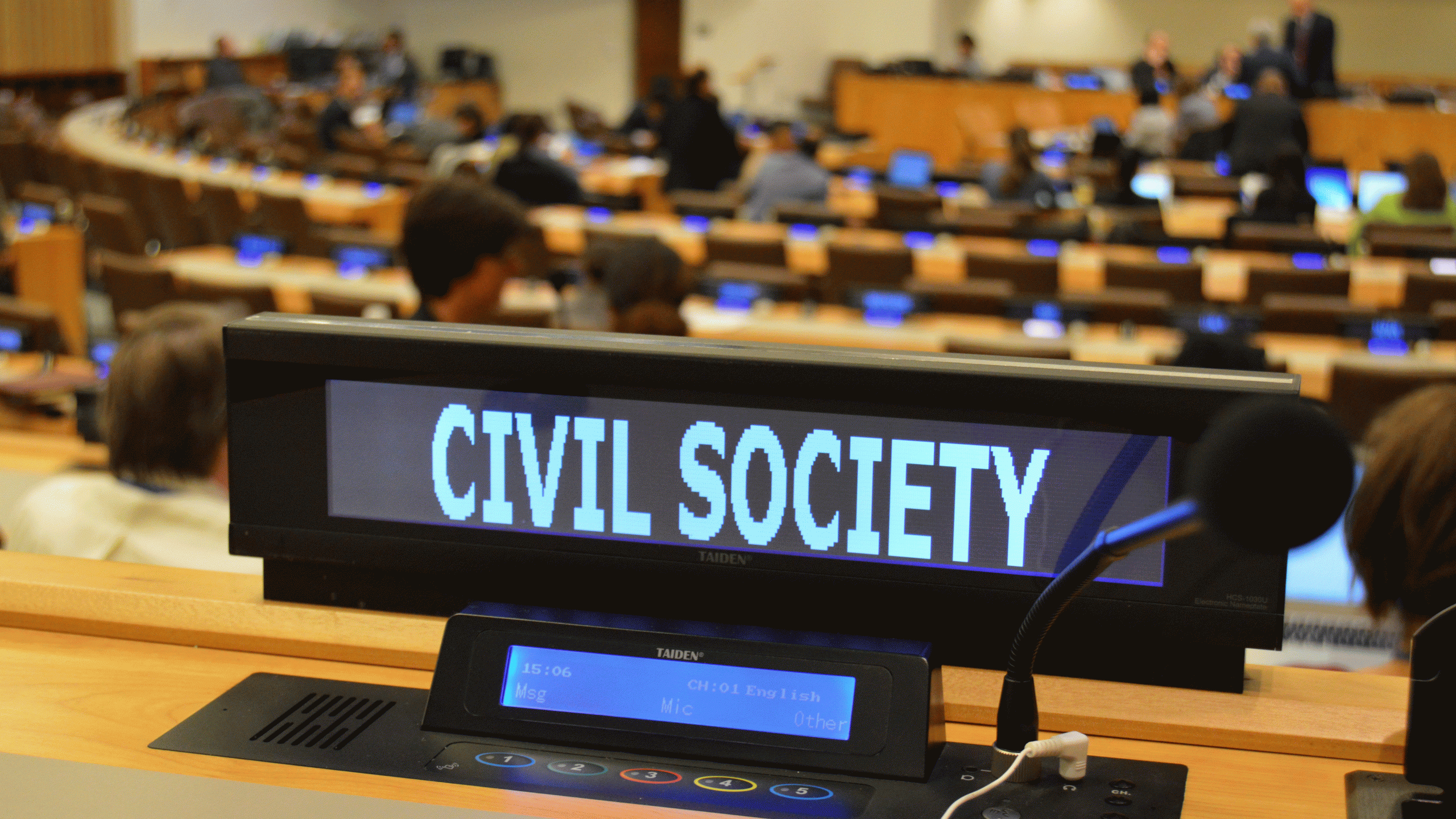
UN Committee on NGOs: Civil society organisations call for competitive elections
Over 70 civil society organisations have issued a joint call urging UN regional groups to field more candidates than available seats for the elections to the Economic and Social Council's (ECOSOC) Committee on Non-Governmental Organisations in April.
For civil society organisations to meaningfully engage with the United Nations, they must first obtain ECOSOC consultative status. The Committee on Non-Governmental Organisations, a New York-based body made up of 19 Member States is responsible for managing and deciding on NGO applications for this coveted status, effectively making the gatekeeper for civil society access to the UN.
The Committee’s membership therefore has a direct impact on which civil society voices are heard in multilateral spaces.
That is why competitive elections matter. When regional slates are closed and the number of candidates equals the number of seats, there is no real choice. This undermines accountability and weakens confidence in a body that plays a crucial role in enabling civil society participation at the UN.
Read more about the Committee on NGOs elections.
Excellencies:
We, the undersigned civil society organisations, write to you ahead of the April 2026 elections to the UN ECOSOC Committee on Non-Governmental Organisations (Committee on NGOs) to urge your regional group to demonstrate leadership in advancing civil society participation at the United Nations by fielding more candidates than the number of available seats.
The Committee on NGOs plays a pivotal role in determining which civil society organisations can obtain ECOSOC consultative status, which in turn enables these organisations to meaningfully engage with the work of the UN as a whole.
Unfortunately, in the upcoming election cycle, most regional slates are already closed or risk being non-competitive, meaning that candidate States will be elected without providing Member States with a genuine choice. Only one regional slate currently offers competition (the Eastern European group), underscoring a significant democratic deficit in this process.
Competitive elections matter because:
- They foster accountability. When regional groups present more candidates than seats, Member States and civil society can engage meaningfully with prospective members, evaluate their records, and vote for the States that are most committed to supporting civic space and NGO participation at the UN.
- They strengthen the legitimacy and integrity of the Committee on NGOs. A competitive field enhances confidence that elected members reflect the shared commitment of the UN Charter to inclusiveness, transparency, and principled engagement with civil society.
- They open doors for diverse voices and expertise. Civil society organisations around the world provide indispensable insights on human rights, sustainable development, health, climate, and peace. A Committee on NGOs that is representative and committed to civil society access is essential to ensure that these voices are heard.
We therefore call on your regional group to:
- Encourage additional Member States with strong records of supporting civil society to stand for the election so that the number of candidates exceeds the number of seats available;
- Ensure that candidacies are confirmed and publicly announced in sufficient time before March 2026, allowing Member States and civil society to assess and engage with them; and
- Commit to promoting a transparent, participatory and competitive election process for the Committee on NGOs.
By stepping forward with a competitive slate, your regional group can reinforce the principle that civil society access and participation are essential to a strong, effective multilateral system and help to safeguard the UN’s commitment to inclusive, informed decision-making.
We thank you for your attention and remain ready to support constructive engagement throughout this electoral process.
Respectfully,
List of signatories NGOs
In Africa:
- Africa Development Interchange Network (ADIN)
- Amnesty International Kenya
- Association pour le Respect du Droit des Populations Autochtones du Développement Durable et du Droit de l’Homme (ARPA2DH)
- Centre pour l’Information Environnementale et le Développement Durable
- Champions for Nature Conservation of Liberia
- Coalition Ivoirienne des Défenseurs des Droits Humains (CIDDH)
- Coalition of Somali Human Rights Defenders (CSHRD)
- Disability Peoples Forum Uganda
- Dunia Salama Foundation
- Emonyo Yefwe International
- Friends with Environment in Development
- Humanitaire Plus
- JOINT: Liga de ONGs em Moçambique
- Kutakesa
- Ligue Burundaise des Droits de l’Homme ITEKA
- Network of the Independent Commission for Human Rights in North Africa (CIDH AFRICA)
- NGO: Amis des Etrangers au Togo (ADET)
- Nigerian Women Agro Allied Farmers Association
- Observatoire Africain des Droits de l’Homme, de l’Environnement et des Ressources Naturelles (OADHER-RDC)
- One 4 Africa
- Pastoralist Women for Livelihood and Social Support (PWLS)
- Savie ASBL NGO LGBTQ DRC
- Silver Lining for the Needy Initiative (SLNI)
- Tanzania Child Welfare (TCW)
- The Kesho Trust
- The Lesbian and Gay Association of Liberia (LEGAL-Liberia)
- Underprivileged Welfare Support Development Association
In Asia Pacific:
- Aine Sohayata Kendro Asok Foundation
- Association of Women for Awareness and Motivation (AWAM)
- Blue Diamond Society
- Cisadane Resik Indonesia
- Empower India
- Human Rights Development Centre
- ILGA Asia
- International Centre for Ethnic Studies
- Kazakhstan International Bureau for Human Rights and Rule of Law (KIBHR)
- Myanmar Ethnic Rohingya Human Rights Organization in Malaysia (MERHROM)
- Pusat Komas
- Salam for Democracy and Human Rights
In Eastern Europe:
- Estonian Institute of Human Rights
In Latin America and the Caribbean:
- AKAHATA A.C.
- Aqualtune Lab
- Casa Marielle Franco Brasil
- Clima21
- Coalizão Negra por Direitos
- Corporacion Ilex Accion Juridica
- Instituto Coletivo Black Divas
- Instituto Marielle Franco
- PerifaConnection
- Sociedad Cooperativa Chac Lol
- Synergía – Initiatives for Human Rights
In Western Europe and Other States:
- Alliance for Democracy in Laos
- ALQST for Human Rights
- American Civil Liberties Union
- Asociación Española para el Derecho Internacional de los Derechos Humanos (AEDIDH)
- Coordination des Associations et des Particuliers pour la Liberté de Conscience
- International Legal Initiative
- Lawyers’ Rights Watch Canada
- National Alliance of Women’s Organisations (NAWO)
- Refugee Council of Australia
- US Women Connect
- World Christian Life Community
International:
- Amnesty International
- British Black Anti Poverty Network
- CIVICUS
- Coalition for the UN We Need (C4UN)
- Company of the Daughters of Charity of Saint Vincent de Paul
- Democracy Without Borders
- Front Line Defenders
- Humanists International
- IFEX
- International Council of Women (ICW-CIF)
- International Service for Human Rights (ISHR)
- MENA Rights Group
- International Planned Parenthood Federation*
- PEN International*
- Robert & Ethel Kennedy Human Rights Center
- The William Gomes Podcast
- Transparency, Accountability & Participation Network
- UN Antiracism Coalition (UNARC)
- UPR Info
*Joint the letter after it was sent to regional groups