
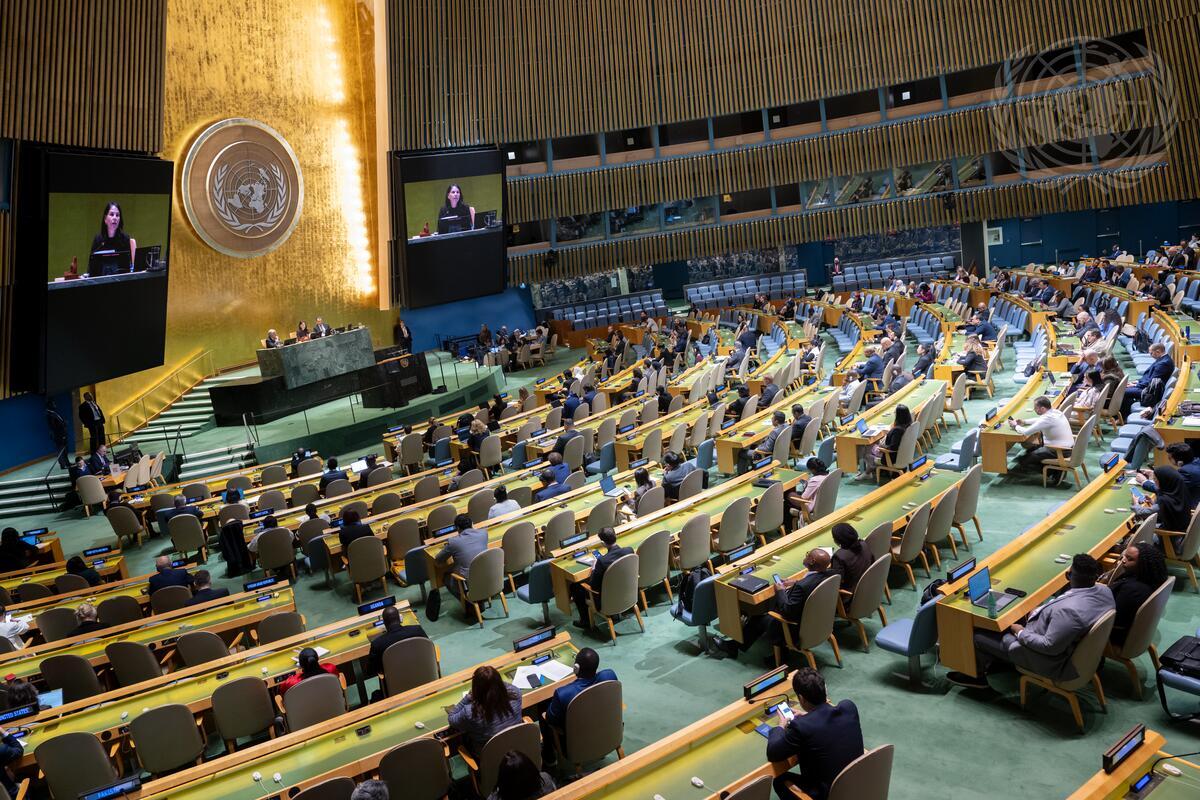
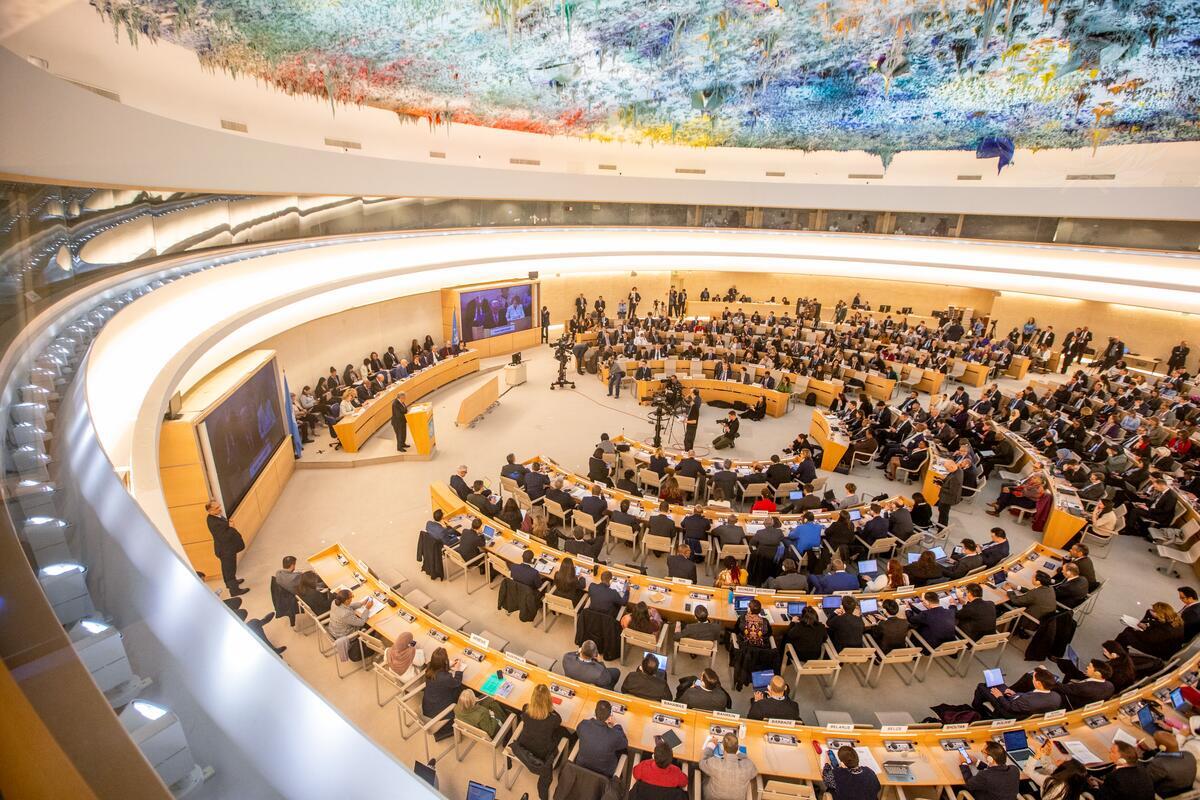
UN Photo/Manuel Elías General Assembly President Annalena Baerbock (on screen) chairs the General Assembly meeting on strengthening of the United Nations System.
UN80: Member States agree on modalities for review of UN mandates
The UN General Assembly adopts a much awaited resolution to streamline and improve how mandates are created, implemented and reviewed, aiming for a more focused and efficient UN. States should ensure that future mandate review discussions take into full consideration the specificities of human rights mandates, and fully consult civil society.
UN Member States adopted today at the UN General Assembly a landmark resolution under the UN80 Initiative to reform how the organisation creates, implements and reviews its mandates. The UN’s work is guided by the mandates created by its Member States through resolutions and decisions across various intergovernmental bodies such as the General Assembly and the Human Rights Council, which then translate into concrete activities and give rise to budgetary requirements. Examples of mandates include decisions of the Human Rights Council to establish various Special Rapporteurs and commissions of inquiry to investigate and report on grave human rights issues and situations, or to commission reports from the Office of the High Commissioner for Human Rights (OHCHR) on relevant issues.
Aimed at ensuring UN decisions are more focused, coherent and capable of delivering tangible results, this resolution is the main outcome of ‘Workstream 2’ on mandate review of the UN80 Initiative, a whole-of-organisation reform effort launched in March 2025 by Secretary-General António Guterres to strive for a leaner, more efficient and impactful UN. Other areas of the Initiative have included steep budget cuts (‘Workstream 1’) that have disproportionately impacted human rights, and over 80 structural reform proposals (‘Workstream 3’) that include the creation of a new Human Rights Group to enhance top-level UN coordination and cohesion on human rights.
Today’s adoption is the culmination of six months of negotiations facilitated by New Zealand’s and Jamaica’s UN ambassadors in New York, appointed last September as Co-chairs of the Informal Ad Hoc Working Group on the Mandate Implementation Review. The Co-chairs convened a series of briefings with UN officials and external experts to discuss the entire mandate lifecycle (creation, implementation, review) and challenges related to duplication, fragmented reporting and limited visibility.
During negotiations, ISHR coordinated a joint NGO submission on the draft resolution underscoring the need to guarantee meaningful civil society consultation and engagement, ensure accessibility of new digital tools, and secure adequate funding of mandates. The submission urges States to refrain from one-size-fits-all approaches and collective review, and instead to take into full consideration the specificities of human rights mandates, such as their time-sensitivity, their responsiveness to the needs of victims and activists, their duration and continued relevance when tackling root causes, and the inherently polarising nature of some mandates.
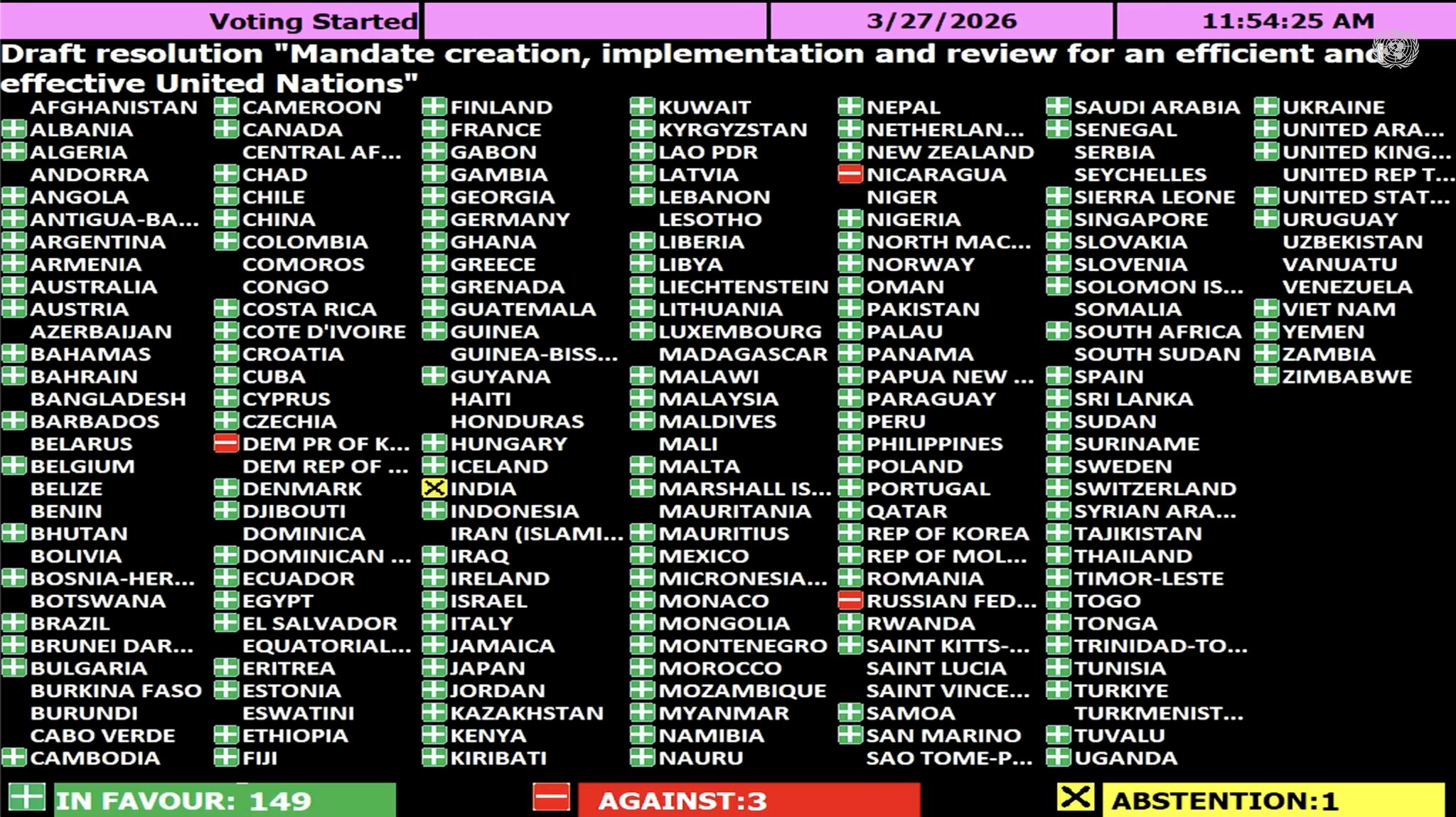
The resolution fell short of being adopted by consensus as many countries hoped during the General Assembly’s plenary session, after a vote was called by Russia, the text’s main opponent. The resolution was adopted by 168 votes in favour, 4 against, and no abstentions, with remaining countries absent or not voting.
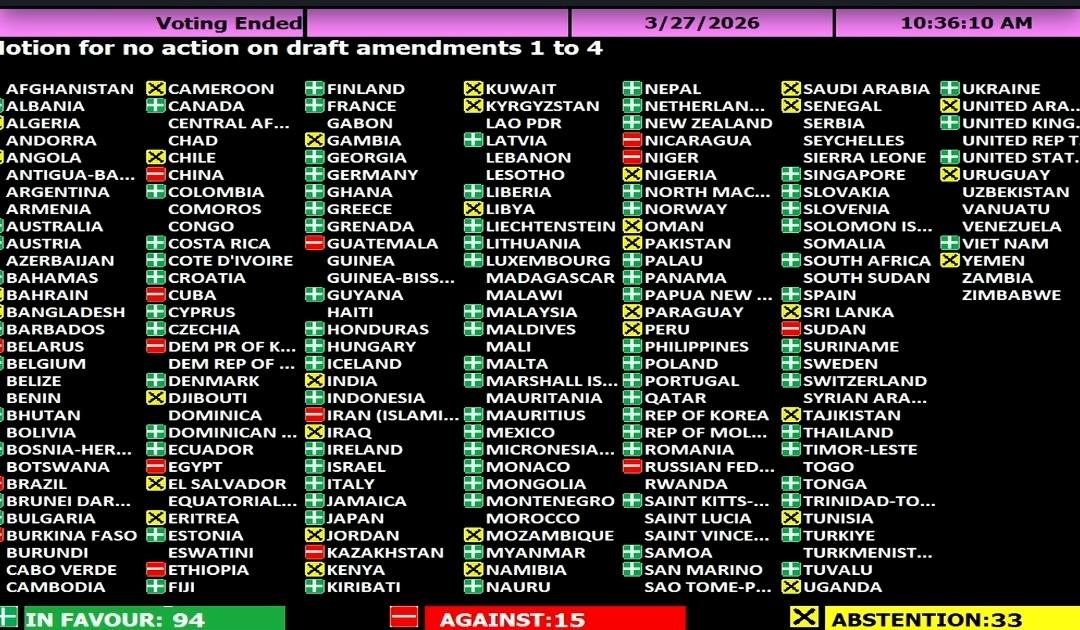
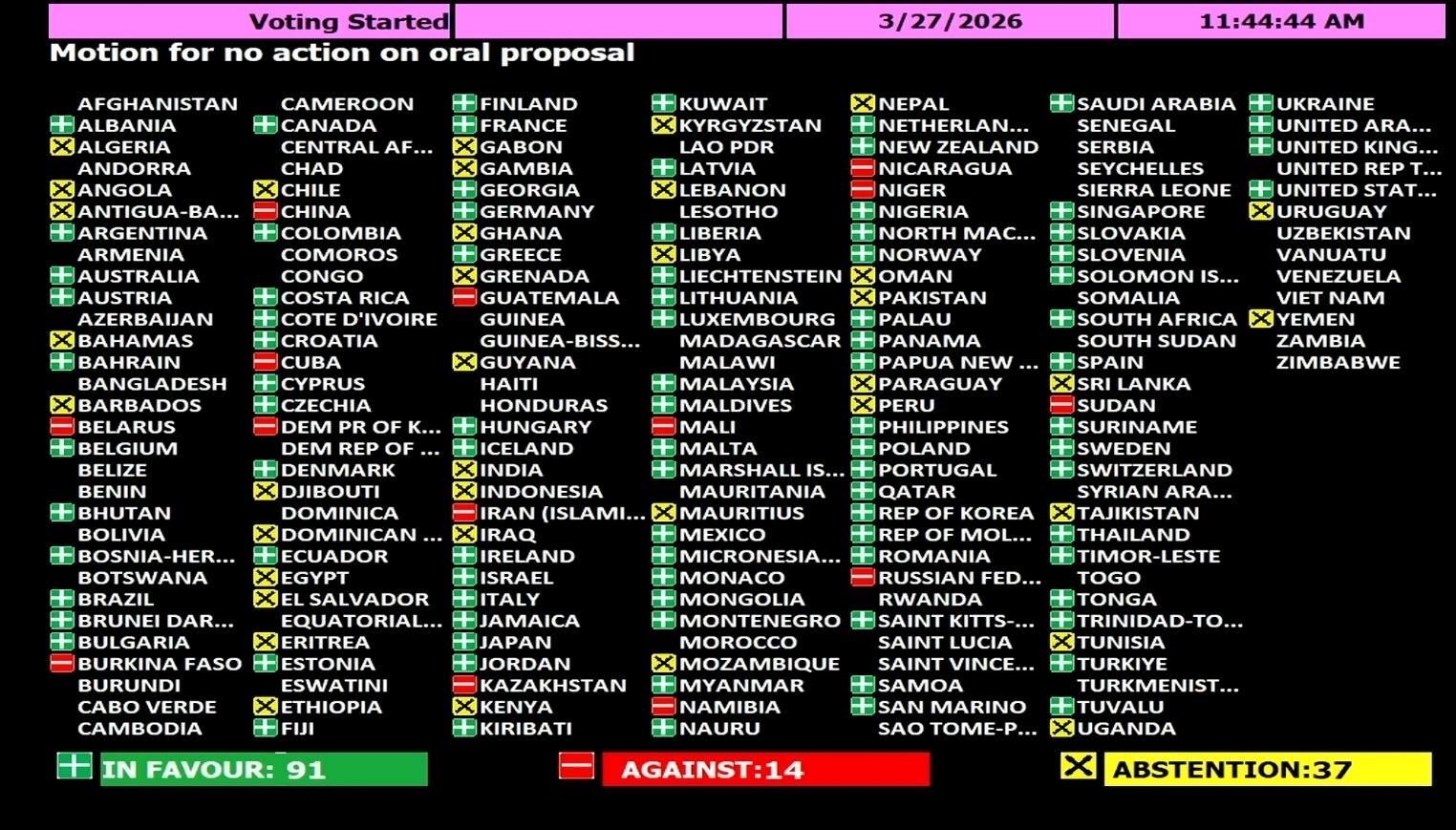
In a first consideration of the text a few days before, Russia had already sought to table hostile amendments to the draft and to extend negotiations by another month. Both attempts were defeated by ‘no action’ motions tabled by Norway and Switzerland, respectively, and voted by over 90 delegations.
Across both sessions, numerous delegations took the floor to support the resolution: the European Union, the Solomon Islands (on behalf of the Pacific Island Forum), Trinidad and Tobago (on behalf of CARICOM), Bahrain (on behalf of the Gulf Cooperation Council), Singapore (on behalf of the Small States Group), Netherlands (on behalf of the Benelux), Australia (on behalf of CANZ), Japan, the Republic of Korea, Brazil, Mexico, Uruguay, Argentina, Jamaica, Barbados, Malta, Norway, South Africa, Zambia, Senegal, India and Turkey. Mexico and Senegal stressed the importance of seeking cross-pillar balance in reforming the UN, not overlooking any of the UN’s three pillars: peace and security, development and human rights.
While endorsing the text, China, Saudi Arabia, Pakistan, Cuba, Syria and El Salvador called for a firmer grip of Member States over the process. Only a handful of countries – Russia, Belarus, Nicaragua, North Korea and Iran – openly spoke against the text.
Secretary-General Guterres and General Assembly President Annalena Baerbock hailed the adoption as a historic step toward a more agile and effective UN. They emphasised that this is merely the beginning of a Member State-led process to ensure the UN remains fit for the future.
A roadmap to review existing and future mandates
The resolution outlines a series of principles that States commit to apply in the creation, implementation and review of mandates, while mandating the Secretary-General to develop digital tools to assist States in doing so, such as the UN Mandate Source Registry.
Key changes introduced by the resolution include clearer mandate design supported by better data, stronger coordinated implementation with improved reporting, and more systematic reviews to ensure continued relevance. When creating mandates, States are required to clarify scope and objectives, and to include implementation roadmaps, timelines, review clauses and, as appropriate, sunset clauses. States are also expected to provide user-friendly reporting on the mandate’s implementation against its stated objectives.
Importantly, the text calls on States to fulfil their UN financial obligations and to allocate sufficient resources for mandates. The UN Secretariat indicated the resolution’s adequate implementation will require an allocation of USD 1.1 million from this year’s UN budget, and between USD 1.6 to 1.7 million for the years after.
Looking ahead, the resolution establishes a formal Ad Hoc Working Group on Mandate Implementation Review, with Co-chairs yet to be appointed, set to resume work on 1 May and to conclude by 30 April 2027 at the latest. The Working Group will guide the next phase of reforms, hosting discussions among Member States on the development of objective criteria for mandate renewal, adaptation, merger, replacement or retirement, and on modalities for a review of existing General Assembly mandates. It is expected to soon publish a detailed roadmap for its work, and to report on its progress to the General Assembly by the end of August.
The resolution mandates a series of reviews of existing UN mandates, for later consideration by States in the Working Group. It requests the Secretary-General to:
- Review the full portfolio of Secretary General-mandated reports and recommend mergers or changes in periodicity by end of June 2026 (to be considered by the Working Group by end of July 2026);
- Advise on possible mechanisms for collective review of mandate implementation across different bodies by end of September 2026 (to be considered by the Working Group by mid-December 2026);
- Review inactive, duplicative, or fully implemented mandates by end of December 2026 (to be considered by the Working Group by end of March 2027).
It also requires States to review existing General Assembly mandates to decide on their ‘renewal, adaptation, merger, replacement or retirement’, for which modalities are to be developed by the Working Group by August 2026. Co-chairs New Zealand and Jamaica clarified that this includes mandates of the Human Rights Council, as a subsidiary body of the General Assembly, while other intergovernmental organs across the UN system are also expected to review their existing stock of mandates under their own processes.
Crucially, the resolution provides grounds of exclusion from review, further clarified by the Co-chairs, for mandates that are:
- Foundational, establishing norms of a universal character (such as on human rights and non-discrimination);
- Structural, governing the existence of standing institutions (such as the Human Rights Council);
- Related to political situations with implications for international peace and security, including those addressing ‘active, unresolved political situations where the UN plays a continuing role’, such as preventing escalation.
In early March, 92 States endorsed a joint pledge at the Human Rights Council to defend human rights multilateralism, including throughout UN80 reform. ISHR urges States to take individual and collective steps, in Geneva and New York, to uphold the pledge’s commitment to ‘engage with the UN80 reform process with a view to building and maintaining an international human rights system that is credible, adequately resourced, and responsive both to States’ needs for technical assistance and capacity building and to the demands of victims and affected communities for accountability and justice.’
UN80 - Take action so reforms are in line with human rights defenders' needs.
Never have we needed a robust international human rights system so badly. But the UN human rights system is in crisis and must be reformed. We need institutions that are principled, consistent, and accountable. Follow our campaign to find out how!
Take action