
UNGA73 | States must work with civil society to end violence against LGBT persons
In presenting his report to the UN Third Committee, the Independent Expert on violence and discrimination on the basis of sexual orientation and gender identity highlights how crucial civil society is in ending the violence against LGBT people.
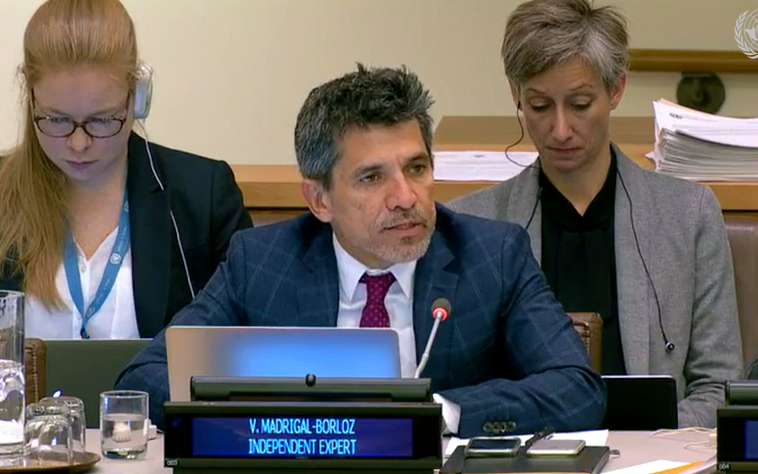
On 25 October, the Independent Expert on violence and discrimination on the basis of sexual orientation and gender identity Victor Madrigal-Borloz presented his first report as mandate holder to the Third Committee of the General Assembly. In his report, he examines the process of declassifying ‘certain forms of gender as a pathology,’ or as a disorder or disease, and the State’s duty to respect and promote respect of gender identity.
He emphasised that States can end violence against Lesbian, Gay, Bisexual and Trans persons (LGBT), but that to do so they must work with civil society. Noting the crackdown on LGBT communities, civil society spaces and those working in defense of the rights of LGBT persons, he urged States to defend spaces that are under attack. ‘Regressive measures should not be adopted,’ he said.
Madrigal-Borloz added that his mandate calls for dialogue and that he is open to working with all States to end violence and discrimination on the basis of sexual orientation and gender identity.
During the dialogue, many States voiced their support for the Independent Expert and engaged with the content of his report. The United Kingdom welcomed his recommendation for States to adopt measures to protect the rights of those defending the rights of LGBT persons. Others such as Argentina, Uruguay and Mexico similarly regretted the violence against LGBT people, supporting the findings in Madrigal-Borloz’s report.
South Africa expressed support for the mandate and agreed that effective measures are necessary to eliminate the social stigma associated with gender diversity. In addition, Australia acknowledged the history of diverse gender identities in its Aboriginal and Torres Strait Islander people, such as the recognition of a third gender identity, noting that it has more to do when it comes to the protection of the rights of LGBTI persons.
Despite the overwhelming support of member States in the room, there were a number of States from the African and MENA regions not in attendance.
‘The Independent Expert’s mandate is to protect people from violence and discrimination on the basis of sexual orientation and gender identity. No person should suffer violence or discrimination on any ground. All States should stand for that, support the principle of non-discrimination and support the Expert in his mandate,’ said ISHR’s programme manager and legal counsel Tess McEvoy.
Contact: Tess McEvoy [email protected]
Photo Credit: United Nations WebTV