UN budget info hub

The UN human rights pillar faces a critical funding crisis, with chronic underfunding and delayed contributions from major member states severely undermining its ability to fulfill its mandates; this page offers essential insights into UN budget mechanics, details on human rights funding challenges, and a collection of ISHR's reports, submissions, and articles advocating for sustainable financial support.

The UN’s human rights pillar remains chronically underfunded, accounting for only about 5-7% of the UN’s regular budget and less than 1% of the UN’s total expenditure (regular budget plus voluntary contributions by States).

In recent years, a range of States have  worked to defund the UN’s human rights work. A liquidity crisis fuelled by the late or non-payments of dues by Member States (especially the US and China), and harsh cuts to human rights budgets and posts under the UN80 Initiative  have severely undermined the ability of human rights mechanisms to fulfill their mandates, brief the international community, protect victims, assist States, and investigate abuses. 

ISHR has advocated for States and UN bodies to secure adequate, predictable, increased and sustainable funding for the UN human rights pillar.

Below you will find some key facts on how the UN budget works and how the portion of the budget dedicated to human rights have been handled. You will also find the reports, submissions and articles that ISHR has published to support its campaigning. 

Human rights cannot be a pillar of the UN in name while being denied the resources needed to deliver its mandates. Human rights mechanisms offer among the best returns on investment in the UN system: relatively modest costs for major structural changes. Increased political and financial investment in human rights safeguards international peace and security, promotes inclusive and sustainable development for all, and has a vital preventive function, helping to avert severe humanitarian crises.


A snapshot of the human rights pillar budget

What were the budget cuts expected in 2026?

On 16 September 2025, the UN Secretary-General published published his report revising his earlier proposal for the UN’s 2026 budget (known as ‘Revised estimates’ report). Budget cuts proposed disproportionately targeted the human rights pillar, with 15% proposed cuts, compared with 11.7% for the development pillar. This run contrary to the Secretary-General’s reiterated commitment to ‘ensure balance across pillars’, a concern shared by many countries. Human rights bodies affected by reductions other than OHCHR included investigative mechanisms on Myanmar (15%) and Syria (16%), the UN’s mechanism for missing persons in Syria (15-17%), and UN Women (15%).

Variation of proposed UN80 budget reductions per pillar and areas of work

Pillar / area of work 2025 approved budget
(USD ‘000)
Initial 2026 proposal
(USD ‘000)
Revised UN80 proposal
(USD ‘000)
Reduction
(USD ‘000)
Reduction vs. initial proposal Share of total UN80 reductions
Human rights
Part VI, Section 24
258,224.00 262,955.40 223,563.70 39,391.70 -15.0% 8.3%
Development
Parts IV, V and XIII
697,718.30 697,441.80 615,536.70 81,905.10 -11.7% 17.2%
Peace and security
Part II
915,068.70 864,670.30 741,737.60 122,932.70 -14.2% 25.8%
Humanitarian assistance
Part VI, Sections 25–27
155,060.80 157,233.70 154,113.00 3,120.70 -2.0% 0.7%
International justice and law
Part III*
104,744.10 106,464.20 95,079.90 11,393.30 -10.7% 2.4%

Source: Secretary-General Revised Estimates Report for 2026 PPB. Amounts are in thousands of US dollars. *Includes the Independent Mechanisms on Myanmar and Syria.

In its report circulated at the beginning of December, the ACABQ broadly endorsed the cuts proposed by the Secretary-General. It accepted the creation of two additional posts but proposed cutting 14 others across regional offices, increasing the total of post reductions from 105 to 117. This brought the total of recommended post abolitions to 18.3% of OHCHR’s current 2025 posts, and to 16.7% of the initial 2026 budget proposal, which reflects the actual resources OHCHR needs to deliver on new mandates created by Member States. 

Variation in OHCHR posts under UN80 budget reduction proposals

  Posts in 2025
(including vacancies)
Initial 2026 proposal Revised UN80 proposal ACABQ recommendation
Number of posts 641 702 597 585 (-12 posts)
Variation vs. initial proposal — — 15% (-105 posts) 16.7% (-117 posts)

Source: Secretary-General Revised Estimates Report for 2026 PPB and ACABQ report.

How does the 2026 budget look?

On 30 December 2025, States at the UN General Assembly’s Fifth Committee (5C) – the UN’s main budgetary body – approved a budget for 2026, agreeing on significant budget cuts under the first stage of the UN80 Initiative process (‘Workstream 1’). 

The resolution approving the UN’s 2026 budget largely endorses the recommendations of the Advisory Committee on Administrative and Budgetary Questions (ACABQ) – an advisory body to the Fifth Committee – which had endorsed and expanded upon a proposal made by Secretary-General Antonio Guterres in September to reflect efficiencies sought under UN80 reform.

While the ACABQ endorsed the proposed redeployment of 71 posts to OHCHR regional offices as part of the Office’s ‘regionalisation’ strategy to boost its presence on the ground, its cuts target posts proposed for establishment in the regional offices of Vienna, Beirut, Panama, Bangkok, Pretoria and Addis Ababa. In the end, 117 jobs were cut at the UN’s Human Rights Office.

A separate budget resolution adopted by the Fifth Committee endorsed the ACABQ’s recommendations concerning the Secretary-General’s request for additional resources arising from HRC resolutions adopted in 2025 that were not anticipated in the original proposed budget (known as the HRC Revised Estimates). The ACABQ recommended a drastic reduction of 20% to the Secretary-General’s proposed additional appropriation of USD 14.6 million, approving only 13 of the 25 new posts requested. Of those approved posts, ten are dedicated to the establishment of an independent mechanism to investigate atrocities committed in Afghanistan, mandated by a historic consensus resolution adopted by States at the HRC last September. 

While accounting for less than 10% of UN80 cost-saving efforts, the budget cuts approved will gravely jeopardise the UN’s ability to promote and protect human rights, given its historic underfunding and related understaffing.

How are the cuts affecting the UN’s ability to fully deliver on human rights mandates?

Human rights work is human resources-intensive, yet proposed cuts mostly take the form of post abolitions. Cutting these posts will severely hamper the UN’s ability to assist States in revising laws and policies, improving governance, training officials and participating in global debates, as well as its ability to monitor, document and act on early warning signs to prevent rights violations, and to investigate and promote accountability.

Even at equal percentage of cuts, the human rights pillar would be disproportionately impacted given it is chronically underfunded and it is already stretched in its core capacity (OHCHR mandate) and its capacity to deliver HRC mandates. OHCHR has limited capacity to absorb cuts given the nature and structure of its work. Year after year, human rights bodies have been asked to do more without a proportionate increase in budget, and with a recent decrease in voluntary donations by States. Forcing OHCHR to work ‘within existing resources’ has greatly reduced OHCHR’s capacity to deliver on mandates across all areas of human rights work.  

Nearly all the cuts in the 2026 budget are to posts that were vacant as a result of a hiring freeze prompted by the UN’s cash crisis, further eroding chances for these important human rights mandates to be implemented. Most vacancies relate to Human Rights Council (HRC) resolutions adopted in recent years, tabled by countries from all regions, covering diverse areas of economic, social, cultural, civil and political rights. 

These include priorities for Global South countries in the areas of economic, social and cultural rights, sustainable development, racial discrimination, and climate change, among others. They also include innovative areas of human rights work requiring dedicated external expertise, such as new and emerging technologies, AI or biodiversity. 

More than any other pillar of the UN, the human rights system draws on and leverages the very substantial pro bono expertise and experience of hundreds of independent human rights experts. Cuts to the human rights pillar will substantially reduce the UN’s capacity to access and leverage this substantial in-kind contribution. While inquiries on atrocities in the Democratic Republic of the Congo and in Palestine remain not fully operational, cuts to country visits by Special Rapporteurs and reduced sessions for human rights treaty committees have already reduced opportunities to engage with civil society and governments to revise laws and policies, and protect at-risk individuals. 

Finally, as a recent States’ joint statement stresses the impact of budget cuts for Global South countries, as a reduced OHCHR presence on the ground means fewer opportunities to document local realities and engage meaningfully. The indefinite postponement of HRC-mandated mechanisms also affects key priorities for civil society and countries in the Global South, in areas as diverse as child digital safety, cyberbullying, domestic violence, adolescent pregnancies, law enforcement and peaceful protest, HIV response, the rights to work and social security in the informal sector, accessibility for persons with disabilities, and education as a tool to combat racism.

‘Against the entrenched belief that human rights only benefit the ‘West’, these budget cuts will greatly weaken the UN’s ability to provide vital assistance to developing countries in training national authorities, building human rights-respectful economies and development policies, combatting racial discrimination and tackling the human rights impacts of climate change’ (Raphaël Viana David, ISHR)

Cuts to the UN human rights regular budget mean that the system will become more reliant on voluntary donations, which have the potential to skew the work of the system. The best way to ensure that the human rights system is universal and can operate in the most principled, non-selective and non-discriminatory manner is to ensure that it receives adequate regular budgetary contributions and is not unduly reliant on the largesse of certain States.

What has been the impact of the liquidity crisis so far?

In recent years, a liquidity crisis fuelled by the late or non-payments of dues by the US and China had already prompted High Commissioner for Human Rights Volker Türk to suspend the delivery of reports, workshops and other activities mandated by the Human Rights Council (HRC). The HRC has also reduced the length of its sessions, limiting space for States, experts and civil society to address some of the world’s most pressing rights issues and crises. 

In 2024, OHCHR only received 87% of its approved regular budget. The lack of funds led the HRC to adopt resolution 55/115 on postponing 17 mandated activities. This included cancelling a written update on the human rights situation in Myanmar and cancelling or postponing to later sessions or to the following year other activities such as updates, seminars, workshops, high-level panels, reports and guidelines. The Office was also limited to hiring temporary staff only.

The disbursement of funds to OHCHR worsened in 2025, and as of June, the Office had received only 73% of its approved regular budget for the year. According to the Office, it has been allocated 85% of its required resources for core staff salaries, 73% for temporary personnel supporting mandated activities, and 45% for operation costs and activities. A letter from High Commissioner Türk highlighted the impact of cuts the Office has been forced to adopt. This included 13 HRC-mandated activities that cannot be completed in 2025 or 2026, including several reports, workshops, or panel discussions around the rights of women and girls, or a global consultation on peaceful protests. A commission of inquiry on serious human rights violations in the Democratic Republic of Congo (DRC), the most recent country investigation established by the HRC (at the time of drafting), cannot operate due to the lack of liquidity. 

According to an update of the UN Secretariat to the 5th Committee of the General Assembly on 9 October 2025, as of 30 September 2025, the UN would require about $3,530 million to execute the 2025 budget in full.  As of 30 December, only 151 of the 193 UN Member States had paid their dues for 2025. On 1 December 2025, Secretary-General Guterres reminded the Fifth Committee that non-paying States had accumulated an ‘unacceptable volume of arrears’ totalling some USD 1.586 billion, 95% of which were owed by the United States. Taking into account the late payments by Russia and Argentina in early December, Mexico and Venezuela closed out the year with the largest amounts of unpaid contributions by year-end after the US, although in amounts that represent a small fraction of US arrears.

The liquidity crisis is exacerbated by the return of unspent cash (from late payments of contributions) to all Member States (proportionately to their scales of assessment) in the form of credits to their assessments two years later (eg. the UN will return USD 300 million in credits in 2026 from unspent liquidities in 2024, most probably relating to China’s payment on 27 December). While this rule exists to ensure that cash unspent due to efficiencies is returned, the reality is that cash is unspent because States are paying their dues too late to be spent, leaving the already cash-strapped organisation with an even smaller budget.

In a somewhat positive development, in December 2025, States agreed to suspend the return of unspent funds in the form of credits to Member States’ future payments, but only for those Member States in arrears on their payments. Returned funds will now be deducted from those States’ arrears, instead of as a credit to future payments. Unfortunately, States failed to agree to suspending the return of unspent funds in times of liquidity crisis when such return would impair the UN’s ability to implement its approved budget, as repeatedly called for by the UN Secretariat. This would have prevented the UN from returning USD 300 million in 2026 (nearly 10% of its 2026 regular budget), largely resulting from China’s late payment on 27 December 2024. The suspension of credit return to those in arrears will only result in reducing credits by 25%, per UN Secretariat estimates.

The impact of regular budget reductions is compounded with the reduction of voluntary donations (in particular un-earmarked), as OHCHR relies approximately at 60% to voluntary contributions. 

Visit our landing page on how the liquidity crisis and budget cuts related to the UN80 Initiative are affecting the work of UN human rights mechanisms since 2024 to learn more.

What does a further 15% cut concretely mean?

Reducing human rights budgets does not contribute substantially to cost-saving efforts. For instance, cuts to the OHCHR budget accounts for 10% of the total UN80 budget reduction. 

However, budget reductions to the human rights pillar have severe ramifications for human rights protection on the ground, investigation, accountability and technical assistance to revise laws and improve policies. 

ISHR has calculated what OHCHR could do with 1% budget increase or what it could lose for each 1% budget reduced.

Based on the OHCHR budget approved for 2025, 1% = approximately USD 2.582 million.

What approximately USD 2.582 million could fund: 

Activity Approximate equivalent
Inter-sessional panel discussions 31 half-day discussions with summary report
Comprehensive studies 32 
Accessible reports (plain language and accessible format) 35
Technical reports using in house expertise 92
Technical reports requiring new expertise (ie. exploring a new topic) 36
One-day seminars with report 14 
Regional consultations 5 three-day consultations in five regions
Technical assistance mandates 21 mandates with report and Interactive Dialogue
Fact-finding missions 1 new one-year mission, including 16 staff based in the field
Special Procedures 4 years of costs for a new mandate
Renewed Special Procedures 5.5 years of costs for a renewed mandate
Country visits 27 visits by one Special Procedure and one accompanying staff member
Thematic Working Groups 1.5 years of a renewed mandate and 2.5 years of a new mandate
Country Presences 2  new country presences established for technical assistance and capacity building

In simple terms: a 15% cut would mean losing roughly 15 times these activities.

* Estimates calculated by ISHR using the latest 2024 Programme Budget Implications (PBI) guidance.

What is ISHR calling for?

ISHR urges all States to:

  1. Pay assessed contributions in full and on time in line with their legal obligation under the UN Charter. The UN should strengthen accountability for persistent non-payment of assessed contributions, including through the effective application of existing consequences under the UN Charter and consideration of further measures to deter chronic non-payment. 
  2. Increase investment in human rights, in particular, the UN human rights pillar. Wherever possible, they should increase their unearmarked and voluntary contributions to the UN Human Rights Office and the investigative and accountability mechanisms it supports.
  3. Mobilise cross-regionally to increase regular budget funding and core capacity for the UN Human Rights Office (OHCHR) and independent human rights mechanisms and bodies to ensure they can fully discharge their mandates. In any ongoing or future reform, efficiency or cost-saving effort, States should protect the budget for the UN human rights pillar from disproportionate or indiscriminate overall UN budget and spending cuts. 
  4. Reform the UN’s Advisory Committee on Administrative and Budgetary Questions (ACABQ) to ensure it is more transparent and accountable, including by adopting public working methods, a code of conduct and a code of ethics, holding open and transparent elections, and introducing rules on the non-accumulation of posts for ACABQ members.

Key Statistics

The human rights pillar remains chronically underfunded and is consistently among the budgets that suffer the most significant cuts by the General Assembly’s Fifth Committee on the basis of recommendations from the Advisory Committee on Administrative and Budgetary Questions (ACABQ).

  • <1%

    of the UN total expenditure is spent by the human rights pillar

    The UN’s human rights pillar is already chronically underfunded, accounting for approximately 5% of the UN regular budget and less than 1% of UN’s total expenditure (regular budget and voluntary contributions).

  • 73%

    of the budget was received in 2025

    Only 73% of the regular budget that was approved for OHCHR was actually received in 2025, as a result of Sates not paying their dues in full and on time.

  • 117

    positions cut

    117 posts were cut at the UN’s Human Rights Office in 2026. This imperils the UN’s ability to investigate grave abuses, and advance human rights globally.

Additional resources

UN Financial Crisis: Mapping the Impact for Human Rights

This is a compilation of publicly available information on how the liquidity crisis and budget cuts related to the UN80 Initiative are affecting the work of UN human rights mechanisms since 2024, including their ability to fulfil their mandates and deliver tangible improvements for individuals and communities.

Defunding human rights: analysis of votes at the Fifth Committee

ISHR analysed how UN Member States voted at the General Assembly Fifth Committee over the past seven years (2018-2024) on initiatives that seek to defund Human Rights Council (HRC) resolutions establishing investigative mechanisms on specific countries. None of these initiatives have so far been successful.

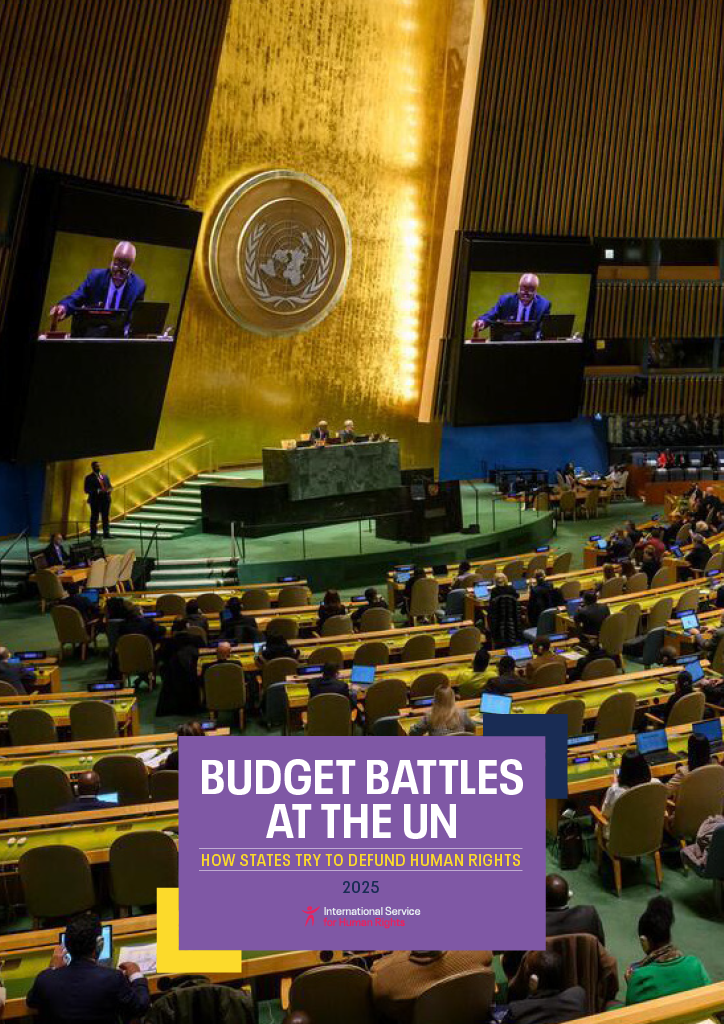
Budget battles at the UN: How States try to defund human rights’

ISHR report exposes how some States are manoeuvring to defund the UN's human rights work. The report documents coordinated efforts to block or cut funding for the Office of the High Commissioner for Human Rights (OHCHR) and Human Rights Council investigations, as well as inconsistent payments that have deepened the UN’s financial crisis.