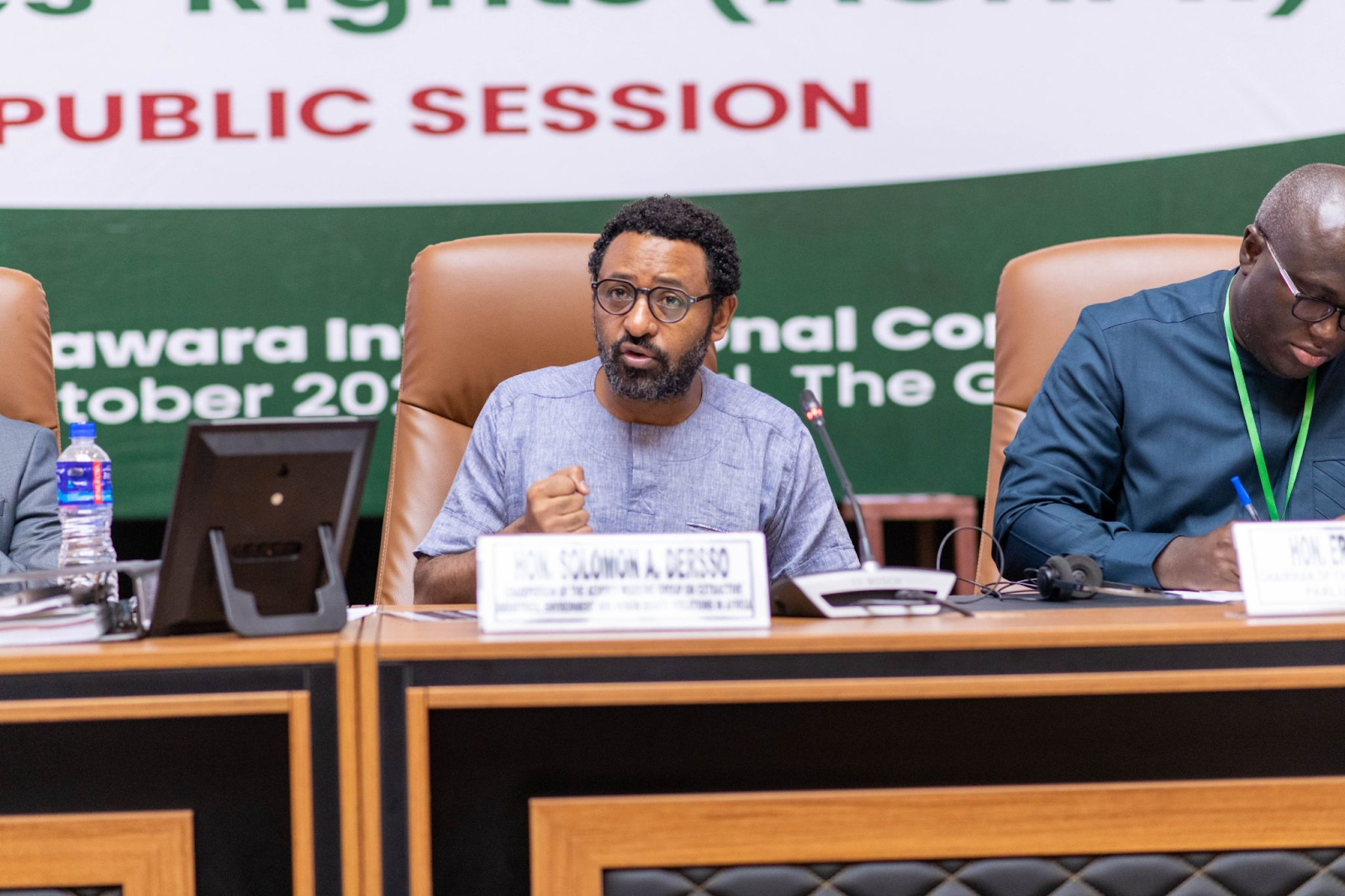
The panel was composed of Ernest Yaw Anim (Parliament of Ghana), Fiona Illiff (American Bar Association), and Voke Ighojordje (Rights Education, Empowerment, and Development Centre for Social Change), and was chaired by Commissioner Solomon Aleye Dersso, Chairperson of the Working Group on Extractive Industries, the Environment, and Human Rights.
Participants discussed the ACHPR Resolution on Developing a General Comment on the Protection and Promotion of the Right to the Environment in Africa, adopted in June 2025 – this general comment is still being developed. They also covered the possibility of adopting a crime of ecocide in Africa for severe environmental degradation as a way to punish the most egregious offenders.
Finally, the discussion went over the issues and risks faced by environmental human rights defenders in Africa, who are unduly targeted by State and non-State actors in their form of attacks and threats in retaliation for their work. Panellists also discussed the possibility of adopting an environmental rights agreement for Africa, as advocated by the Environmental Rights Africa (ERA) Coalition, an initiative supported by ISHR.
The panel highlighted the close interconnection between the protection and promotion of human rights, the protection of the natural environment, the fight against climate change, Indigenous Peoples’ rights, and responsible business conduct. This is particularly true in the African context, in light of the continent’s simultaneously low environmental footprint and high environmental vulnerability.