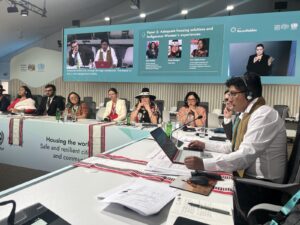
From 17 to 22 May, the13th edition of the World Urban Forum (WUF), organised by UN-Habitat, took place in Baku, Azerbaijan. The WUF was established in 2001 to examine the impacts of urbanisation on communities, cities, economies, climate crisis and policies. ISHR accompanied some Indigenous defenders from Guatemala and Ecuador to participate into this edition and supported the organisation of the first ever Indigenous Peoples Caucus, a dedicated platform to convene and discuss Indigenous Peoples’ needs and challenges in relation to the realisation of their right to adequate housing.
At the Caucus, Indigenous defenders emphasised that no urban planning agenda can be credibly implemented without respecting and protecting Indigenous Peoples’ right to self-determination and ensuring their meaningful participation in the development of national policies and international frameworks.
The Indigenous defenders further stressed that access to adequate housing must respond to the specific needs of Indigenous Peoples by respecting their vision, cultures and identities, and by recognising their unique relationship with their lands and territories.

© ISHR
In addition to addressing the challenges faced by Indigenous Peoples in urban areas, participants discussed the importance of examining the underlying factors driving migration to cities, including conflict, large-scale development projects, forced evictions and climate change.
Additional points that the Caucus developed as a contribution to the Baku Call of Action included:
- Recognising the collective rights to self-determination and free, prior and informed consent in accordance with the United Nations Declaration on the Rights of Indigenous Peoples.
- Stopping the criminalisation and harassment against Indigenous Peoples and Indigenous defenders
- Consider peace as a prerequisite in urban planning.
- Ensuring urban planning and housing initiatives are culturally appropriate and incorporate Indigenous Peoples’ identity and spirituality in the designing of housing policies
- Providing increased and sustained support for Indigenous-led housing initiatives, including through equitable access to financing, land tenure security, infrastructure investment, capacity strengthening, and climate-resilient development strategies
- Seeking accountability for State and non-State actors perpetrating human rights violations against Indigenous Peoples, including developers, financial institutions and businesses.
- Including Indigenous Peoples in all forms of decision making for the new Urban Agenda 2026-2029 and beyond.
© ISHR
The final text of the Baku Call of Action recognised Indigenous techniques and practices in the context of urban planning, as well as the right to free, prior and informed consent. However, it felt short of expressly mentioning the Indigenous right to self-determination, the vital role that human rights defenders, and Indigenous defenders in particular, play in the realisation of the right to adequate housing.
Lastly, the language on guaranteeing accountability is not strong enough to appropriately guarantee the right to adequate housing in the implementation of the commitments of the Call of Action, including on how to improve existing accountability mechanisms, concrete paths to access to justice and the role of grievance mechanisms.
Priorities for the new Special Rapporteur on adequate housing
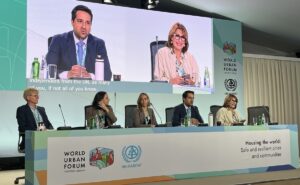
Indigenous defenders also participated in a meeting with the newly appointed United Nations Special Rapporteur on adequate housing. This was an opportunity not only to discuss the priorities of the mandate for the following years, but also to share testimonies of the human rights situation in their countries – including as Indigenous defenders – as well as the persecution, harassment and intimidation they face.
In Guatemala, Indigenous women face persistent and structural State discrimination and are frequently deprived of property and land titles by existing legislation coupled with patriarchal and colonial legacies, while communities continue to suffer forced evictions associated with the construction and operation of extractive industries, hydroelectric plants, and other development projects. In some instances, urban expansion has led to the appropriation of water sources protected by Indigenous communities to supply urban centres, resulting in acute water shortages and pollution for these Indigenous populations.
From this perspective, guaranteeing the right to adequate housing necessitates an intersectional approach that addresses the multiple forms of racism and discrimination faced by Indigenous women.
Finally, there is a call upon the new Special Rapporteur to follow up on the implementation of the recommendations made by the former mandate holder during his official visit in 2025.
© ISHR
Bolivias’s Constitution expressly recognises the collective ownership of land and territory by Indigenous Peoples. However, in practice, policies driving urban expansion often fail to respect these collective rights.
For Indigenous communities, housing is not merely a physical structure but an integral component of their territory, culture, and spirituality. Guaranteeing the right to adequate housing is therefore impossible unless the right to land and collective territory is first recognised and protected.
In light of this, the Special Rapporteur is urged to incorporate this perspective into the mandate’s upcoming work.