
China: UN child rights experts question national security and ethnic unity laws, restrictions on fundamental freedoms
Ahead of China’s first UN child rights review since 2013, UN committee raises questions about Hong Kong's national security laws and China's Ethnic Unity Law, alongside longstanding concerns over children’s fundamental freedoms.
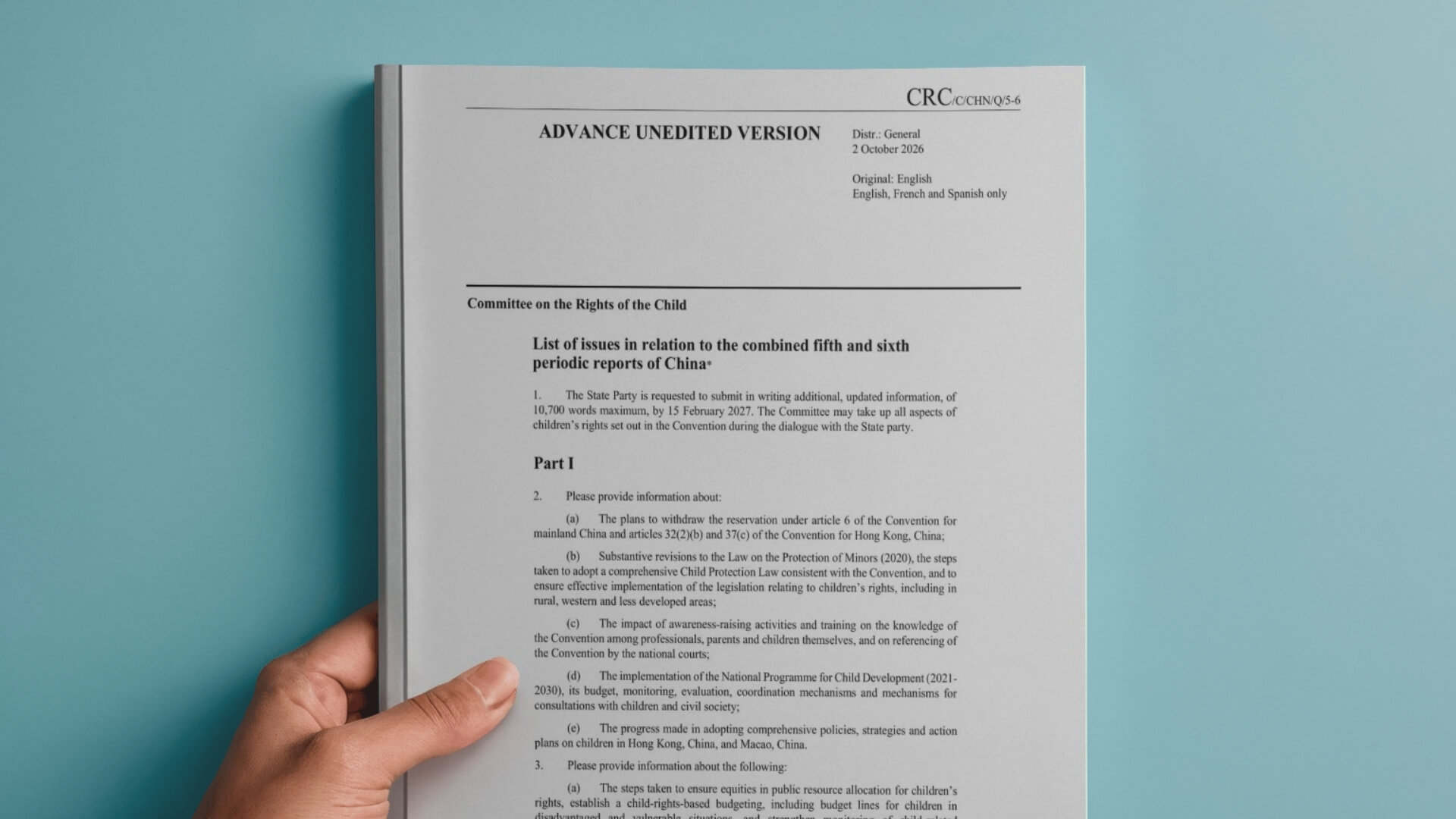
The UN Committee on the Rights of the Child (CRC) has published its List of Issues, adopted on 2 October 2026, in relation to China’s combined fifth and sixth periodic reports under the Convention on the Rights of the Child.
The List of Issues contains 28 numbered paragraphs, setting out detailed questions and requests for information on a broad range of children’s rights concerns across mainland China, Hong Kong, and Macao. It marks the first step in the process of China’s first review by the Committee since 2013, expected to take place next year at the earliest, providing an opportunity to assess progress in implementing the Committee’s 2013 recommendations and examine new human rights concerns that have emerged over the past 13 years.
The latest questions revisit several concerns raised in the Committee’s 2013 assessment and recommendations (known as ‘concluding observations’), including discrimination against Tibetan and Uyghur children, restrictions on their religious and linguistic rights, barriers to education, family separation, and retaliation against human rights defenders. They also address developments since the last review, including Hong Kong’s national security laws and the new Law on Promoting Ethnic Unity and Progress.
In August 2026, ISHR submitted information to the Committee highlighting recurring children’s rights concerns raised by UN human rights mechanisms and gaps in the implementation of their recommendations. Drawing on previous UN findings and recommendations, the submission focused on violations related to national security legislation, restrictions on fundamental freedoms, family separation, and access to education, particularly in Tibet, the Uyghur region, and Hong Kong. These concerns feature prominently in the Committee’s questions.
National security laws and restrictions on children’s freedoms
A central concern is the impact of national security and counter-terrorism legislation on children’s fundamental freedoms, particularly in Hong Kong, where new national security laws have been introduced since the previous review. The Committee examines how these laws affect children’s freedom of expression, access to information and participation in public life, as well as the protection of those defending children’s rights.
The Committee seeks information on:
- Measures to address obstacles faced by journalists, human rights defenders and NGOs in reporting children’s rights violations and seeking justice in mainland China, and to protect child rights advocates from retaliation under Hong Kong’s National Security Law.
- Measures to ensure that children can safely and freely express their views without fear of prosecution under national security provisions, particularly in Hong Kong.
- Police violence, arrests and ‘rioting’ charges involving more than 1,700 students in the context of the 2019 anti-extradition protests in Hong Kong.
- Safeguards to ensure that restrictions intended to protect children from harmful content also respect their access to diverse, age-appropriate information and freedom of expression, including online, in light of restrictions imposed under Hong Kong’s National Security Law, which have resulted in the prosecution and imprisonment of children and caregivers.
Cultural and linguistic rights in Tibet and the Uyghur region
The Committee pays particular attention to China’s Law on Promoting Ethnic Unity and Progress, which entered into force on 1 July 2026.
In April 2026, UN human rights experts warned that the law risked further restricting linguistic, cultural and religious rights, including through provisions promoting Mandarin as the basic language of instruction and imposing obligations on parents concerning their children’s education. The Committee’s questions now place the law’s compatibility with the Convention under scrutiny.
The Committee’s questions also address reports of restrictions on education in these languages and concerns about the situation of children attending State-run boarding schools.
In particular, the Committee requests information on:
- The compatibility of legislative and practical restrictions, including those under the 2026 Law on Promoting Ethnic Unity and Progress, with the rights of Tibetan, Uyghur and other Muslim children to enjoy their culture, practise their religion and use their own language.
- Reports that Tibetan, Uyghur and other children are pressured to speak only Mandarin from preschool, that schools providing instruction in Tibetan, Uyghur and other languages have been forcibly closed, and that parents have been punished for teaching their children their own language, culture or religion.
- Measures to ensure that children, including those from Tibetan, Uyghur and other ethnic communities, can access quality education close to their families and communities, and that boarding schools are used only where objective factors, such as distance, make attendance difficult, with safeguards for family contact, wellbeing, language, culture and child protection.
- Measures to investigate, prosecute and bring perpetrators to justice in relation to reports of death, torture and ill-treatment of children in State-run boarding schools and preschools in Tibet.
Family separation, surveillance and access to justice
The Committee draws attention to how detention, surveillance and other security-related measures affect children and their families, particularly in Tibet and the Uyghur region. It also raises detailed questions about surveillance practices in Tibet and the Uyghur region, including the collection of children’s genetic data, as well as restrictions affecting families living abroad.
Among the issues the Committee asks China to address are:
- Measures to prevent the separation of children from their parents when it is not in their best interests, particularly in cases of domestic labour migration and forced labour transfers of parents from ethnic communities, and to protect children whose parents are detained, interned, forcibly disappeared, on death row or executed.
- The scope, legal basis, purpose and compatibility with children’s right to privacy of non-consensual collection of children’s genetic data in Tibet, ‘home-stay’ or ‘become family’ monitoring programmes for Uyghur and other families.
- The scope, legal basis, purpose and compatibility with children’s right to privacy of travel restrictions affecting Tibetan, Uyghur and other children, and pressure campaigns against families from ethnic communities, including children, living abroad.
- Measures to ensure that children are not punished or subjected to differential treatment because of their parents’ or caregivers’ ethnicity, religious or political activities or beliefs, profession, socioeconomic status, marital status, religion or language.
- The availability of independent, confidential, accessible and child-friendly complaints mechanisms, particularly in closed settings, including institutions, boarding schools and correctional facilities in Tibet, the Uyghur region, Hong Kong and Macao, to report discrimination, ill-treatment, deprivation of liberty, sexual exploitation and abuse.
Discrimination and violence against LGBTI children
The Committee’s latest questions also give more explicit attention to discrimination and harmful practices affecting LGBTI children than its 2013 review.
Beyond addressing discriminatory legislation and practices, the Committee examines ‘conversion therapy’, the classification of gender diversity as a disorder and unnecessary medical interventions on intersex children.
The Committee asks China to provide information on:
- Measures to review legislation, policies and practices that stigmatise and discriminate against LGBTI children and children born to same-sex parents.
- Measures to prevent violence and abuse, including bullying, particularly against children in vulnerable situations, including LGBTI children.
- Measures to address ‘conversion therapy’ aimed at changing the sexual orientation and gender identity of children and adolescents, and remove ‘gender diversity disorder’ from the Chinese Classification of Mental Disorders which stigmatises transgender and gender-diverse children and provides justification for harmful conversion practice.
- Measures to address unnecessary and irreversible surgeries and treatments on intersex children, particularly in Hong Kong.
What comes next?
China has until 15 February 2027 to submit written responses to the Committee’s questions. These responses will inform the next, central stage of the review: an interactive dialogue between the Committee and the Chinese authorities that will inform the Committee’s concluding observations.
For civil society organisations, the List of Issues provides an opportunity to assess China’s implementation of previous recommendations, document developments since the 2013 review and identify gaps in the government’s responses. NGOs can use the Committee’s questions to gather updated evidence, including on the impact of national security and ethnic unity policies on children, and provide information to the Committee at the latest 2–3 weeks before the review session.
ISHR calls on China to engage constructively and transparently with the review process, respond comprehensively to the Committee’s concerns, and take concrete steps to bring its legislation and practices into compliance with international human rights standards.