
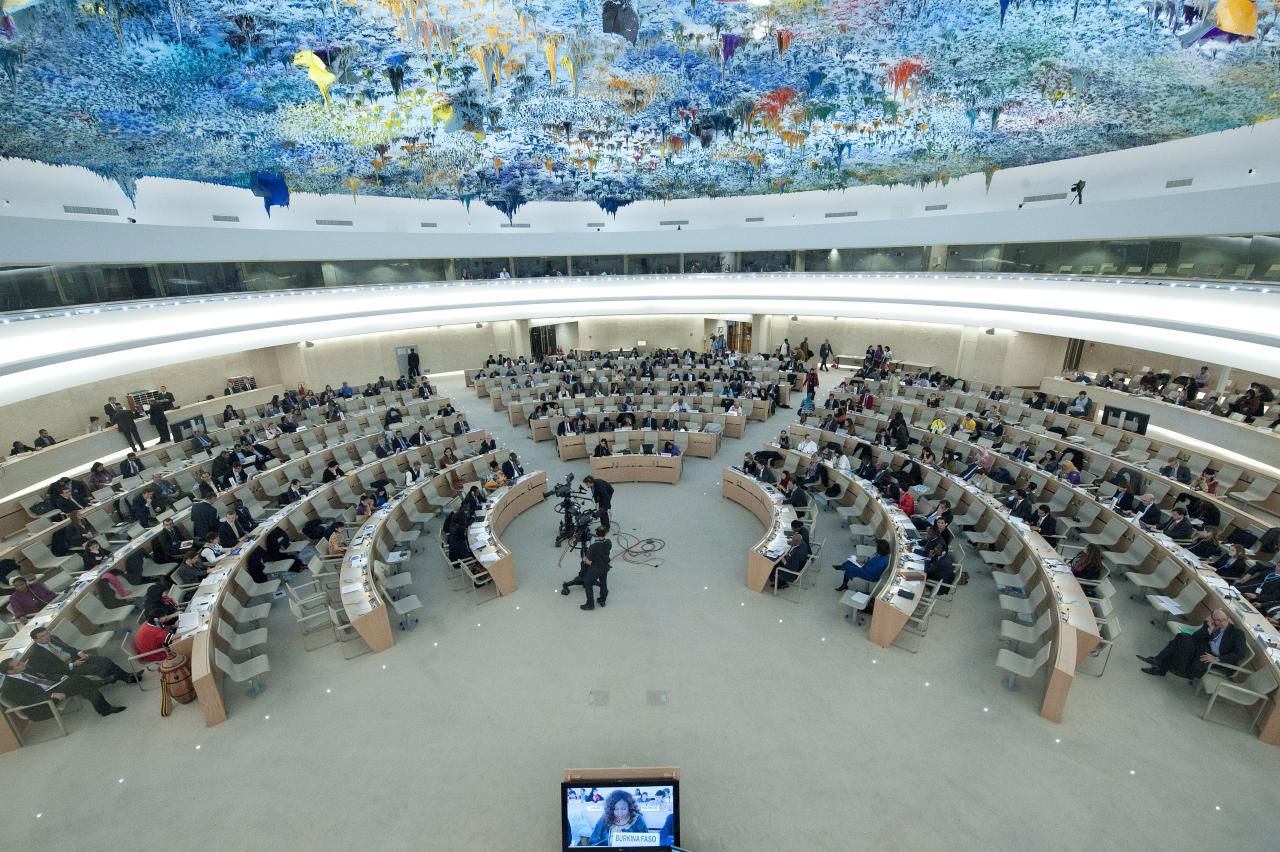
UN Photo / Jean-Marc Ferré
HRC62: Key issues at the Human Rights Council in June 2026
As the Human Rights Council marks its 20th anniversary and the General Assembly reviews its institutional status, HRC62 will be an important test of the Council’s credibility, accessibility and ability to respond to human rights crises. This briefing highlights key opportunities for States and civil society to strengthen civil society participation, address reprisals, uphold the integrity of the Universal Periodic Review, advance climate justice, and ensure principled scrutiny of serious country situations, including those that States should raise during relevant debates. It also provides a practical overview of entry points for civil society engagement during the session.
The UN Human Rights Council will hold its 62nd regular session at Palais des Nations in Geneva from 15 June to 7 July 2026.
Marking its 20th anniversary, the UN Human Rights Council has established itself as the primary global body for promoting and protecting human rights. In the past two decades, the Council has strengthened human rights norms, recognised emerging human rights concerns, documented grave violations in many countries, and provided a crucial platform for civil society, victims, and human rights defenders to seek justice, accountability, and visibility.
This anniversary should be used to strengthen the Council’s accessibility and impact. To ensure the Council can continue to fulfill its mandate effectively, ISHR urges States to
- secure adequate and predictable funding;
- remove barriers to and strengthen meaningful civil society participation;
- ensure competitive elections so the Council membership upholds the highest human rights standards;
- end selectivity and double standards through principled decision-making;
- ensure the General Assembly’s review of the status of the Council aims to strengthen the Council and elevate the status of human rights across the UN system.
- in the context of UN80 reform, ensure that the Council is responsible for the review of its mandates and, in doing so, consults independent civil society and affected communities, takes into account the specificities of human rights mandates, and assesses the long-term impact of its mandates in a holistic manner on the basis of human rights criteria.
- support initiatives to strengthen the Council such as allowing it to refer matters to the Security Council and request advisory opinions from the International Court of Justice;
- strengthen the Special Procedures system by safeguarding its independence and autonomy, ensuring adequate resources for the implementation of mandates, and consulting both mandate holders and affected communities before making any decisions that may affect their work;
- ensure remote participation in formal and informal meetings by taking action on Council Decision 55/116.
Stay up-to-date: Follow @ISHRglobal and #HRC62 on X and @ishr.ch on BlueSky, and look out for our Human Rights Monitor.
ISHR side event
ISHR will organise a side event on racial justice and democracy on 18 June, 1:00–2:00pm, at Room IX. Event details are available here.
ISHR thematic priorities
Civil society participation
Civil society organisations face growing barriers to meaningful participation at the Council, including WebEx and interpretation charges for side events, reduced travel support, visa obstacles, and limited hybrid access to informal negotiations. Because States must cover WebEx costs for informal consultations, few negotiations are accessible remotely, restricting participation by organisations and defenders, particularly from the Global South. At HRC62, a provisional funding-related measure will also limit NGOs in ECOSOC consultative status to three written statements instead of five.
ISHR urges States to ensure online access to informals and address the UN liquidity crisis without further restricting civil society engagement, and urges OHCHR to review any provisional restrictions arising from the funding crisis by the end of 2026.
Reprisals
ISHR remains deeply concerned about reprisals against civil society actors engaging or seeking to engage with UN mechanisms, and urges States and the Council to do more to address them. Council debates are key moments for States to raise specific cases, demand updates on investigations, and promote accountability.
An increasing number of States have raised such cases across recent Council sessions. This practice helps combat impunity and sends vital messages of solidarity to human rights defenders. ISHR calls on States to continue raising and following up on cases during country-specific and general debates, including those highlighted by ISHR.
Non-cooperation at the UPR
With the fourth Universal Periodic Review (UPR) cycle concluding in early 2027, States need to urgently act to uphold the integrity and universality of the UPR given the non-cooperation of Nicaragua and the United States of America. The Council should adopt the outcome of the review of Nicaragua in its absence and proceed with the review of the United States without its participation, as failing to do so would effectively reward non-cooperation.
Annual resolution on climate change
The annual resolution on climate change at HRC62 will focus on adaptation and future generations. ISHR urges States to ensure the resolution remains coherent with existing Council standards, advances the right to a clean, healthy and sustainable environment, and centres environmental human rights defenders, communities and Indigenous Peoples. The text should recognise the role and risks faced by defenders, address national implementation, and strengthen language on corporate accountability and financial institutions. Following recent climate advisory opinions and General Assembly action, States should treat climate action as a human rights obligation and ensure relevant mandates are renewed and adequately resourced.
Country-specific priorities
China
UN experts and OHCHR continue to document severe human rights violations in China. In April, UN experts warned that China’s new Law on Promoting Ethnic Unity and Progress (commonly known as the ‘Ethnic Unity Law’) risks violating a wide range of human rights affecting Tibetans and Uyghurs, and may create risks of transnational repression. OHCHR also raised concerns over criminal charges against artist Gao Zhen for ‘slandering heroes and martyrs’, and urged China to ensure lawyer Yu Wensheng’s release is unconditional, and lift restrictions on him and his wife Xu Yan.
States should use national and joint statements to urge China to implement UN recommendations, grant access to UN mechanisms, ensure follow-up to the OHCHR Xinjiang report, repeal national security laws that restricts civic space, and call for the release of those arbitrarily detained by naming them directly, including Gao Zhen, Ding Jiaxi and Xu Zhiyong, Gulshan Abbas, and Chow Hang-tung.
Occupied Palestinian Territory & Israel
UN experts, the High Commissioner , the Commission of Inquiry (CoI) and Committee on the Elimination of Racial Discrimination (CERD) urged Israel to immediately repeal the law effectively providing for the death penalty solely against Palestinians. UN experts also expressed grave concern that patterns of forced displacement in the West Bank, including East Jerusalem, and Israeli military attacks in Gaza ‘serves an ultimate purpose: to make life unbearable for Palestinians and permanently force them from their land’, as well as the use of sexual violence by Israel ‘as a tool of control, subjugation and dispossession’.
The CoI, which found that Israel continues to perpetrate genocidal acts in Gaza and that Israeli settlers have been carrying out daily attacks, will present its report this session on the killing and injuring of civilians by non-State actors, including by Israeli settlers and Palestinian armed groups.
ISHR supports calls by UN experts and Palestinian civil society for the General Assembly to suspend Israel’s credentials. ISHR reiterates its call on States to implement recommendations of UN experts, UN agencies, OHCHR and the International Court of Justice (ICJ) through immediate political and economic measures, including sanctions and a two-way arms embargo. States should also take urgent steps to protect UNRWA and UN monitoring and accountability mechanisms, including the Special Rapporteur on the OPT, the CoI, the ICJ and the International Criminal Court.
Occupied Western Sahara
Sahrawi human rights defenders documenting violations, mobilising communities, or asserting the right to self-determination face criminalisation, administrative harassment, physical and psychological abuse, sexual violence, surveillance, and restrictions on fundamental freedoms. This creates a climate of intimidation and self-censorship, limiting defenders’ ability to organise, document violations, or communicate securely.
In May, the Sahrawi Arab Democratic Republic presented its report as a State party to the African Charter on Human and People’s Rights to Africa’s main human rights body. ISHR, together with the Working Group on Human Rights in Occupied Western Sahara and Front Line Defenders, submitted a civil society report addressing the persistent and systemic human rights violations in the occupied parts of Western Sahara. The organisations were also scheduled to organise a side event in Banjul, which was unilaterally cancelled by the conference venue, sparking condemnation by civil society.
The Council should ensure unhindered access for OHCHR and Special Procedures to Western Sahara, urge Morocco to uphold fundamental freedoms, release all arbitrarily detained individuals, guarantee fair trial standards, end reprisals and intimidation against Sahrawi defenders, and ensure their safe engagement with UN mechanisms.
Sudan
Civilians in Sudan continue to endure unbearable conditions in Dillinj, South Kordofan, while thousands walk on foot for days in search of safety in the Blue Nile State. Local responders and human rights defenders face vicious attacks as they work to save lives and document war crimes. The conflict in South Kordofan region has intensified, with the Rapid Support Forces (RSF) and Sudan People’s Liberation Movement–North (SPLM-N) forces launching indiscriminate drone strikes and shelling on civilian areas, killing dozens of civilians, including children and local responders.
ISHR urges States to press all parties to the conflict to respect international humanitarian law, ensure an immediate ceasefire, protect civilians, ensure unimpeded humanitarian access, and guarantee freedoms of expression, peaceful assembly and association.
United States of America
ISHR is concerned about the deteriorating human rights situation and erosion of the rule of law in the United States, as well as its commission of, or complicity in, grave violations abroad, including in Iran, Venezuela, Palestine, and the Caribbean and Pacific. The Trump Administration’s refusal to participate in the Universal Periodic Review (UPR) undermines peer-to-peer dialogue on pressing human rights concerns of all countries, and should be condemned by the Council.
In light of extensive evidence of violations at home and abroad, ISHR urges increased monitoring, reporting and scrutiny of the United States by Special Procedures and the High Commissioner. We also urge States to address the situation, both through individual and joint statements, under appropriate Council agenda items.
Venezuela
Although the crackdown on organised civil society has eased, the repressive structures remain in place and have not been held to account for their role in large-scale human rights violations. The ten urgent demands put forward by civil society to steer the current situation towards a genuine and credible democratic transition have not been implemented.
The Council-mandated Fact-Finding Mission (FFM) plays a key role in ensuring the rights to truth, justice, reparation and guarantees of non-repetition for victims of human rights violations and international crimes, as well as in highlighting the structural reforms needed to prevent future abuses.
ISHR urges States to support the FFM, its renewal and its full, safe and independent access to Venezuelan territory.
Adoption of UPR reports
At HRC62, the Council will adopt UPR outcomes for Australia, Austria, Georgia, Lebanon, Mauritania, Micronesia (Federated States of), Nauru, Nepal, Oman, Rwanda, Saint Kitts and Nevis, Saint Lucia, and São Tomé and Príncipe.
States should pay particular attention to recommendations outlined in ISHR’s briefing paper on human rights defenders in São Tomé and Príncipe.
Civil society guide to the 62nd session of the Human Rights Council
The session will include high-level statements by States, updates by the UN High Commissioner for Human Rights, interactive dialogues with mandate holders, panel discussions, adoption of UPR outcomes, consideration of resolutions, and the appointment of new mandate holders.
NGOs in consultative status with ECOSOC may deliver oral statements in person or by pre-recorded video during interactive dialogues, general debates and panel discussions. Guidance on accreditation and participation is available on the NGO participation information page.
Useful links:
- HRC62 webpage – official information of the session
- HRC Extranet – oral statements and meeting documents
- HRC62 Sched – meeting calendar updated daily with meeting times
- UN Web TV – live and archived webcasts of all public meetings
Presentations of the High Commissioner for Human Rights
The High Commissioner will present his annual report on 15 June, presenting global human rights trends, priorities and concerns. The annual report will be considered in an interactive dialogue on 16 June, allowing States and civil society organisations to respond.
The High Commissioner will also present separate updates and reports under relevant agenda items, including on Iran, Nicaragua, Myanmar, Georgia, Colombia, Ukraine, South Sudan, and Venezuela. Some of these will be presentations only, while others will be followed by interactive dialogues.
Civil society organisations may follow developments through these updates and deliver oral statements where interactive dialogues follow.
Interactive dialogues
Interactive dialogues are formal meetings between the Council and independent human rights experts or the High Commissioner. Reports or updates are presented, followed by oral statements from States and NGOs. See the full list of reports here.
The Council will hold interactive dialogues with the following thematic mandate holders:
- Independent Expert on international solidarity
- Special Rapporteur on health
- Special Rapporteur on freedom of expression
- Special Rapporteur on education
- Special Rapporteur on summary executions
- Independent Expert on sexual orientation and gender identity
- Special Rapporteur on leprosy
- Special Rapporteur on climate change
- Special Rapporteur on migrants
- Special Rapporteur on trafficking
- Special Rapporteur on violence against women and girls
- Special Rapporteur on peaceful assembly and association
- Working Group on business and human rights
- Working Group on discrimination against women and girls
- Special Rapporteur on independence of judges and lawyers
- Special Rapporteur on extreme poverty
- Special Rapporteur on internally displaced persons
- Special Rapporteur on racism
The Council will also hold an interactive dialogue on the High Commissioner’s report on the impact of anti-personnel mines on the enjoyment of human rights.
The Council will address country situations through the following interactive dialogues:
- Enhanced interactive dialogue on the oral update of the Fact-Finding Mission for Sudan
- Enhanced interactive dialogue on the report of the Special Rapporteur on Eritrea
- Interactive dialogue with the Commission of Inquiry on the Occupied Palestinian Territory, including East Jerusalem, and Israel
- Interactive dialogue on the report of the High Commissioner on Venezuela
- Enhanced interactive dialogue on the oral update of the Independent Commission of Inquiry on the Human Rights Situation in the South and North Kivu Provinces of the Democratic Republic of the Congo
- Interactive dialogue on the oral update of the Special Rapporteur on Burundi
- Interactive dialogue with the Special Rapporteur on Belarus
- Interactive dialogue on the oral presentation of the High Commissioner on Ukraine and interim report of the Secretary-General on human rights in Crimea
- Interactive dialogue on OHCHR report on technical assistance in South Sudan
Panel discussions
Panel discussions bring together experts, States and civil society to discuss specific themes. Four panel discussions are scheduled for this session:
- Annual panel discussion on the adverse impacts of climate change on human rights
Theme: Facilitating actionable pathways for gaining momentum in climate financing in the context of addressing the adverse impacts of climate change on the full realisation of human rights for all people - Panel discussion on the intensification of efforts to empower women and girls in and through sport
- Annual full-day discussion on the human rights of women
Panel 1: Domestic violence against women and girls
Panel 2: Commemoration of the International Day of Women in Diplomacy focusing on women’s right to work and representation in decision-making - Biennial thematic panel discussion on technical cooperation and capacity-building
Theme: Technical cooperation and capacity-building in supporting States in the full and effective realisation of the right of everyone to the enjoyment of the highest attainable standard of physical and mental health
Adoption of UPR reports
The Council will adopt the Universal Periodic Review (UPR) working group reports on Australia, Austria, Georgia, Lebanon, Mauritania, Micronesia (Federated States of), Nauru, Nepal, Oman, Rwanda, Saint Kitts and Nevis, Saint Lucia, and São Tomé and Príncipe.
Civil society organisations may monitor which recommendations are accepted and use them to support follow-up advocacy at the national level.
Resolutions
States negotiate and adopt resolutions and decisions throughout the session. These may address thematic issues, country situations, technical assistance, or the creation or renewal of mandates.
At the organisational meeting on 1 June, the following resolutions were announced (States leading the resolution in brackets). Additional resolutions may also be presented during the session.
- Mandate renewal of the Special Rapporteur on extrajudicial, summary or arbitrary executions (Sweden, Finland)
- 20th anniversary of the Human Rights Council (Mexico, Morocco, Slovenia, Spain, Thailand)
- Mandate renewal of the Special Rapporteur on the rights of persons with disabilities (Mexico, New Zealand)
- Elimination of all forms of discrimination against women and girls, focusing on the gender dimension of care and support systems and discrimination (Mexico, Chile, Spain, Iceland)
- Mandate renewal of the Working Group on business and human rights (Argentina)
- Protection of healthcare in armed conflicts (Qatar)
- Situation of human rights of Rohingya Muslims and other minorities in Myanmar (Pakistan on behalf of the OIC)
- Freedom of opinion and expression (Netherlands, Brazil, Canada, Fiji, Namibia, Sweden)
- Mandate renewal of the Special Rapporteur on extreme poverty and human rights (France, Albania, Belgium, Chile, Morocco, Peru, Philippines, Romania)
- Human rights and climate change, focusing on adaptation and the realisation of the human rights of present and future generations (Philippines, Bangladesh, Viet Nam)
- Elimination of discrimination against persons affected by leprosy or Hansen’s disease and their family members (Brazil, Ecuador, Ethiopia, Fiji, India, Kyrgyzstan, Morocco, Japan)
- Mandate renewal of the Special Rapporteur on human rights and international solidarity (Cuba)
- The Social Forum (Cuba)
- Promotion, protection and respect for the full enjoyment of the human rights of women and girls in humanitarian situations (Colombia, Uruguay, Sweden, Georgia, Fiji, Sierra Leone, Japan)
- Child, early and forced marriage, focusing on the implementation of guidelines (Switzerland, Canada, Honduras, Italy, Montenegro, Netherlands, Poland, Sierra Leone, Thailand, Uruguay)
- Technical assistance and capacity-building for South Sudan (Kenya on behalf of the African Group)
- Situation of human rights in Eritrea, including renewal of the mandate of the Special Rapporteur on Eritrea (European Union)
- Independence and impartiality of the judiciary, jurors and assessors and the independence of lawyers, including mandate renewal of the Special Rapporteur on the independence of judges and lawyers (Hungary, Australia, Botswana, Mexico, Thailand, Maldives)
- Role of States in countering the negative impact of disinformation (Ukraine, Japan, Latvia, Lithuania, Poland, United Kingdom)
- Mandate renewal of the Special Rapporteur on the right to education (Portugal)
- Human rights and the acquisition, possession and use of firearms by civilians (Peru, Ecuador)
Civil society organisations may follow draft texts and negotiations, share recommendations with delegations, advocate on language and priorities and monitor the adoption of resolutions. Adopted resolutions can support advocacy at national and international levels.
Appointment of mandate holders
At this session, appointments are expected for the following four vacancies:
- Special Rapporteur on toxics and human rights
- Special Rapporteur on freedom of opinion and expression
- Special Rapporteur on the right to health
- Special Rapporteur on torture
Civil society may review shortlisted candidates and engage with newly appointed mandate holders once confirmed. Early outreach can help establish working relationships and share priority concerns to shape future reporting, communications, and country visits.
Read here the three-year programme of work of the Council with supplementary information.