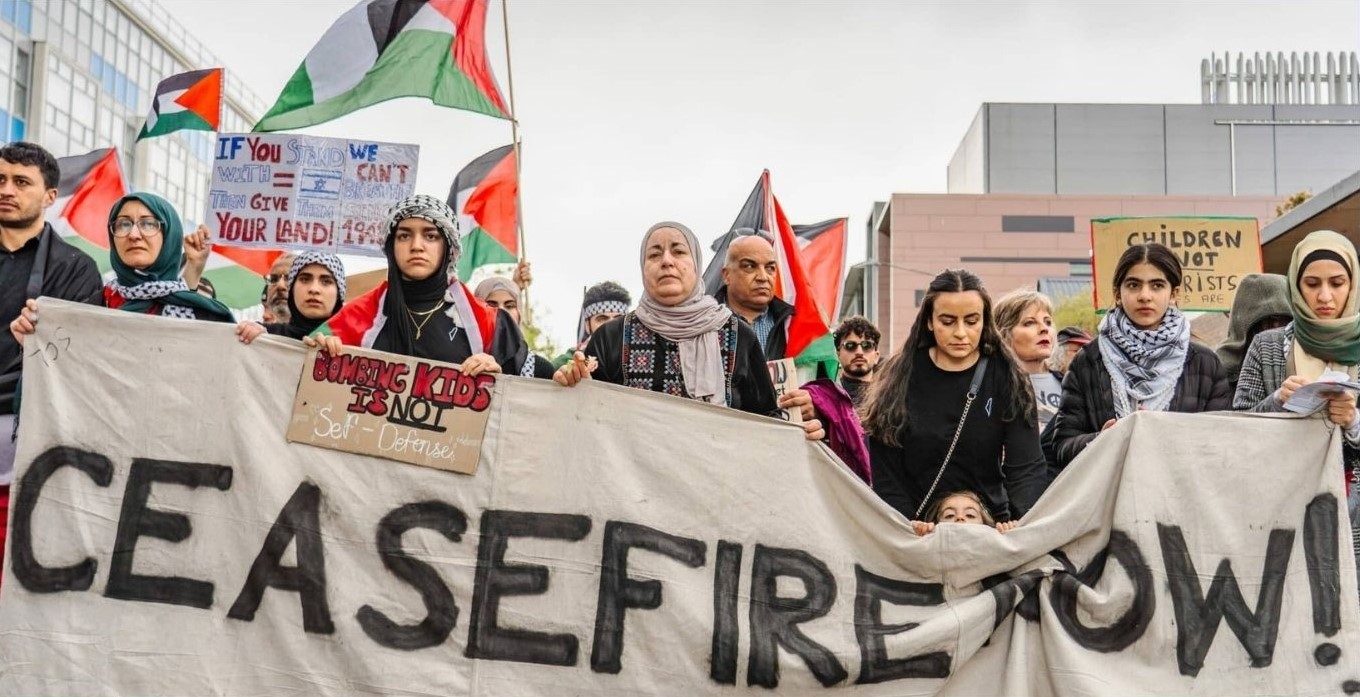
On 24 November 2025, ISHR, the Business & Human Rights Resource Centre, and Front Line Defenders co-organised an event to examine how corporations and investors are involved in, and must be held accountable for the ongoing genocide and system of apartheid against the Palestinian people. Attendees included Palestinian human rights defenders, NGOs and diplomats.
The event built on the findings of the UN Special Rapporteur on the situation in the Occupied Palestinian Territory, Francesca Albanese, whose latest report exposes the central role of corporate and financial actors in perpetuating Israel’s economy of occupation, dispossession, and violence. The event aimed to clarify the legal responsibilities of corporations and third States, home State obligations, explore accountability avenues, and highlight measures needed to protect human rights defenders who expose corporate complicity.
Throughout the discussion, the Special Rapporteur underlined that amidst the genocide, the Tel Aviv stock exchange soared with billions generated in profits. She stressed that companies supplying technology, weapon systems, infrastructure or cloud services to Israel during military operations cannot claim neutrality as they are enablers and profiting. International humanitarian and human rights law should guide corporate behaviour, she said, but many actors have failed even basic human rights due diligence.
Albanese reiterated that at this stage, Israel cannot be treated as a normal business partner: Israel as a State pursues colonial settlements, illegal occupation, exploits Palestinian resources, maintains a system of apartheid and is accused of genocide, war crimes and crimes against humanity. Therefore, corporate engagement must reflect that reality. This would also be consistent with the Advisory Opinion by the International Court of Justice. She called for respect for international law, sector-wide transparency, and tools such as a Genocide-free Index to guide responsible conduct.
Corporate due diligence and legal obligations
The panel stressed that companies providing services to an army perpetrating atrocity crimes have clear responsibilities under the UN Guiding Principles, OECD Guidelines, and emerging EU due diligence legislation. These frameworks require refusing or terminating contracts where human rights risks and violations cannot be mitigated. Cloud infrastructure and surveillance technologies were highlighted as areas where firms continue to enable military operations despite foreseeable harm. In addition, the Israeli economy cannot be detached from its role as an Occupying Power.
Investors also have similar responsibilities and they can also play an important role. While many companies rely on generic human rights regulations, they chose to ignore concrete responsibilities. Many institutions have excluded companies implicated in supplying components used in attacks on Palestinians and stressed the need for transparency, rigorous assessment of risks of violations of humanitarian law, and holding boards accountable when engagement fails. Investors also have the responsibility to disinvest when it is clear that atrocity crimes are being committed by companies they are investing in.
State obligation to regulate companies, prevent and punish
States also bear obligations under the Convention on the Prevention and Punishment of the Crime of Genocide, international humanitarian law, and human rights law. As one of the panelists explained, third-party States must ensure that companies under their jurisdiction are not directly or indirectly contributing to Israeli violations. This requires domestic regulatory measures, mandatory screening of business relationships, and consequences for non-compliance—mirroring, for example, the EU’s approach to sanctions on Russia. Current inaction reflects a widespread failure of States to fulfil their duties and could be tantamount to complicit, aiding and abetting.
Human rights defenders at the frontline
The panel underscored that human rights defenders, including journalists, researchers, lawyers, and activists play a vital role in documenting violations and exposing corporate and State complicity. Yet they face mounting repression: surveillance, criminalisation, sanctions, smear campaigns, and physical threats. For example, Francesca Albanese herself and several Palestinian organisations, have been subject to targeted sanctions, some of these were following similar sanctions imposed on judges from the International Criminal Court.