The latest session of the UN Committee on Non-Governmental Organisations raises serious concerns regarding civil society access to the UN. A subsidiary body of the UN Economic and Social Council (ECOSOC), the Committee has an important gatekeeping role in determining NGO participation at the UN.
Through the granting of ECOSOC consultative status – also known as ECOSOC accreditation- to interested NGOs, the Committee determines which NGOs can access UN premises, make statements at various UN meetings, provide policy recommendations and organise events.
The Committee meets biannually, typically in January and May, and is composed of 19 States from all UN regional groups. The current members of the Committee are Algeria, Armenia, Bahrain, Cameroon, Chile, China, Costa Rica, Cuba, Eritrea, Georgia, India, Israel, Liberia, Nicaragua, Pakistan, Türkiye, United Kingdom, United States and Zimbabwe.
Rushed process with adverse consequences for civil society
On the first day of its 2026 regular session, Algeria raised questions regarding compliance with ECOSOC consultative status of Italy based-organisation Il Cenacolo and Comité International pour le Respect et l’Application de la Charte Africaine des Droits de l’Homme et des Peuples (CIRAC), a group based in Geneva.
Algeria alleged that Il Cenacolo did not appear on the registry of Italian NGOs and that it was making politically motivated statements at the Human Rights Council. Their delegate further claimed that CIRAC was selling UN grounds passes, intervening in matters beyond their declared expertise, and displaying a ‘pattern of behaviour’ which led to calls to order at the Council. Algeria sought clarifications to these allegations and requested the submission of documents such as registration certificate, board resolutions, and financial statements from the NGOs.
On 30 January, only four days after the questions were raised, Algeria called for Il Cenacolo’s consultative status to be revoked permanently, and for CIRAC’s status to be suspended for one year. While it appears that both NGOs had provided some information in response to the Committee’s questions, Algeria deemed the responses insufficient. As CIRAC is headquartered in Switzerland, the Swiss delegation requested the floor to comment on the rushed process and point out that the NGO had only had four days to respond to complex queries. It called for the decision to be postponed so that translations of CIRAC’s response, received that very morning in French, could be shared with Member States to provide time for consideration.
Israel, Costa Rica and the United Kingdom also made statements urging that the decision be delayed to allow adequate time for facts to be confirmed and considered. Israel called for a no-action motion to adjourn the decision regarding which was unsuccessful. After the motion failed, Members proceeded to vote on Algeria’s motion to withdraw and suspend consultative status for the two NGOs.
Eleven members voted in favour (Algeria, Bahrain, Cameroon, China, Cuba, Eritrea, India, Nicaragua, Pakistan, Türkiye, Zimbabwe), four members voted against (Chile, Costa Rica, Israel, United Kingdom) and one member abstained (Georgia). Armenia, Liberia and the United States were not present for the votes. The Committee ultimately voted to recommend to ECOSOC that: (i) Il Cenacolo’s consultative status be revoked and (ii) CIRAC’s status be suspended for one year.
The Committee is expected to adopt its report for this session during its final meeting on 20 February.
ECOSOC, the parent body of the Committee on NGOs, will then consider whether to accept or reject the Committee’s recommendations regarding Il Cenacolo and CIRAC’s consultative status in June 2026. If accepted, Il Cenacolo would need to wait at least three years before it may be eligible to re-apply for consultative status.
We urge the Committee and its parent body ECOSOC to ensure that a reasonable amount of time is dedicated to assessing serious allegations before revoking consultative status, given the grave impacts of loss of status on the ability of NGOs to engage at the UN.
Further State actions against NGO accreditation
After the Committee had recommended granting consultative status to Transnational Anti-Organized Crime Intelligence Group Inc., an organisation based in the Philippines that had been consistently deferred since January 2018, the Philippines took the floor as a non-Member alleging that the organisation’s certificate of incorporation had been revoked and raising concerns about the organisation’s leadership.
The NGO was asked a question by the Committee to clarify the allegations made by the Philippines, effectively deferring the application for the ninth year in a row.
Later in the session, Algeria raised allegations of impersonation and ‘NGO hopping’ – the same individuals allegedly representing different organisations during Human Rights Council sessions regarding four more NGOs in consultative status:
- Réseau Unité pour le Développement de Mauritanie, in consultative status since 2016
- Organisation pour la Communication en Afrique et de Promotion de la Coopération Économique Internationale (OCAPROCE) in consultative status since 2008
- Réseau Africain pour le Développement, la Gouvernance et les Droits Humains in consultative status since 2015
- Africa Culture Internationale in consultative status since 2012
These groups are based in Mauritania, Switzerland, Mali and Senegal respectively.The Committee submitted questions to and requested documents from these NGOs.
Other notable developments during this session
The NGO Committee did not meet on 29 January due to the UN liquidity crisis.
The Chief of the NGO Branch also referred to the impact of the current UN financial situation including a shrinking office, which may reduce the number of applications submitted for the NGO Committee’s consideration as well as adversely impact activities such as processing of UN grounds passes, conference services and day-to-day support to the Committee.
The Chief warned of a real risk that the NGO Branch may eventually be unable to support the Committee in accordance with ECOSOC Resolution 1996/31.
The in-person Q&A interaction with NGOs that usually takes place during the last hour of the Committee’s sessions did not go ahead on 5 February due to early adjournment of the Committee’s meeting.
India stated that it would be helpful for NGOs to be informed in advance if the Q&A is suspended, to assist them with scheduling. The Chair responded that this suggestion may be considered in the Committee’s informal working group.
This session, the Committee considered 618 applications in total – 237 new applications and 381 applications deferred from previous sessions.
Of these, 214 NGOs (34.6%) were granted special consultative status, consisting of 148 (62.4%) new NGO applicants and 66 (17.3%) deferred applications.
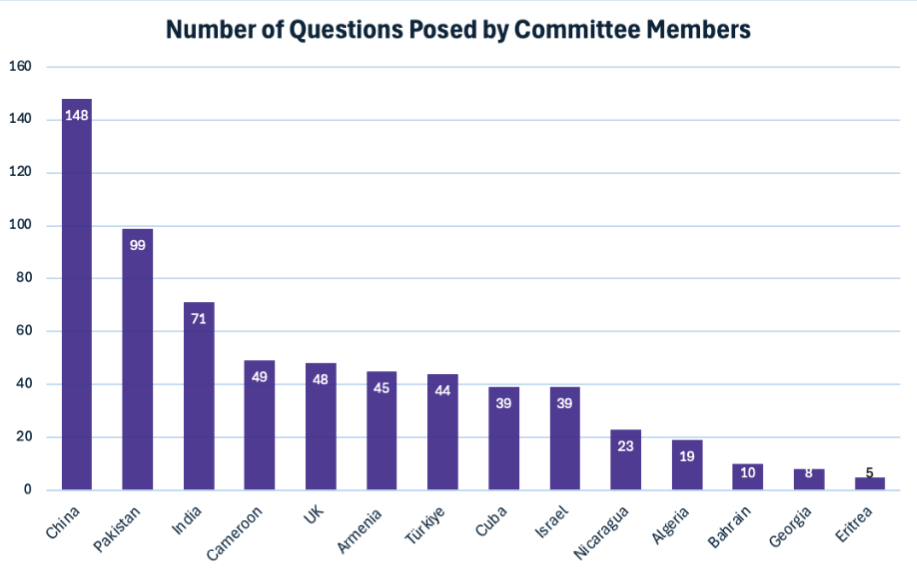
©ISHR (all figures based on ISHR’s in-person monitoring of sessions)
China, Pakistan and India together accounted for nearly 50% of questions posed to applicants by Committee members in this session, leading to deferrals in their requests for UN accreditation.
In a notable departure from past practice, the United States did not pose any questions to NGOs or actively participate in this session.