
@ISHR
Treaty Bodies | Strengthening treaty bodies, protecting human rights
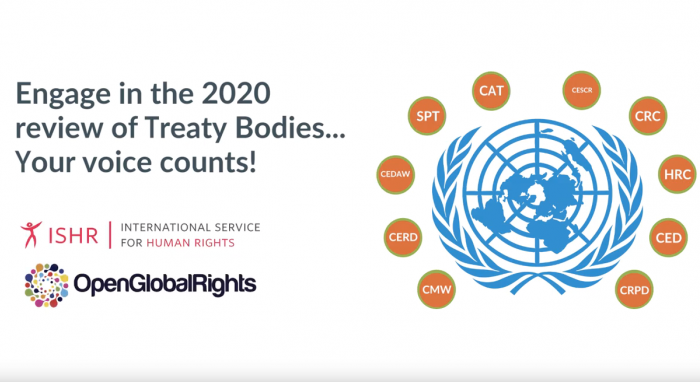
In 2020, the United Nations will review the functioning of the ten human rights treaty bodies. OpenGlobalRights and ISHR are publishing a series of op-eds to stimulate more discussion on ways to improve the work of the treaty bodies. Eleven of these op-eds are collated in a publication.
Download the publication here.
What challenges and solutions for improving the work of UN treaty bodies?
In 2020, the United Nations will review the functioning of the ten human rights treaty bodies. While the issue has received some attention from the academic community, there has been only limited interest from States and international NGOs, and very limited consultation of national and local actors. The treaty bodies are far from perfect, but they have contributed to far-reaching changes and improvements in human rights protection. For many victims of human rights violations, they continue to constitute a last hope for justice. Their improvement and effective functioning is critical to the global human rights movement.
In advance of the UN review, OpenGlobalRights and the International Service for Human Rights want to stimulate more discussion on ways to improve the work of the treaty bodies, by launching a series of op-eds addressing the following questions:
- What are the main challenges facing the treaty bodies?
- What innovations have been tried to meet these challenges?
- What more can be done?
- What examples are there of the impact of the treaty bodies, and what lessons emerge from such cases?
Watch our video and read the series of op-eds listed below!
Op-ed series: “Strengthening treaty bodies, protecting human rights: Views from the ground”
No more tinkering: real reform needed to UN human rights treaty monitoring – By Navi Pillay
UN treaty bodies advance LGBTI rights – By Kseniya Kirichenko
UN human rights system needs more coherence and coordination – By Marianna A. Romero
UN inefficiencies undermine effective handling of individual petitions – By Kamelia Kemileva
How a UN Committee contributed to end a controversial mining project in French Guiana – By Alexandre Sommer-Schaechtele
Following up: The key to seeing States act on treaty body recommendations – By Marcia V. J. Kran
The Committee System: 2020 and beyond – By Olivier de Frouville
How do treaty bodies respond to situations of crisis such as Burundi? – By Armel Niyongere
Small States face big challenges in engaging UN treaty bodies – By Malene Alleyne and Felix Kirchmeier
What difference does the UN human rights treaty system make, and why? – By Christof Heyns and Frans Viljoen
Improving domestic compliance with UN treaty body decisions – By Irina Crivet
Human rights victims’ complaints to UN not treated effectively – By Alexandre Skander Galand and Başak Çalı
Putting people at the heart of the human rights treaty body system – By Ashley Bowe and Joshua Cooper
Eleven of these articles are collated in a publication, download it here.