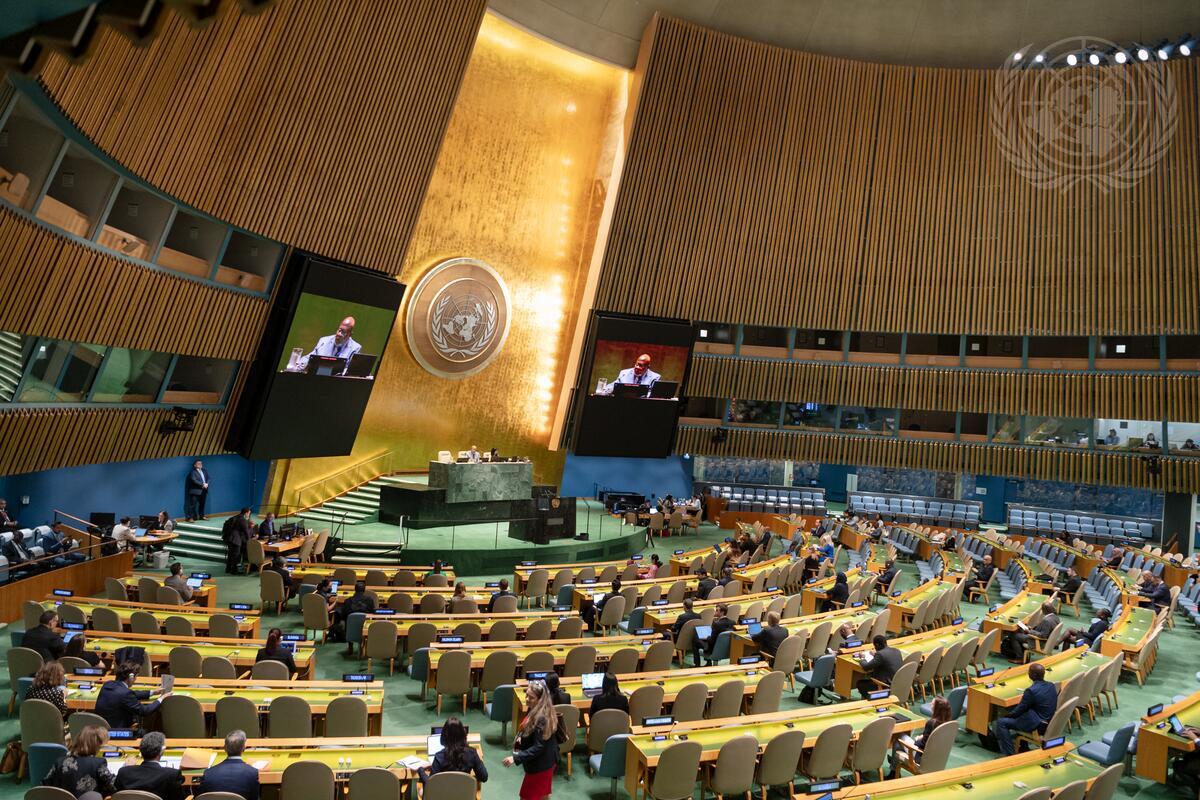
As States start negotiating a reduced budget for the United Nations (UN) in 2026, draft proposals pose a grave risk for the UN’s ability to respond to mounting global human rights crises. Delegations at the Fifth Committee – the General Assembly’s budgetary body in New York – now have little less than ten days to battle over the extent of budgetary cuts under the first stage of the UN80 Initiative, while human rights cuts risk exceeding the already significant reductions proposed by Secretary-General António Guterres in his September revised budget.
The UN’s regular budget, including that of the Office of the High Commissioner for Human Rights (OHCHR) is funded by Member States’ assessed contributions. Its allocation is decided by Member States at the Fifth Committee, on the basis of a budget proposal by the Secretary-General, and recommendations by the Advisory Committee on Administrative and Budgetary Questions (ACABQ), a little-known yet powerful committee that has historically targeted human rights budgets for further cuts.
While the revised Secretary-General proposal already hit the human rights pillar with a 15% reduction in budget (against 14.2% and 11.7% for the peace and security, and development pillars, respectively), ACABQ’s most recent report endorses the proposal, and recommends additional cuts that would exacerbate the reform’s outsized impact on human rights. ACABQ opposes the creation of 14 posts across OHCHR’s regional offices* while agreeing on two, recommending an overall 11% increase to the 105 posts the Secretary-General already proposed to abolish at OHCHR. The ACABQ proposal increases the total proposed post reductions to 117, representing 18% of OHCHR’s posts in 2025.
Additional cuts tabled by Russia, Belarus, and G77+China
In a recent version of the draft resolution on the proposed budget for 2026 seen by ISHR, Russia and Belarus have tabled extreme proposals that seek to defund human rights, and threaten consensus with a range of disruptive proposals – in keeping with patterns played out in previous budget negotiations as documented by ISHR. The draft resolution, which compiles all proposals by States, whether individually or in political groups, serves as the basis for closed-door negotiations between delegations in New York.
The European Union (EU), the United Kingdom (UK), Norway, Canada, Australia, New Zealand and Mexico – known as the ‘Like-Minded States’ in the Fifth Committee – endorse the Secretary-General’s revised budget proposals. An EU proposal objects to the additional cuts recommended by ACABQ, asking for the 23 targeted posts to be established.
The Russia-Belarus proposals oppose the creation of a new OHCHR office for Europe and Central Asia in Vienna and staff redeployments to regional offices closer to local realities, while requesting a ‘critical staffing review of all posts’ to ‘undertake additional cost-saving measures.’ They also aim to downgrade the role and position of the Assistant-Secretary-General for Human Rights in New York (who also leads efforts to prevent and address reprisals for cooperation with the UN), a move opposed by Western States.
Both countries also jointly seek to slash funding for 14 resolutions of the Human Rights Council (HRC) related to inquiries into human rights violations in Belarus, in Russia, and in Ukraine in the context of Russian aggression. This marks a departure from previous joint attempts to defund a larger group of country investigations.
Russia and Belarus recommended an additional cut to 20% of the non-post resources for human rights, while the G77+China – a group of 134 developing countries over which China wields great influence – put forward a smaller percentage of proposed additional reductions to several non-post resources in that budget section. The US has so far remained silent, although concerns remain about future possible public and private attempts to undermine human rights budgets.
In a positive development, a group of Latin American countries (Chile, Costa Rica, Dominican Republic, El Salvador, Uruguay) introduced a joint proposal outside the G77+China to endorse new budget requirements arising from HRC resolutions adopted this year.
In a separate document – known as the as HRC Revised estimates –, the Secretary-General outlines some additional requirements arising from HRC resolutions that were not anticipated in the original proposed budget. Through this document, the Secretary-General has requested an additional budget of USD 14.6 million – already reduced by 8.7% under UN80 efficiency efforts – that includes the creation of 25 posts for mandates on the rights of older persons, access to vaccines, rising sea levels, and economic, social and cultural rights. Out of the 25 posts requested, 14 are linked to the launch of an independent mechanism to investigate atrocities committed in Afghanistan, that States at the HRC adopted in a historic consensual resolution last September.
ACABQ has recommended a drastic reduction of 20% to the Secretary-General’s proposal, recommending that only on 13 of the 25 proposed posts, out of which 10 would be for the Afghanistan mechanism. In this and other reports, ACABQ also continues to recommend that posts be filled by temporary positions instead of permanent ones, weakening expertise retention within UN human rights bodies.
The draft resolution on the HRC Revised estimates has yet to be circulated among States for negotiation, and will need to be considered in addition to the draft resolution for the 2026 proposed budget.
ACABQ’s differential treatment for human rights
In contrast with the additional 11% in post cuts ACABQ recommends for human rights, it has recommended an overall 2.7% decrease in posts to be abolished in the development pillar, and no overall variation for peace and security. This gap corroborates ISHR’s assessment of ACABQ’s differential treatment between pillars over the past four years, during which cuts recommended to human rights reached 2-4%, while they never exceeded 0.6% for development.
In its report, ACABQ repeatedly invokes widely-supported human resources objectives of rejuvenation and equitable geographic distribution to justify recommendations against cutting entry-level posts – where youth and staff from Global South countries are more strongly represented – in development-related budget sections such as DESA and UNCTAD. However, it fails to apply the same reasoning to the human rights pillar, despite the fact that it faces the most severe reductions at junior levels: only 1.4% of the proposed cuts target positions at the ‘P5’ level or above, while this percentage reaches 10-20% for most other budget sections.
Similarly, ACABQ points to the risk that a high level of vacancies ‘disrupt the core of normative work’ of the European Commission for Europe and opposes post cuts to this development budget section, yet fails to oppose human rights post suppressions on similar grounds, despite acknowledging that 185 posts remain vacant at OHCHR (29% of existing posts). Scholars argue the report mistakenly treats vacant posts as ‘unused capacity and therefore as a savings indicator’, and not as structural ‘under-resourcing with potential risk for mandate delivery’, stressing the need to develop a methodology that accounts for the impact of vacancies on performance.
In its report, ACABQ indicates its awareness that 15% reductions ‘would affect the [OHCHR]’s operation capacity’ with the most affected areas being those ‘labour-intensive and reliant on specialised expertise, such as support to HRC mechanisms, investigative bodies, technical assistance [to States] and treaty body servicing.’
ISHR reported earlier on efforts by over 40 countries – in a joint statement led by Chile on 8 December in Geneva – to bring attention to the outsized impact of budget cuts and cash shortages on the UN’s human rights work, affecting key priorities for individuals and governments across all regions, including in the Global South.
Despite this, ACABQ worryingly concludes by stating it ‘trusts that OHCHR will adopt mitigation measures during the current financial situation to ensure mandate delivery within approved resources.’ This recommendation perpetuates a documented tendency of requiring OHCHR to absorb growing budget and capacity needs within existing resources, while States reduce their voluntary donations and allocate insufficient shares of the regular budget to fully implement new mandates.
Shifting approaches: from cost-saving to mandate delivery
One of the major shortcomings of current negotiations lies in the evaluation of budget or post cuts in terms of financial losses compared to the UN’s 2025 budget. Instead, ACABQ and States at the Fifth Committee should assess the impact of cuts on the UN’s ability to duly deliver on mandates, by comparing reductions against the organisation’s actual needs for 2026, which are best reflected by the Secretary-General’s original budget proposal before its September revision under UN80. A similar approach was underscored by States in the joint statement led by Chile in early December.
A growth in budget requirements does not happen in a vacuum. Instead, a shift from a cost-cutting mindset to one focused on strengthening mandate implementation requires also accounting for the growth in mandates when assessing each UN pillar’s capacity to deliver. While the human rights pillar’s share of the UN’s regular budget has increased slightly in recent years – still averaging only around 5% between 2021-2025 – this modest growth falls far short of the significant expansion of human rights mandates adopted by Member States in response to mounting global crises across all regions, including climate change, deepening inequalities, and the commission of war crimes and genocide. By contrast, other budget lines follow opposite trajectories, such as the UN’s Development Account, whose budget grew by 33% between 2019 and 2025 despite no corresponding change in mandate.
Because the human rights pillar already receives such a small share of the regular budget, even across-the-board cuts affect it far more severely. OHCHR starts from a dramatically smaller baseline: the same nominal reduction erodes a much larger share of functional capacity, and OHCHR has far less flexibility to absorb losses.
ISHR urges all States to:
-
- oppose budgetary cuts with a disproportionate impact on human rights (Section 24 of the regular budget). This includes opposing further cuts proposed by ACABQ, and limiting cuts in the Secretary-General’s revised budget to ensure equitable burden-sharing across pillars, taking into due consideration the structural fragility of the human rights pillar.
- adopt a mindset for UN80 reform that moves away from cost cutting and toward ensuring, and wherever possible strengthening, mandate implementation, including by using the original Secretary-General budget proposal for 2026 as a baseline to assess budget and post variations.
- launch a cross-regional coalition to defend the UN’s human rights pillar and ensure it is adequately funded to deliver on all its mandates. As an immediate step, endorse the joint statement led by Chile and similar initiatives, bring them to the attention of delegations at the Fifth Committee in New York.
- support UN Secretariat proposals to temporarily suspend the return of credits to Member States as of 2026, and for the full duration of the liquidity crisis.
- request that the Secretary-General clarifies the impact of vacancy on mandate implementation in the budget design for 2027.
* The ACABQ recommended against the establishment of 19 posts in the P and GS categories across regional offices, requesting 5 of them to be instead established as NPO posts (National Professional Officers).