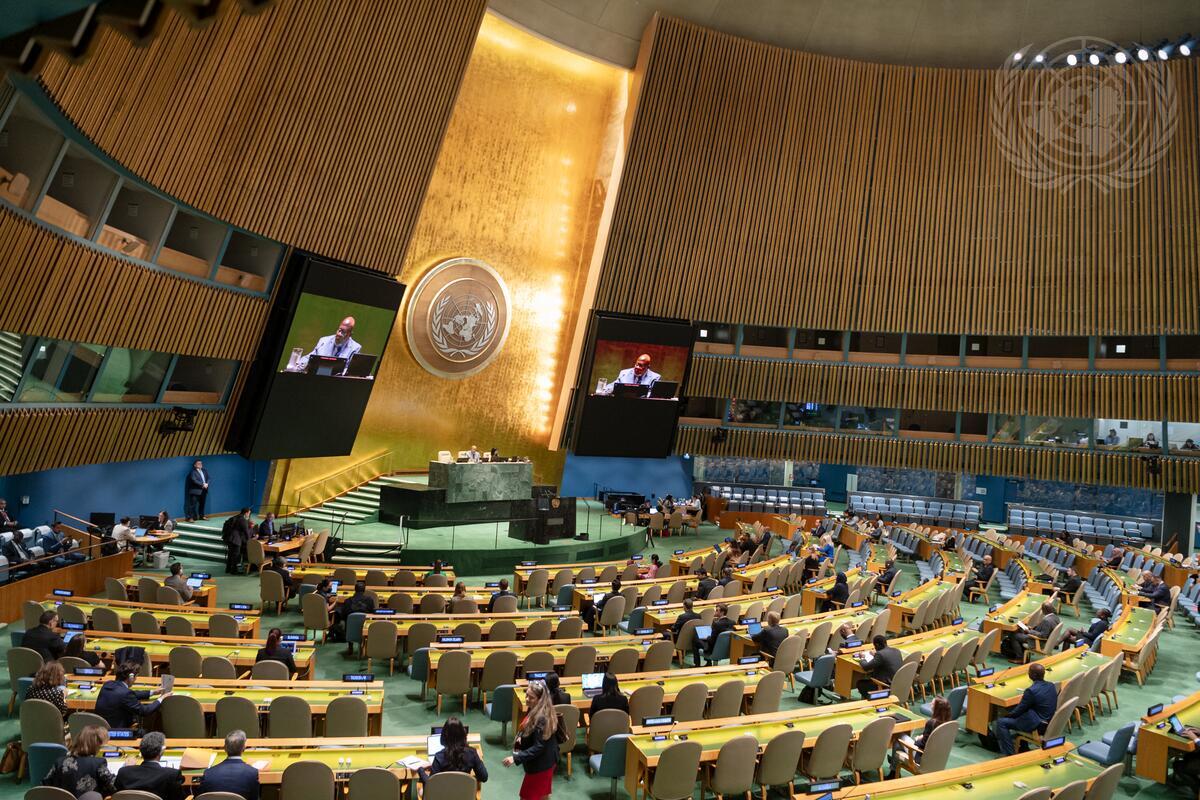
States at the UN General Assembly’s Fifth Committee (5C) – the UN’s main budgetary body – approved a budget for 2026, agreeing on significant budget cuts under the first stage of the UN80 Initiative process (also known as ‘Workstream 1’).
The resolution approving the UN’s 2026 budget largely endorses the recommendations of the Advisory Committee on Administrative and Budgetary Questions (ACABQ) – an advisory body to the Fifth Committee – which had endorsed and expanded upon a proposal made by Secretary-General Antonio Guterres in September to reflect efficiencies sought under UN80 reform.
The UN’s regular budget is funded by Member States’ assessed contributions. Its allocation is decided by Member States at the Fifth Committee, on the basis of a budget proposal by the Secretary-General, and recommendations by the ACABQ, a little-known yet powerful committee that regularly cuts human rights budgets.
The Secretary-General’s revised ‘UN80’ proposal released in September called for eliminating 105 posts at the Office of the High Commissioner for Human Rights (OHCHR) as part of a 15% reduction in its overall budget, compared to the original budget for 2026 released earlier in 2025. The ACABQ’s report, circulated in early December, endorsed the Secretary-General’s proposed cuts, and recommended a further 11% in post reductions at OHCHR, bringing the total cut to OHCHR posts to some 16.7% (117 posts). These further reductions deepen the reform’s disproportionate impact on the UN’s human rights pillar.
The Secretary-General’s proposed 15% cut to human rights spending was already higher than proposed cuts to the budgets allocated to development and peace and security (11.7% and 14.2% respectively), the other two ‘pillars’ of the UN’s mandate. While the ACABQ endorsed the proposed redeployment of 71 posts to OHCHR regional offices as part of the Office’s ‘regionalisation’ strategy to boost its presence on the ground, its cuts target posts proposed for establishment in the regional offices of Vienna, Beirut, Panama, Bangkok, Pretoria and Addis Ababa.
Nearly all the cuts in the 2026 budget are to posts that were vacant as a result of a hiring freeze prompted by the UN’s cash crisis, further eroding chances for these important human rights mandates to be implemented. Most vacancies relate to Human Rights Council (HRC) resolutions adopted in recent years, tabled by countries from all regions, covering diverse areas of economic, social, cultural, civil and political rights.
Unsuccessful cross-regional efforts to stave off ACABQ cuts
While the European Union (EU), the United Kingdom (UK), Norway, Canada, Australia, New Zealand and Mexico (known as the ‘Like-Minded’) tried to avoid the steeper ACABQ cuts and pushed for a human rights budget in line with the Secretary-General’s revised budget proposals, extreme proposals jointly tabled by Russia and Belarus during negotiations threatened consensus, ultimately forcing countries to come together around the ACABQ’s recommendations. This tactic is consistent with patterns played out in previous budget negotiations as documented by ISHR. A group of Latin American countries (Chile, Costa Rica, Dominican Republic, El Salvador, Honduras, Uruguay) tabled a joint proposal to endorse funding specifically for certain HRC resolutions at the level proposed by the Secretary-General, not the steeper ACABQ cuts. This is significant because these countries typically negotiate the main budget resolution within the G77+China – (a group of 134 developing countries over which China wields great influence). This year was the second time these countries succeeded in having a separate position, voicing support for human rights funding.
A separate budget resolution adopted by the Fifth Committee endorsed the ACABQ’s recommendations concerning the Secretary-General’s request for additional resources arising from HRC resolutions adopted in 2025 that were not anticipated in the original proposed budget (known as the HRC Revised Estimates). The ACABQ recommended a drastic reduction of 20% to the Secretary-General’s proposed additional appropriation of USD 14.6 million, approving only 13 of the 25 new posts requested. Of those approved posts, ten are dedicated to the establishment of an independent mechanism to investigate atrocities committed in Afghanistan, mandated by a historic consensus resolution adopted by States at the HRC last September.
In this additional resolution, a similar group of Latin American countries (The Bahamas, Chile, Costa Rica, Dominican Republic, Guatemala, Mexico, Uruguay) also endorsed funding for all these additional HRC resolutions at the level proposed by the Secretary-General, emphasising that ‘blanket reductions risk undermining mandate delivery.’ Even though these proposals did not carry the day, in a positive development, there were supported by new allies (Cabo Verde, Mauritius and the Maldives) from regions typically silent on human rights at the Fifth Committee. It appears these countries have taken into consideration that budget cuts would affect climate-change related human rights mandates, signaling growing Global South concern beyond Latin America over adequate resourcing of human rights budgets.
On the other hand, while the Like-Minded also sought to push back against ACABQ cuts, China tabled all proposals seeking to endorse and further deepen such cuts, while pushing to carve out rare exceptions to draconian cuts for the HRC’s resolutions on access to vaccines and economic, social and cultural rights – two initiatives co-led by China at the HRC.
Though the 2026 budget resolutions were ultimately adopted without a vote, a small group of States led by Russia and China once more tabled a motion seeking to fully defund 18 HRC resolutions related to investigations on human rights violations committed in Iran, North Korea, Sudan, Eritrea, Venezuela, Nicaragua, Belarus, Russia, and Ukraine (in the context of Russia’s aggression). These same States were behind this defunding initiative. Similar to previous years, the vote was defeated by large margin of 85 votes against to 14 in favour, with 48 States abstaining. States also voted down a yearly Cuban amendment to delete all references to the Special Adviser of the Secretary-General on the Responsibility to Protect. (Both vote records can be found here, and ISHR’s analysis of voting patterns on attempts to defund HRC mandates at the Fifth Committee here).
In closing remarks, Russia denounced funding such HRC resolutions, branding them ‘anti-Russian and anti-Belarusian.’ In contrast, the Ukrainian delegate emphasised that ‘the role of the Fifth Committee is to ensure adequate funding for the implementation of UN mandates, not to politicise or undermine mechanisms designed to uphold human rights.’ Russia and Cuba subsequently forced two other votes on the same proposals during the General Assembly’s consideration of the Fifth Committee resolutions, with a nearly identical vote outcome.
‘Band-aid’ alleviation of the UN’s liquidity crisis
Under UN financial rules, all contributions unspent by year-end must be returned to all Member States two years later, in the form of credits and proportionate to their share of the UN’s regular budget. While this rule exists to ensure that cash unspent due to efficiencies is returned, the reality is that cash is unspent because States are paying their dues too late to be spent, leaving the already cash-strapped organisation with an even smaller budget.
In a somewhat positive development, States agreed to suspend the return of unspent funds in the form of credits to Member States’ future payments, but only for those Member States in arrears on their payments. Returned funds will now be deducted from those States’ arrears, instead of as a credit to future payments.
Unfortunately, States failed to agree to suspending the return of unspent funds in times of liquidity crisis when such return would impair the UN’s ability to implement its approved budget, as repeatedly called for by the UN Secretariat. This would have prevented the UN from returning USD 300 million in 2026 (nearly 10% of its 2026 regular budget), largely resulting from China’s late payment on 27 December 2024.
The suspension of credit return to those in arrears will only result in reducing credits by 25%, per UN Secretariat estimates.
As of 30 December, only 151of the 193 UN Member States had paid their dues for 2025. On 1 December 2025, Secretary-General Guterres reminded the Fifth Committee that non-paying States had accumulated an ‘unacceptable volume of arrears’ totalling some USD 1.586 billion, 95% of which were owed by the United States. Taking into account the late payments by Russia and Argentina in early December, Mexico and Venezuela closed out the year with the largest amounts of unpaid contributions by year-end after the US, although in amounts that represent a small fraction of US arrears.
At the Fifth Committee, the Brazilian delegation underlined that ‘assessed contributions must be paid on time, in full and without conditions. Persistent arrears, particularly by major contributors, undermine predictability, rational planning and the orderly implementation of mandates [while] payments made only at the end of the financial year deprive the [UN] Secretariat of the ability to plan responsibly and place unnecessary strain on the organisation.’
The UN’s long-standing liquidity crisis exacerbates the impact of adopted budget cuts and chronic underfunding of the UN’s human rights pillar, which only received 87% of its budget allotment in 2024 and similar figure in 2025.
Minimal savings for an outsized human rights impact
While accounting for less than 10% of UN80 cost-saving efforts, the budget cuts approved will gravely jeopardise the UN’s ability to promote and protect human rights, given its historic underfunding and related understaffing.
In October, an ISHR report revealed how a small group of States, primarily led by China and Russia, have wielded enormous influence in recent years to coopt and disrupt budget proceedings at the ACABQ and Fifth Committee.
These States then systematically opposed funding for human rights work despite the UN’s long-standing underinvestment in the human rights pillar, which has only received an average of 5% of the regular budget since 2021.
On 8 December, over fourty States, led by Chile, voiced their concerns in a joint statement in Geneva over the ‘serious and systemic budgetary pressures affecting the human rights pillar.’ Their message echoed ISHR warnings stressing that, though cuts across all pillars appear similar, ‘in practice the impact is markedly disproportionate due to how resources are structured and executed within the human rights pillar, which is already the smallest and most overstretched.’
Approved budget cuts will further weaken UN human rights bodies, increasingly unable to fully deliver their functions. While inquiries on atrocities in the Democratic Republic of the Congo and in Palestine remain not fully operational, cuts to country visits by Special Rapporteurs and reduced sessions for human rights treaty committees have already reduced opportunities to engage with civil society and governments to revise laws and policies, and protect at-risk individuals.
Weakened support to the Global South
Chile’s joint statement stresses the impact of budget cuts for Global South countries, as a reduced OHCHR presence on the ground means fewer opportunities to document local realities and engage meaningfully.
The indefinite postponement of HRC-mandated mechanisms also affects key priorities for civil society and countries in the Global South, in areas as diverse as child digital safety, cyberbullying, domestic violence, adolescent pregnancies, law enforcement and peaceful protest, HIV response, the rights to work and social security in the informal sector, accessibility for persons with disabilities, and education as a tool to combat racism.
ISHR urges all States to:
-
- Launch a cross-regional coalition to defend the UN’s human rights pillar and ensure it is adequately funded to deliver on all its mandates.
- Oppose future disproportionate cuts to the human rights pillar, including by the ACABQ.
- Suspend the return of credits for the full duration of the liquidity crisis, including by adopting the methodology of the UN’s peacekeeping budget allowing for States to decide whether to receive, delay or offset credits.
- Pay assessed contributions in full and on time and call on the US and other States in arrears to do so.
- Increase voluntary, unearmarked contributions to OHCHR.