HRC 52: Council addresses attacks against Palestinian defenders, including deportation of Salah Hammouri
During the General Debate on item 7, ISHR, the Community Action Center – Al-Quds University, Al-Haq, and Women Centre for Legal Aid and Counselling addressed the escalation of Israeli laws and policies of forcible transfer targeting Palestinians on both sides of the Green Line.
The statement also focused on the deportation of human rights defender Salah Hammouri to France following Israel’s punitive revocation of his residency based on the illegal criterion of ‘breach of allegiance’ to Israel. This case opens the way for the escalation of transfer of Palestinians to further achieve demographic goals in Jerusalem.
The organisations urged the international community to call on Israel to revoke transfer laws and policies and to guarantee the return of forcibly displaced Palestinians as well as support accountability measures to put an end to decades of impunity.
During the session, several missions, including Chile, Ireland, and Mexico addressed Israel’s escalating attacks against civil society organisations as well as the targeting of defenders with arbitrary detention and unfounded terrorism charges. Luxembourg condemned the deportation of Salah Hammouri, while Namibia called on Israel to rescind ‘its punitive residency revocations, including that of Salah Hammouri’.
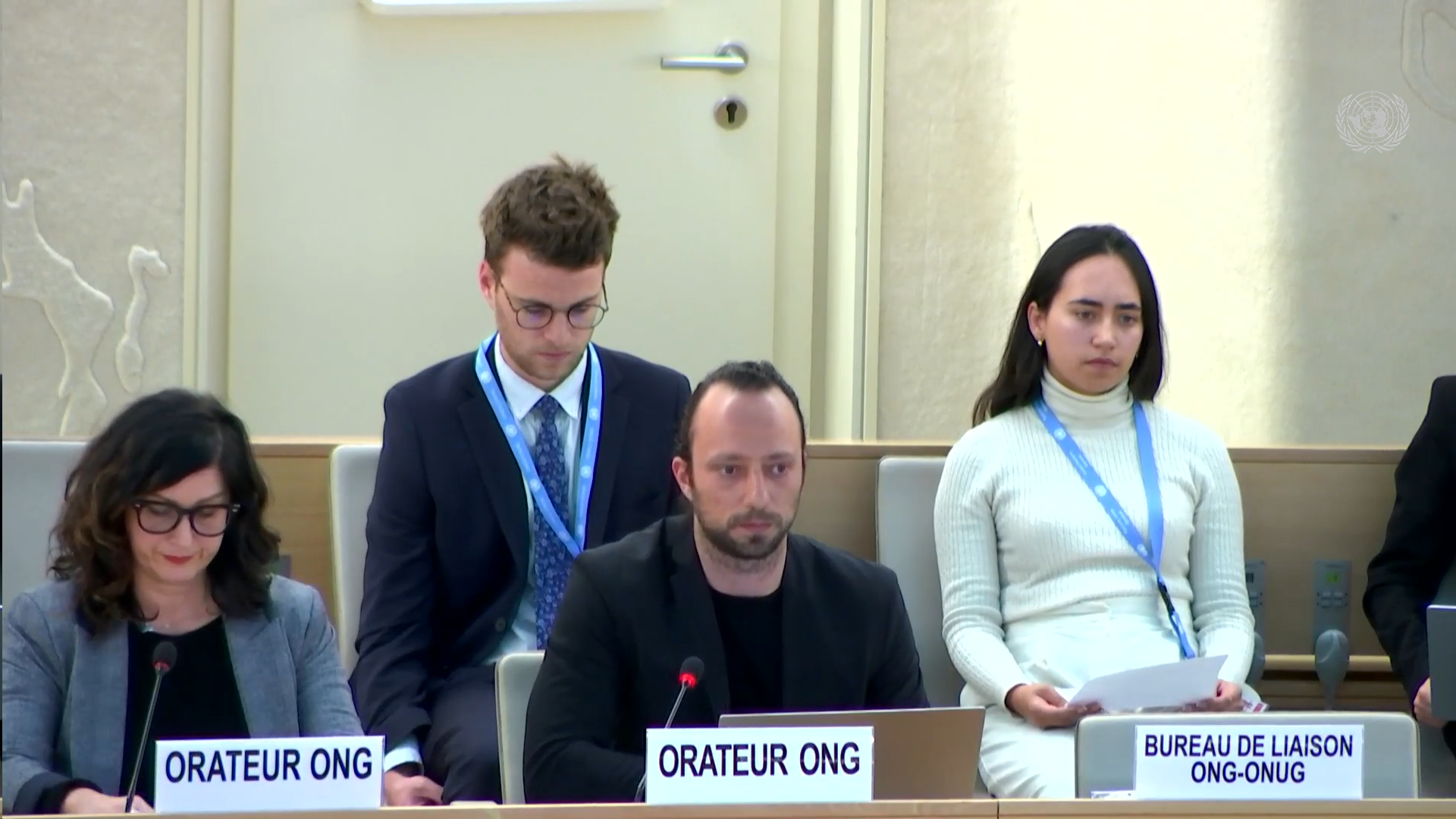
During the General Debate on Item 7, Moneer Marjeieh delivered a joint statement with ISHR. Read the statement and watch the video below:
Mr. President,
This is a joint statement.
On 19 February 2023, the Israeli Knesset passed a law expanding the criteria for the forcible transfer of Palestinian citizens and residents. The law empowers Israel to transfer Palestinians to the ‘Palestinian Authority-controlled areas’ following revocation of their residency or citizenship, based on their conviction for a so-called ‘act of terrorism’, their imprisonment, and the receipt of money from the Palestinian Authority.
This law, targeting Palestinians on both sides of the Green Line, is a clear example of Israel’s apartheid regime over the Palestinian people and the escalation in the transfer legislation aiming at changing the demography.
Israel has punitively revoked the residency of at least 15 Palestinians from Jerusalem based on a policy established in 2006, and the subsequent amendment of the law in 2018, providing the Israeli Minister of Interior the authority to revoke the residency status of Palestinians on the illegal and vague criterion of ‘breach of allegiance’.
To date, this led to the forcible transfer of 4 Palestinians to other areas of the West Bank outside Jerusalem, and the deportation of French-Palestinian human rights defender Salah Hammouri to France, leaving at least 10 individuals awaiting their transfer after completing lengthy prison sentences.
The deportation of Palestinians from Jerusalem constitutes a war crime and a crime against humanity as it is committed in a widespread and systematic manner.
The Israeli airline, El-Al, which allowed for the deportation of Salah Hammouri to France, in violation of international law, is also complicit in the crime committed by Israel.
We call on the international community to:
Call on Israel to revoke transfer laws and policies targeting Palestinians, and guarantee the return of forcibly displaced Palestinians to Jerusalem, including Salah Hammouri;
Support the CoI in investigating violations of international law to bridge the accountability gap and put an end to decades of impunity;
And ensure the annual updating of the UN database of businesses involved in Israel’s illegal settlement enterprise in line with resolution 31/36 to ensure transparency for business compliance with international law.
At the 89th session of the African Commission on Human and Peoples Rights, ISHR shared concerns about the situation of human rights defenders in Cameroon, Zambia and Guinea, especially in regards to the restrictive legal framework they work in and drew their attention to the state of civic space in Africa.
At the Human Rights Council's session, 47 States jointly denounced the dismantling of democracy in Nicaragua, while UN experts presented new evidence of systematic repression, enforced disappearance and deaths in State custody.
The Human Rights Council has renewed the mandate of the Special Rapporteur on Afghanistan for another year, maintaining dedicated scrutiny of the rights of women and girls. ISHR welcomes the renewal and calls on States to make sure the new Independent Investigative Mechanism for Afghanistan is up and running without delay.