This year, ISHR will be involved in three official sessions:
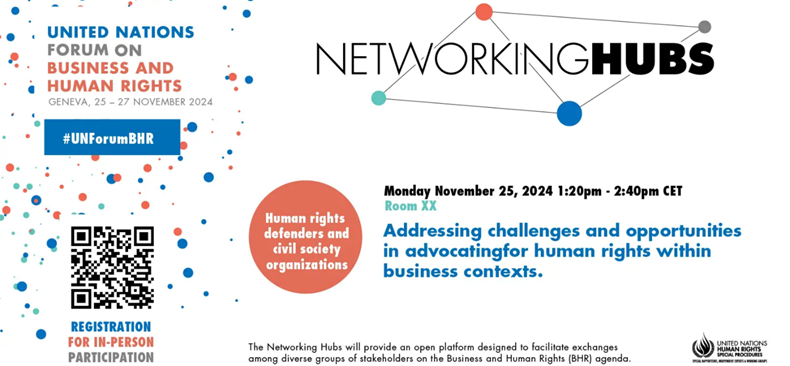
Networking hubs
Networking hubs: Human Rights Defenders & Civil Society Organisations
Monday 25 November 2024, 1:20pm – 2:40pm – Room XX
Download the flyer here.
This is a new space organised by ISHR and the Business and Human Rights Resource Centre. The Networking Hubs will provide an open platform designed to facilitate exchanges among diverse groups of stakeholders on the Business and Human Rights agenda. These spaces are structured to encourage autonomous, participant-led conversations without formal speakers or panelists, fostering a free-flowing exchange of experiences and perspectives. The aim is to create a collaborative peer learning space within stakeholders, where each stakeholder group can directly engage with one another, fostering meaningful dialogue. The format of these spaces leverages the networking essence of the Forum, offering a flexible and open environment for different stakeholder groups to share best practices, challenges, and innovative proposals.
Stakeholder groups: The Networking Hubs will focus on a range of pressing topics, including Human Rights Defenders & Civil Society Organisations: Addressing challenges and opportunities in advocating for human rights within business contexts.
Human rights defenders session
Have Smart Mix measures worked for (W)HRDs, Indigenous Peoples and Afro-descendant communities?
Monday 25 November 2024, 3:00pm – 4:20pm – Room XX
Download the flyer here.
This session will explore different policies and regulations, both globally and in the different regions and how they have proved effective or not in improving the situation for (W)HRDs, Indigenous Peoples, and Afro-descendent communities at risk, and what needs to be done.
It is a joint session developed with the UNWG and Zero Tolerance Initiative members and allies: Accion Ecologica, AFRILAW, Asia Indigenous Peoples Pact (AIPP), Business and Human Rights Resource Center, CEMSOJ, Forest Peoples Programme (FPP), Greater Whange Residents Trust, International Lawyers Project, International Service for Human Rights (ISHR), The Indigenous Peoples Rights International (IPRI), Jamaa Resource Initiatives, Marginalised Mirror, Peace Brigades International (PBI), Protection International, Star Kampuchea, Swedwatch and Talent des Femmes Rurales.
The key objectives of the sessions are:
- To explore if different policies, voluntary measures, and regulations in different regions have contributed to improving the situation for Indigenous Peoples, afro-descendent communities and (W)HRDs at risk.
- To reflect critically on the extent to which these smart mix initiatives have proved (in)effective, especially for rights-holders, and what would be the next steps that States and businesses need to implement to guarantee the protection of (W)HRDs.
How to participate?
In-person and online attendance are possible. Please register here.
Online racism and content moderation
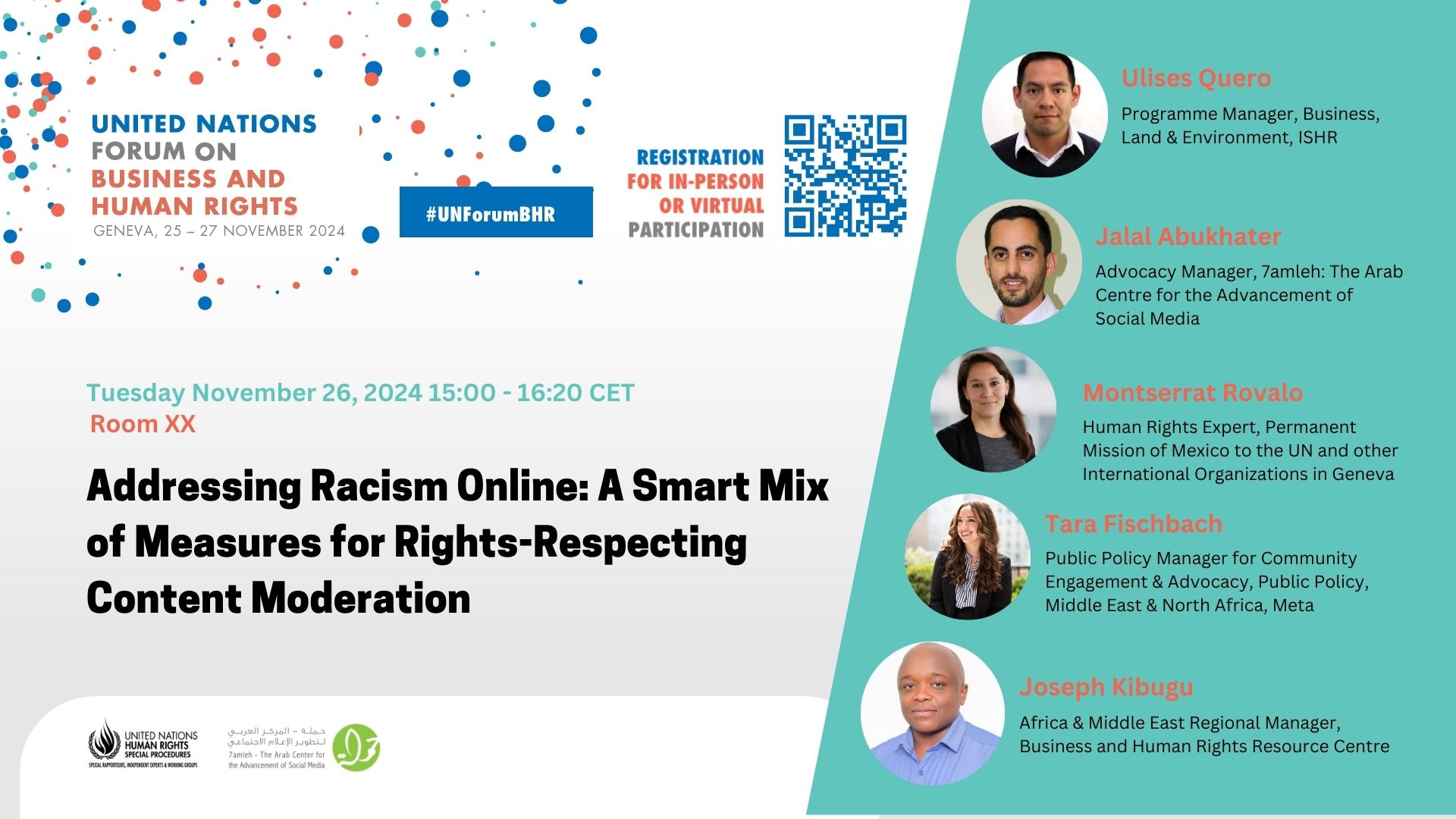
Addressing Racism Online: A Smart Mix of Measures for Rights-Respecting Content Moderation
Tuesday 26 November 2024, 3:00pm – 4:20pm – Room XX
Download the flyer here.
From user-facing platforms to humanitarian tools and services, the tech sector, and in particular social media, has an ever-increasing impact on individuals and groups in the most vulnerable situations, including people of African descent and communities of colour. The failure to address the dissemination of hatred that incites discrimination on social media seriously undermines the promise of business and human rights – that is to provide a framework to prevent and remedy abuses by businesses, including tech companies, of internationally recognised human rights. Where online content moderation systems fail to effectively detect such content, it can risk increasing incitement to violence, and can hinder the enjoyment of a variety of human rights online and offline, including the right to life, the right to physical integrity, the right to health, freedom from non-discrimination. As the Secretary General of the United Nations indicated in the organisation’s Strategy and Plan of Action on Hate Speech, hate speech is a menace to democratic values, social stability and peace.
The key objectives of the sessions are:
- To analyse current initiatives in the context of content moderation in relation to incitement to hatred and discrimination targeting people of African descent and ethnic and racial minorities on social media.
- To identify good practices and challenges, including a smart mix of measures to protect and respect human rights in the context of social media content moderation.
- To discuss concrete steps and actions that States, businesses, civil society organisations, and other stakeholders can and should take to implement the UNGPs for social media content moderation, and provide affected individuals and groups with effective access to remedy.
This session will be moderated by Ulises Quero, Business, Land & Environment Programme Manager at ISHR.