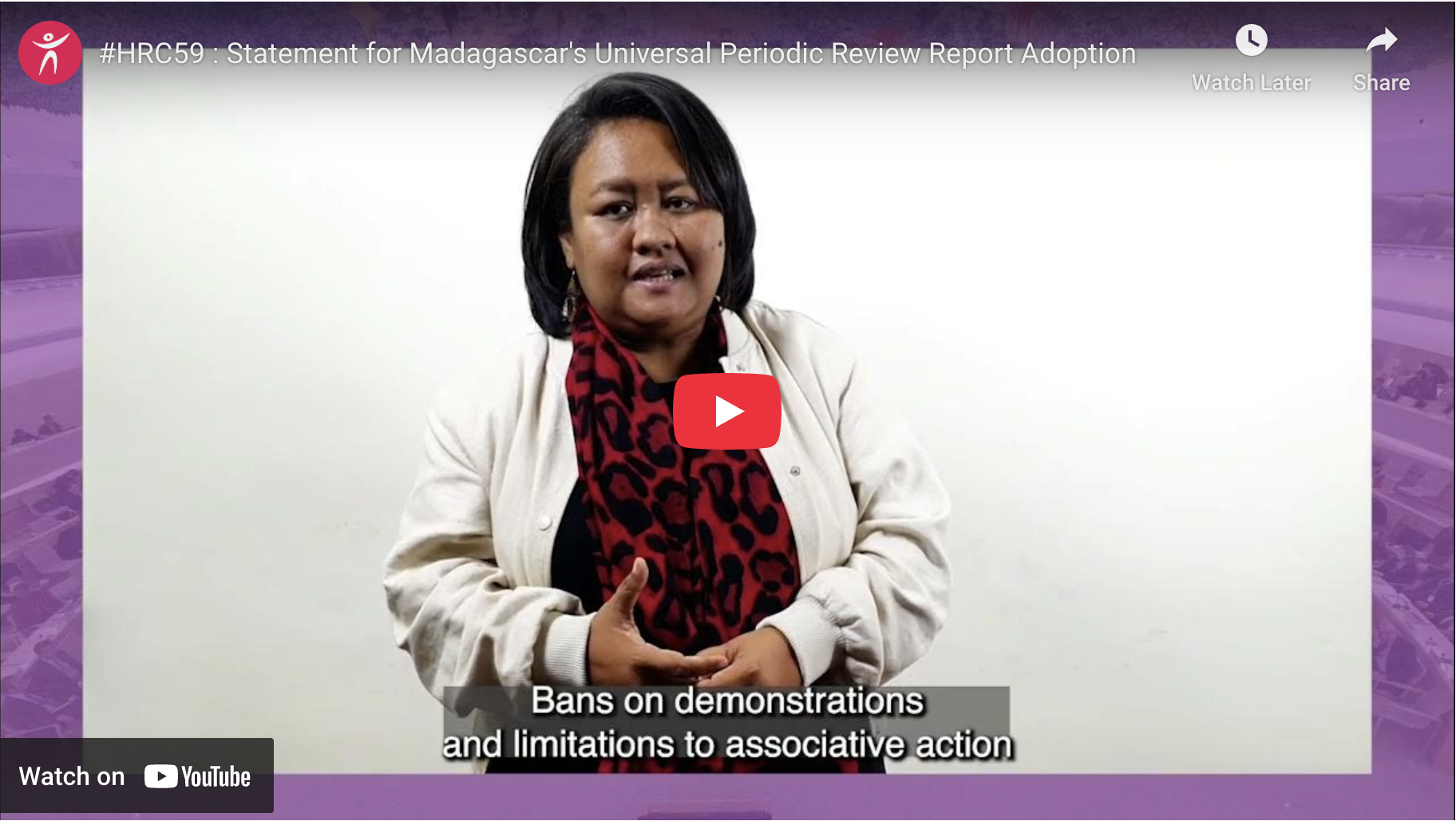
As part of Madagascar’s UPR report adoption meeting, ISHR submitted a video statement in partnership with Transparency International Madagascar. In this statement, ISHR called for strengthening the legislative protection of human rights defenders and whistleblowers in Madagascar through the adoption of a human rights defenders protection law.
The statement further called on Madagascar to protect civic space and put an end to restrictions on civil society. In particular, Madagascar should stop banning protests, in accordance with its international obligations regarding freedom of association and assembly.
Finally, Madagascar should guarantee the right to access to information and amend the Code de la communication and the Loi sur la cybercriminalité to ensure protection for freedom of expression and for journalists.
At its UPR, Madagascar received 235 recommendations from HRC Member States, accepting a total of 204 of them. During the UPR report adoption meeting, Madagascar highlighted in its statement its acceptance of recommendations relating, inter alia, to the protection of human rights defenders, journalists, and civil society actors, and to freedom of expression and freedom of assembly.
Watch the statement below:
Author
Antoine Tremblay
Antoine holds an LL.M. from Peking University, a Master of International Law from Université Panthéon-Assas, and a B.C.L. and J.D. from McGill University. He is a global citizen and young professional in human rights, development cooperation, and humanitarian action and supports the Africa programme at ISHR.
Following the report of the Special Rapporteur on the situation of human rights defenders to the Human Rights Council, ISHR commended her work, denounced human rights violations and encouraged the next mandate-holder to continue the effective work of the protecting defenders worldwide in collaboration with regional mechanisms.
The Human Rights Council President has proposed that States select Bolaños Vargas as the Special Rapporteur on human rights defenders by the end of the body’s ongoing 61st session.
In a stark setback for civil society at the UN, members of the Committee on NGOs moved to strip two organisations of their consultative status, with several more NGOs likely to face similar action in upcoming sessions.