
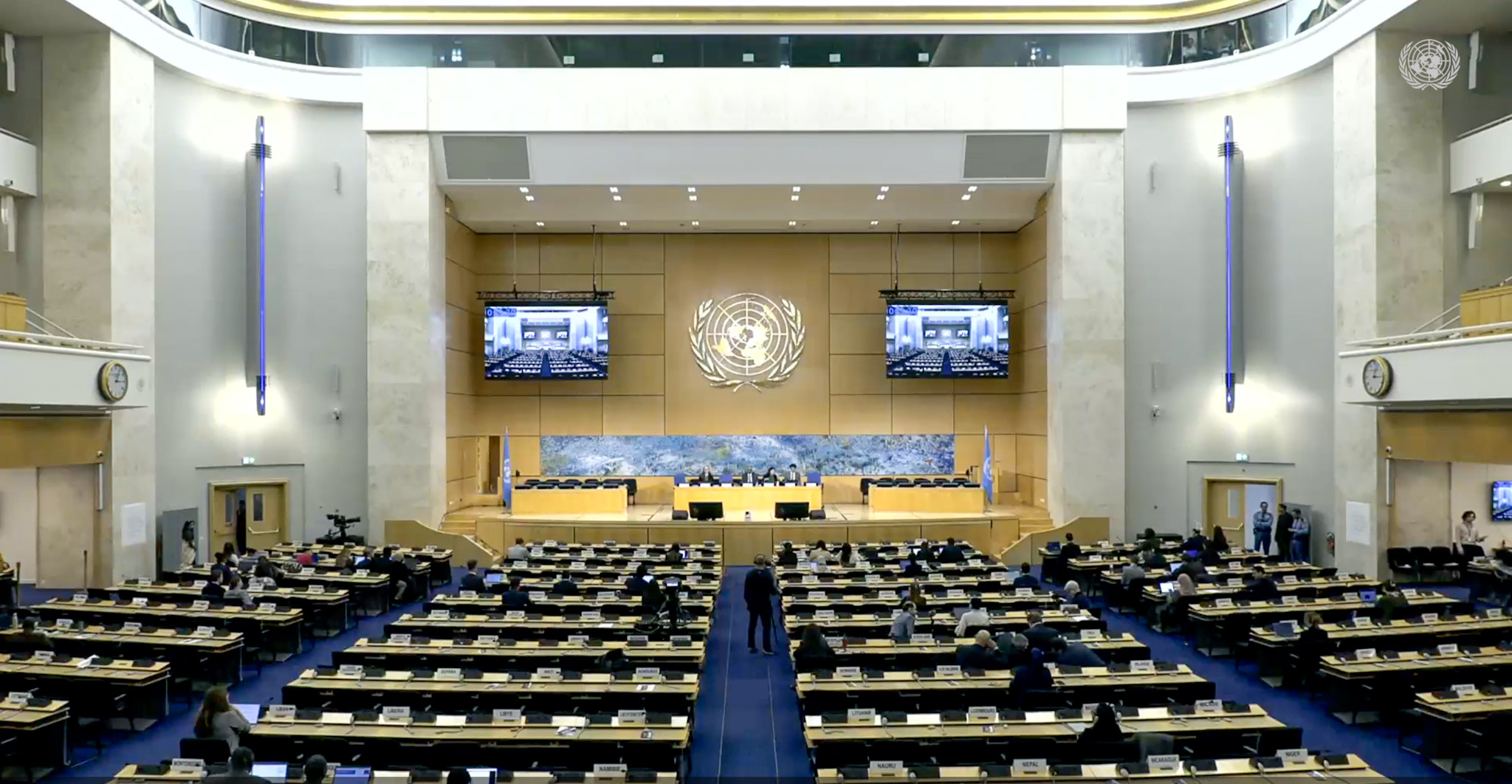
UNOG Assembly Hall © UN Web TV
HRC63: Key issues at the Human Rights Council in September 2026
This briefing highlights ISHR’s key priorities at HRC63, including safeguarding Special Procedures reporting, addressing reprisals and transnational repression, upholding the universality of the Universal Periodic Review, and advancing environmental and racial justice. It also identifies country situations requiring principled scrutiny and action, including Afghanistan, China, Israel and the Occupied Palestinian Territory, Sudan, Venezuela, Western Sahara and the United States. Particular attention is needed to renew key investigative and monitoring mandates on Sudan and Venezuela and to ensure meaningful civil society participation throughout the session.
The UN Human Rights Council will hold its 63rd regular session (HRC63) at the Palais des Nations in Geneva, from 7 September to 9 October 2026.
Stay up-to-date: Follow @ISHRglobal and #HRC63 on X and @ishr.ch on BlueSky, and look out for our Human Rights Monitor.
ISHR side event
ISHR and partner organisations will hold a side event on women human rights defenders working at the intersection of gender, climate and conflict on 24 September 2026 at 1:00pm in Room XI.
The event will take place during Women Human Rights Defenders Advocacy Week, which brings together women human rights defenders and organisations from different regions to strengthen solidarity, exchange experiences, engage with UN mechanisms and reflect on feminist advocacy practices.
ISHR thematic priorities
Special Procedures and their reporting to the General Assembly
Between HRC60 and HRC62, a significant number of Special Procedures mandates had the frequency of their reporting to the General Assembly reduced. At HRC61 and HRC62, half of the mandates renewed at each session were affected. These changes are expected to result in 17 fewer reports to the General Assembly across its 81st, 82nd and 83rd sessions: five fewer in 2026, seven in 2027 and five in 2028. States from the Western Europe and Others Group (WEOG) have led these reductions, often through cross-regional initiatives involving one or more WEOG members. Overall, around one in four thematic Special Procedures mandates with General Assembly reporting obligations has already been affected.
ISHR is concerned that reductions could weaken oversight, visibility and political attention to critical human rights issues. ISHR has developed guiding questions to help ensure that efforts to streamline, rationalise or review the Council and its mechanisms remain consistent with Resolution 5/1 and do not inadvertently weaken human rights protection. States should ensure that any streamlining or review of Council mechanisms remains consistent with Resolution 5/1 and does not weaken human rights protection.
Reprisals
Reprisals against those who cooperate with the UN remain a serious concern, including reprisals that extend across borders or target defenders’ families. ISHR’s latest #EndReprisals campaign highlights Anna Kwok from Hong Kong; Basma Mostafa from Egypt; and Burundian human rights lawyers Armel Niyongere, Dieudonné Bashirahishize, Vital Nshimirimana and Lambert Nigarura, who have all faced transnational repression linked to their human rights work and engagement with the UN.
During the interactive dialogue on the Secretary-General’s report on cooperation with the UN, States should raise cases by name, condemn transnational repression and acts of reprisals against defenders and their families; urge the governments concerned to carry out investigations, ensure accountability and provide remedies; and continue following up on cases until the reprisals have ended and defenders can engage safely with the UN.
Racial justice
Marking the 25th anniversary of the Durban Declaration and Programme of Action (DDPA), ISHR calls for the renewal and adequate resourcing of the mandate of the Working Group of Experts on People of African Descent (WGEPAD). We also welcome the report of the International Independent Expert Mechanism to Advance Racial Justice and Equality in Law Enforcement (EMLER) on systemic racism against Africans and people of African descent in the enforcement of drug laws and policies and on its May 2026 visit to Colombia.
States should also support the resolution ‘From rhetoric to reality: a global call for concrete action against racism, racial discrimination, xenophobia and related intolerance’ and build on the momentum generated by General Assembly resolution adopted in March 2026, which recognises the Transatlantic Slave Trade as the gravest crime against humanity. States should use this momentum to advance reparatory justice, including in the design, implementation and enforcement of drug policies and the administration of migration.
Right to a clean, healthy and sustainable environment
HRC63 marks the fifth anniversary of the Council’s recognition of the right to a clean, healthy and sustainable environment (R2HE), a major advancement in international human rights law for the effective protection of the environment and those who protect the planet. Since then, the R2HE has been increasingly reflected across UN and regional human rights mechanisms, including two landmark advisory opinions by the International Court of Justice and the Inter-American Court for Human Rights.
A fifth-anniversary stocktaking event will take place on 24 September from 12:00pm to 1:00pm in Room Concordia 1.
States should continue advancing the R2HE as a cross-cutting issue in Council negotiations and dialogues, including the recognition of the vital role of environmental human rights defenders. At HRC63, States should also support the renewal of the mandates of the Special Rapporteur on toxics and human rights and the Working Group on peasants.
Non-cooperation at the UPR
As the fourth cycle of the Universal Periodic Review concludes in early 2027, States should act to defend the mechanism’s universality and integrity following the non-cooperation of Nicaragua and the United States.
States should raise persistent non-cooperation during the general debate under Item 6 and support a dedicated Council debate or session on States that refuse to participate in the Universal Periodic Review and the human rights situations in those countries.
Human Rights Council elections
Elections for Human Rights Council membership for the 2027–2029 term will take place at the UN General Assembly in October. Council members are expected to uphold the highest standards in the promotion and protection of human rights and cooperate fully with the Council and its mechanisms.
ISHR has published scorecards assessing candidates against objective human rights criteria. On 3 September from 3:00pm to 5:30pm CEST, ISHR and Amnesty International will hold an online pledging event at which candidate States can present their vision for Council membership and respond to questions from civil society and other stakeholders.
ISHR calls on candidate States to make voluntary pledges to improve the human rights situation both at home and abroad and to strengthen their cooperation with the Council and its mechanisms. We also call on all Member States to cast informed votes and support only candidates that uphold the highest standards in the promotion and protection of human rights and cooperate fully with the UN human rights system. Regional groups should also nominate more candidates than the number of available seats to ensure genuinely competitive elections to the Council.
Country-specific priorities
Afghanistan
ISHR calls on States to renew the mandate of the Special Rapporteur on Afghanistan, as the mandate remains indispensable for sustained monitoring, and reporting of ongoing rights violations. In parallel, the newly established independent investigative mechanism must be provided with adequate financial, technical, and political support to begin its work. Adequate staffing and resources are essential to enable the effective collection, preservation, and analysis of evidence. The mechanism will be integral in assessing gender persecution and considering emerging norms under international law, including the crime of gender apartheid.
China
Four years after the release of the Office of the High Commissioner’s Xinjiang report, States should call for meaningful follow-up, including a substantive update from the High Commissioner on implementation. States should also urge Thailand not to return human rights defender Bai Zhaodong to China, call for the immediate and unconditional release of individuals arbitrarily detained for exercising their rights by naming cases directly, including recently convicted Hong Kong human rights defenders Chow Hang Tung and Lee Cheuk Yan, as well as Gao Zhen, Ding Jiaxi, Xu Zhiyong, and Gulshan Abbas; and urge China to take urgent steps to suspend implementation of the Law on Promoting Ethnic Unity and Progress, and to either repeal the law or amend it to ensure full compliance with international human rights standards.
Occupied Palestinian Territory & Israel
UN Special Procedures have condemned the escalation of attacks against Palestinian civilians in Gaza and the West Bank, stressing that ‘States that aid or assist Israel – politically, militarily or financially – in maintaining this unlawful situation are themselves in breach of international law.’
At HRC63, the Council will consider OHCHR’s report updating the database on businesses in Israeli settlements in the Occupied Palestinian Territory, mandated by HRC Resolutions 31/36 (2016) and 53/25 (2023). Following its long overdue release in 2020, the database was updated in 2023 and 2025.
As the Special Rapporteur on OPT demonstrated in her HRC59 report ‘From economy of occupation to economy of genocide’, which exposes the central role of corporate and financial actors in perpetuating Israel’s economy of occupation, dispossession, and violence, there is a prima facie responsibility on every State and corporate entity to completely abstain from or end their relationships with this economy of occupation. The Special Rapporteur reiterated that, at this stage, Israel cannot be treated as a normal business partner: Israel as a State pursues colonial settlements, illegal occupation, exploits Palestinian resources, maintains a system of apartheid and is accused of genocide, war crimes and crimes against humanity.
ISHR reiterates the call to States to support the expansion of the scope of the mandate of the UN database of businesses involved with Israel’s settlement enterprise to include all companies and entities that are involved in, profiting from or advancing Israel’s colonial apartheid on both sides of the Green Line. ISHR also reiterates the Special Rapporteur’s call for businesses to promptly cease all business activities and terminate relationships directly linked with, contributing to and causing human rights violations and international crimes against the Palestinian people.
Occupied Western Sahara
As documented in the civil society report, the human rights situation in occupied Western Sahara has continued to deteriorate, including in the targeting of Sahrawi human rights defenders through arbitrary detention, harassment, surveillance, physical and psychological abuse, and sexual violence.
In April 2026, the Committee against Torture adopted decisions on the cases of of Sahrawi human rights defenders Abdelmoula El Hafidi, Naâma Asfari and several other members of the Gdeim Izik group, finding that Morocco had violated the Convention against Torture.
The Council should call for unhindered access to Western Sahara for OHCHR and Special Procedures; urge Morocco to uphold fundamental freedoms, release all arbitrarily detained individuals, guarantee fair trial standards, end reprisals and intimidation against Sahrawi defenders, and ensure their safe engagement with UN mechanisms.
Sudan
In the last six months, the arrest campaigns against civilians and human rights defenders have intensified. The fragmented security landscape has resulted in the division of Sudan into territories controlled by multiple armed groups, each operating across different regions. SUWRA documented civic space attacks by all warring parties, including a common pattern where activists and civilians are blackmailed into silence and pressured to pay ransoms to secure their release or obtain improved detention conditions. SudanDefenders documented a nationwide pattern of arbitrary detention, enforced disappearances, torture, intimidation, politically motivated prosecutions and targeted killings of human rights defenders including women human rights defenders, journalists, lawyers, and aid workers.
At HRC63, the Council will consider the renewal of the Fact-Finding Mission on Sudan (FFM). Given the worsening environment for human rights defenders, its renewal is more urgent than ever, as it is the only international independent mechanism able to monitor, document, and bring visibility to the violations occurring on the ground. The Council should also urge armed groups to cease the crackdown on civic space, respect the rights to freedom of expression, association, and peaceful assembly, and call for protection measures for at‑risk groups.
United States of America
ISHR is concerned about the deteriorating human rights situation and erosion of the rule of law in the United States, as well as its commission of, or complicity in, grave violations abroad, including in Iran, Venezuela, Palestine, and the Caribbean and Pacific. The Trump Administration’s refusal to participate in the Universal Periodic Review (UPR) undermines peer-to-peer dialogue on pressing human rights concerns of all countries, and should be condemned by the Council.
In light of extensive evidence of violations at home and abroad, ISHR urges increased monitoring, reporting and scrutiny of the United States by Special Procedures and the High Commissioner, including through an inter-sessional briefing. We also urge States to address the situation, both through individual and joint statements, under appropriate Council agenda items, and through questions submitted in advance of the UPR of the US scheduled for November. If the US and other States continue to refuse to cooperate with the UPR, ISHR urges States to support the convening of a dedicated debate or session on persistent non-cooperation with the UPR and the human rights situations in countries which refuse to cooperate.
Venezuela
The mandates of the Fact-Finding Mission (FFM) on Venezuela and OHCHR expire in September 2026. The FFM remains the only independent UN investigative mechanism mandated to examine serious human rights violations and support accountability, while OHCHR provides monitoring and technical assistance.
ISHR and partners are campaigning for the Human Rights Council to renew in full both mandates under Item 4 for a further two years, maintaining the existing reporting and updated timelines.
The renewal of these mandates is important for three reasons: (1) The abduction and removal of President Nicolás Maduro has not contributed to addressing atrocity crimes: individuals, institutions, security structures and legal frameworks enabling international crimes remain in place; (2) International scrutiny matters now: the FFM can distinguish genuine reform from cosmetic change, provide early warnings of renewed repression and incentivise authorities to commit to meaningful reform; (3) The FFM and OHCHR are complementary: together they can document abuses committed in Venezuela, prevent further violations and put an end to impunity so a democratic transition can happen in the country.
ISHR urges States to support the full renewal of both mandates.
Adoption of Universal Periodic Review reports
At HRC63, the Council will adopt UPR outcomes for Belgium, Denmark, Estonia, Latvia, Mozambique, Namibia, Nicaragua, Niger, Palau, Paraguay, Seychelles, Sierra Leone, Singapore, Solomon Islands, and Somalia.
States should pay particular attention to recommendations outlined in ISHR’s briefing papers on Niger, Seychelles, and Sierra Leone.
Civil society guide to the 63rd session of the Human Rights Council
The session will include updates by the UN High Commissioner for Human Rights, interactive dialogues with mandate holders, panel discussions, adoption of UPR outcomes, consideration of resolutions, and the appointment of new mandate holders.
NGOs in consultative status with ECOSOC may deliver oral statements in person or by pre-recorded video during interactive dialogues, general debates and panel discussions. Guidance on accreditation and participation is available on the NGO participation information page.
Useful links:
- HRC63 webpage – official information of the session
- HRC Portal – oral statements and meeting documents (HRC Portal is replacing HRC Extranet; see the presentation of the HRC Portal here)
- HRC63 Sched – meeting calendar updated daily with meeting times
- UN Web TV – live and archived webcasts of all public meetings
Presentations of the High Commissioner for Human Rights and OHCHR
The High Commissioner will present an oral update on 7 September and OHCHR will also present separate updates and reports under relevant agenda items, including on El Obeid (North Kordofan, Sudan), Myanmar, Sri Lanka, Nicaragua, Ukraine, Haiti, the Democratic Republic of the Congo, Somalia, Yemen and the Marshall Islands, as well as the OHCHR report updating the database of business enterprises involved in specified activities related to Israeli settlements in the Occupied Palestinian Territory. Some of these will be presentations only, while others will be followed by interactive or enhanced interactive dialogues.
Other country-specific presentations include an oral update by the Group of Human Rights Experts on Nicaragua and an oral update by the Independent International Commission of Inquiry on the Syrian Arab Republic. These are not scheduled to be followed by separate interactive dialogues.
OHCHR will also present thematic reports of particular relevance to civil society, including on protecting human rights defenders in the digital age, the impact of strategic lawsuits against public participation on human rights, and practical recommendations for creating and maintaining a safe and enabling environment for civil society.
Civil society organisations may follow developments through these updates and deliver oral statements where general debates or interactive dialogues follow.
Interactive dialogues
Interactive dialogues are formal meetings between the Council and independent human rights experts or the High Commissioner. Reports or updates are presented, followed by oral statements from States and NGOs. See the full list of reports here.
The Council will hold the following thematic interactive dialogues:
- Interactive dialogue with the Independent Expert on the promotion of a democratic and equitable international order
- Interactive dialogue with the Special Rapporteur on the negative impact of unilateral coercive measures on the enjoyment of human rights
- Interactive dialogue with the Independent Expert on the enjoyment of all human rights by older persons
- Interactive dialogue with the Special Rapporteur on contemporary forms of slavery and trafficking in persons
- Interactive dialogue with the Special Rapporteur on the right to development
- Interactive dialogue with the Expert Mechanism on the Right to Development
- Interactive dialogue with the Special Rapporteur on the implications for human rights of the environmentally sound management and disposal of hazardous substances and wastes
- Interactive dialogue with the Special Rapporteur on the human rights to safe drinking water and sanitation
- Interactive dialogue with the Working Group on the use of mercenaries as a means of violating human rights and impeding the exercise of the right of peoples to self-determination
- Interactive dialogue with the Special Rapporteur on the promotion of truth, justice, reparation and guarantees of non-recurrence
- Interactive dialogue with the Working Group on enforced or involuntary disappearances
- Interactive dialogue with the Working Group on arbitrary detention
- Interactive dialogue with the Working Group on the rights of peasants and other people working in rural areas
- Interactive dialogue on the Secretary-General’s report on actionable pathways for mobilising sufficient climate financing
- Interactive dialogue on the High Commissioner’s analytical report on the human rights of women and children in conflict and post-conflict situations, with the participation of the Special Rapporteur on the promotion of truth, justice, reparation and guarantees of non-recurrence
- Interactive dialogue with the Special Rapporteur on the rights of Indigenous Peoples
- Interactive dialogue with the Expert Mechanism on the Rights of Indigenous Peoples
- Interactive dialogue on the Secretary-General’s report on cooperation with the United Nations, its representatives and mechanisms in the field of human rights
- Interactive dialogue with the Human Rights Council Advisory Committee
- Enhanced interactive dialogue with the United Nations High Commissioner for Human Rights and the International Independent Expert Mechanism to Advance Racial Justice and Equality in Law Enforcement
- Interactive dialogue with the Working Group of Experts on People of African Descent
- Interactive dialogue on the report of the Permanent Forum on People of African Descent
The Council will address country situations through the following interactive dialogues:
- Interactive dialogue with the Independent International Fact-Finding Mission for Sudan
- Enhanced interactive dialogue on the reports of the High Commissioner and the Independent Investigative Mechanism for Myanmar
- Interactive dialogue with the Special Rapporteur on the situation of human rights in Afghanistan
- Interactive dialogue with the Group of Independent Experts on the Human Rights Situation in Belarus
- Interactive dialogue with the Special Rapporteur on the situation of human rights in Burundi
- Interactive dialogue with the Independent International Fact-Finding Mission on the Bolivarian Republic of Venezuela
- Interactive dialogue on the report of the High Commissioner on the situation of human rights in Nicaragua
- Interactive dialogue with the Special Rapporteur on the situation of human rights in the Russian Federation
- Interactive dialogue with the Independent International Commission of Inquiry on Ukraine
- Interactive dialogue on the report of the Independent International Fact-Finding Mission on the Islamic Republic of Iran
- Interactive dialogue on the oral update of the High Commissioner on the situation of human rights in Haiti, with the participation of the independent human rights expert
- Interactive dialogue with the Independent Expert on the situation of human rights in the Central African Republic
- Enhanced interactive dialogue on the OHCHR report on challenges and barriers to the full realisation of the human rights of the people of the Marshall Islands stemming from the State’s nuclear legacy
- Interactive dialogue on the OHCHR report on technical assistance and capacity-building to improve the human rights situation in Somalia
- Interactive dialogue with the Special Rapporteur on the situation of human rights in Cambodia
- Interactive dialogue on the oral update of the High Commissioner on the situation of human rights in Ukraine
- Enhanced interactive dialogue on the report of the High Commissioner on the situation of human rights in the Democratic Republic of the Congo
Panel discussions
Panel discussions bring together experts, States and civil society to discuss specific themes. Six panel discussions are scheduled for this session:
- Panel discussion on progress, challenges and opportunities in promoting and protecting economic, social and cultural rights within the context of addressing inequalities
- Biennial panel discussion on the right to development
Theme: ‘Commemoration of the fortieth anniversary of the Declaration on the Right to Development’ - High-level panel discussion on the fifteenth anniversary of the United Nations Declaration on Human Rights Education and Training: good practices, challenges and the way forward
- High-level panel discussion on the sixtieth anniversary of the International Covenants on Human Rights: universality, indivisibility, interdependence and interrelatedness of all human rights
- Annual panel discussion on the rights of Indigenous Peoples
Theme: ‘Convention for the Protection of the World Cultural and Natural Heritage: Indigenous Peoples’ rights and engagement’ - Annual discussion on the integration of a gender perspective throughout the work of the Human Rights Council and that of its mechanisms
Theme: ‘From gender stereotypes to structural discrimination: strengthening the Human Rights Council’s response’
Adoption of UPR reports
The Council will adopt the Universal Periodic Review (UPR) working group reports on Belgium, Denmark, Estonia, Latvia, Mozambique, Namibia, Nicaragua, Niger, Palau, Paraguay, Seychelles, Sierra Leone, Singapore, Solomon Islands, and Somalia
Civil society organisations may monitor which recommendations are accepted and use them to support follow-up advocacy at national level.
Resolutions
States negotiate and adopt resolutions and decisions throughout the session. These may address thematic issues, country situations, technical assistance, or the creation or renewal of mandates.
At the organisational meeting on 24 August, the following resolutions were announced (States leading the resolution in brackets). Additional resolutions may also be presented during the session.
- Promoting accessibility for the full enjoyment of all human rights by all (China, Cameroon, Honduras, Pakistan, Türkiye)
- Responding to the human rights and humanitarian crisis caused by the ongoing armed conflict in the Sudan (United Kingdom, Germany, Ireland, Netherlands, Norway)
- Mandate of the Independent Expert on the promotion of a democratic and equitable international order (Cuba)
- Use of mercenaries as a means of violating human rights and impeding the exercise of the right of peoples to self-determination (Cuba)
- Enhancing equal access of children to adequate nutritious food (Indonesia)
- Mandate of the Special Rapporteur on the implications for human rights of the environmentally sound management and disposal of hazardous substances and wastes (Kenya on behalf of the African Group)
- Mandate of the open-ended intergovernmental working group to elaborate the content of an international regulatory framework on the regulation, monitoring and oversight of the activities of private military and security companies (Kenya on behalf of the African Group)
- Mandate of the Working Group of Experts on People of African Descent (Kenya on behalf of the African Group)
- From rhetoric to reality: a global call for concrete action against racism, racial discrimination, xenophobia and related intolerance (Kenya on behalf of the African Group)
- Technical assistance and capacity-building in the field of human rights in the Central African Republic (Kenya on behalf of the African Group)
- Youth and human rights (El Salvador, Côte d’Ivoire, Egypt, France, Greece, Italy, Morocco, Philippines, Portugal, Republic of Moldova, Romania, Tunisia, Uzbekistan)
- Implications of artificial intelligence for the promotion and protection of human rights (Bangladesh, Egypt, Nepal)
- Human rights and Indigenous Peoples (Guatemala, Mexico)
- Human rights and unilateral coercive measures (Uganda on behalf of the Movement of Non-Aligned Countries)
- The right to development (Uganda on behalf of the Movement of Non-Aligned Countries)
- Terrorism and human rights (Egypt, Mexico – announced that they are undergoing consultations, to be confirmed)
- Human rights of migrants (Mexico)
- Technical assistance and capacity-building to address the human rights implications of the nuclear legacy in the Marshall Islands (Marshall Islands, Federated States of Micronesia, Fiji, Nauru, Papua New Guinea, Samoa, Vanuatu)
- The impact of anti-personnel mines on the full enjoyment of all human rights: strengthening victim assistance (Algeria, Mozambique, Peru, South Africa, Vanuatu)
- Technical assistance and capacity-building in the field of human rights in the Democratic Republic of the Congo (Democratic Republic of the Congo)
- Technical assistance and capacity-building for Yemen in the field of human rights (Sudan on behalf of the Group of Arab States)
- Situation of human rights in Afghanistan (European Union)
- Situation of human rights in Burundi (European Union)
- Situation of human rights in the Russian Federation (European Union)
- The role of good governance in the promotion and protection of human rights (Poland, Australia, Chile, Republic of Korea, South Africa)
- Mandate of the Special Rapporteur on the promotion of truth, justice, reparation and guarantees of non-recurrence (Switzerland, Morocco)
- Human rights and transitional justice (Switzerland, Morocco)
- National human rights institutions (Australia, Timor-Leste)
- Situation of human rights in the Bolivarian Republic of Venezuela (Chile, Argentina, Canada, Ecuador, Guatemala, Paraguay, Uruguay)
- Strengthening international cooperation for promoting and protecting the rights of women and girls in the context of digital technologies (Armenia)
- Countering cyberbullying (Argentina on behalf of core group)
- The human rights to safe drinking water and sanitation (Spain, Germany)
- Enforced or involuntary disappearances (France, Argentina, Japan, Morocco)
Civil society organisations may follow draft texts and negotiations, share recommendations with delegations, advocate on language and priorities and monitor the adoption of resolutions. Adopted resolutions can support advocacy at national and international levels.
Appointment of mandate holders
At this session, appointments are expected for the following seven vacancies:
- Special Rapporteur on the human rights to safe drinking water and sanitation
- Special Rapporteur on the situation of human rights in Eritrea
- Working Group on Arbitrary Detention, member from African States
- Working Group on Arbitrary Detention, member from Latin American and Caribbean States
- Working Group on discrimination against women and girls, member from Latin American and Caribbean States
- Working Group on Enforced or Involuntary Disappearances, member from African States
- Working Group on the use of mercenaries as a means of violating human rights and impeding the exercise of the right of peoples to self-determination, member from Asia-Pacific States
Civil society may review shortlisted candidates and engage with newly appointed mandate holders once confirmed. Early outreach can help establish working relationships and share priority concerns to shape future reporting, communications, and country visits.
Read here the three-year programme of work of the Council with supplementary information.