For the second time in as many months, a UN rights review of South Korea will provide an opportunity to address structural challenges to protecting human rights in the context of business activities. South Korea will be reviewed under the Human Rights Council’s Universal Periodic Review process this week, having been reviewed by the UN’s expert Committee on Economic, Social and Cultural Rights in September.
‘In September, the UN Committee on Economic, Social and Cultural Rights issued very clear recommendations to Korea on business and human rights and the protection of human rights defenders,’ said Sarah M Brooks, ISHR Asia advocate.
‘It is clear that the Korean government – and Korean companies – are increasingly going to be challenged on their “anything goes” approach to outbound investment and overseas operations, both by national and international civil society and by UN human rights experts’, Brooks added.
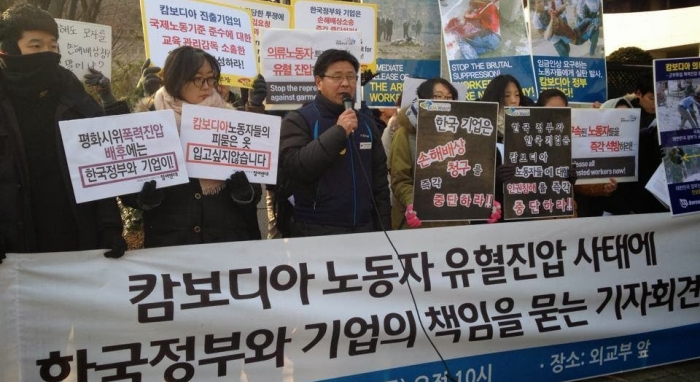
A report to the UN expert committee by ISHR and KTNC Watch, a network based in Seoul focused on addressing the human rights impacts of South Korean companies operating overseas, made a range of recommendations. Many of these were echoed in the Committee’s report after the review, which asked the Government of Korea to address issues linked to corporate accountability.
They specifically called for the development and implementation of a section on Business and Human Rights in the National Human Rights Action Plan that would
- introduce a legal obligation for due diligence by Korean companies to prevent or mitigate their negative human rights impacts
- ensure victims of violations resulting from Korean companies’ activities have access to remedy through judicial and non-judicial mechanisms
- link public procurement and loan provision to respect for human rights
- enhance the impact, transparency, inclusiveness and effectiveness of the OECD National Contact Point (NCP)
Hyun Phil Na, the director of Korea House for International Solidarity (KHIS) and lead drafter on the report for KTNC Watch, said:
‘Traditionally, the Korean government has not had good communication with civil society through the treaty process. This time, at least, the National Human Rights Commission of Korea cooperated with civil society to ensure their reports were complementary’.
Hyun continued, ‘With the current government, we are optimistic about the reform of the NCP. Not only is the National Human Rights Commission working to prepare some recommendations to change it, but also we feel that the government is aware of the criticism and interested in doing something about it’.
Concerns around the environment for human rights defenders domestically were also central to the Committee’s findings, including:
- limits on freedom of association for workers and harassment of unions and their leaders
- lack of protections for whistleblowers, especially related to corruption
- poor labour conditions in agriculture and fisheries and
- high court fees impeding access to remedy.
Whether focused on the actions of companies overseas, or business and human rights issues at home, Brooks points out that additional attention to the issues by South Korea’s bilateral partners during the Universal Periodic Review next week could strengthen that resolve.
‘The review this week is a chance for States to reinforce the recommendations made by UN experts, giving more weight to them and generating leverage for the Korean government to take action,’ she says.
Hyun agrees and emphasises that mainstreaming of business and human rights is important in Korean society.
‘The Korean government announced soon after the Committee’s review that they would hold a hearing on the National Action Plan process.
‘However,’ he concludes, ‘civil society still has some doubts this will happen. One of the biggest challenges, even with this new government, is political will’.
For more information, please contact Sarah at s.brooks[at]ishr.ch.
Photo credit: KTNC Watch, via Labour Bulletin.