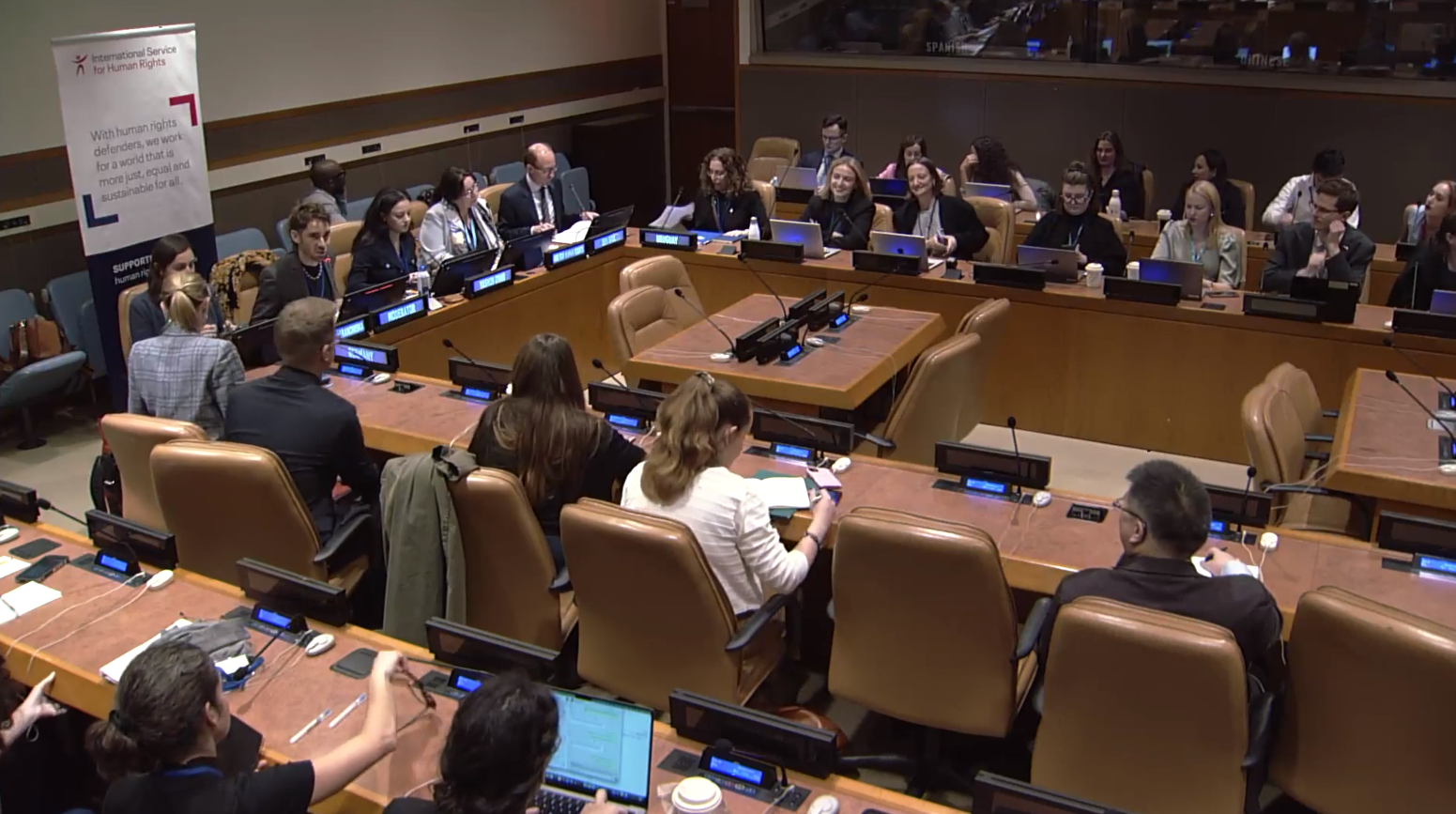
On 20 October, ISHR organised with the UN Working Group on Enforced or Involuntary Disappearances (WGEID) a side event ‘Addressing transnational repression (TNR) and reprisals for cooperation with the United Nations’ at the UN Headquarters in New York. The event was co-sponsored by the Permanent Missions of Germany, Uruguay, Ireland and Estonia, and took place on the margins of the Third Committee of the 81st session of the General Assembly. It is available on UN WebTV.
This first-ever event during the General Assembly brought together UN experts, diplomats, and human rights defenders to discuss the global phenomenon of TNR, its interplay with acts of intimidation and reprisals against those who cooperate with the UN, and the obligations of States in relation to prevention, protection and accountability.
The discussion centred on the joint statement issued on 23 September by more than 130 UN human rights experts, calling for global action to tackle TNR as a growing, direct challenge to the international human rights system and the principles of the UN Charter. The statement draws a roadmap for the international community, clarifying the obligations of States under international law, and setting out concrete steps to be taken by States, businesses, INTERPOL and international organisations.
Speakers emphasised the following points:
-
- Yasmin Omar, an Egyptian human rights lawyer in exile, described acts of TNR from lived experience: from threats, surveillance, denial of passports, to pressure on relatives and host States acting on terrorism allegations from the perpetrator State. She urged better coordination across law enforcement, immigration and judicial bodies, with safe, confidential reporting that does not endanger victims on the basis of their migration status, and increased scrutiny of extradition requests, INTERPOL notices and terrorism allegations while ensuring non-refoulement.
- Claudia Fuentes Julio, Assistant Secretary-General for Human Rights and senior representative on reprisals, explained how TNR and reprisals overlap in nexus, prevalence, targets, methods and chilling effect. She called for better training of officials to detect TNR and apply a human rights-based approach to cybercrime and internet governance, including controls on exports of intrusive cyber tools. She also urged keeping the spotlight on cases through quiet and public diplomacy, and addressing reprisals as a whole-of-UN issue, including at the Security Council.
- Ben Saul, UN Special Rapporteur on counter-terrorism, outlined five ways counter-terrorism tools are abused for TNR: abusive terrorist and extremist listings, extradition requests, forced return of refugees, surveillance technology, and informal cross-border information sharing. He recommended avoiding automatic recognition of foreign terrorist lists, and increasing scrutiny of extradition requests and INTERPOL notices, while regulating surveillance technologies and corporate actors. He also urged strengthening safeguards on informal data-sharing, and imposing real costs on perpetrators, such as Magnitsky-style sanctions.
- Grażyna Baranowska, Chair of the Working Group on Enforced or Involuntary Disappearances, pointed to three forms that enforced disappearance takes the form of TNR: when carried out abroad, when targeting relatives left at home, and after extradition or refoulement. She urged States to take every risk of enforced disappearance seriously before any return, and assess the protection needs of family members, including family reunification, while supporting families’ searches and regulating the legal status of disappeared persons.
In opening remarks, Ambassador Laura Dupuy Lasserre, Permanent Representative of Uruguay, framed reprisals and TNR as threats to the UN’s ability to function, noting the joint statement on reprisals led by Ireland and Uruguay and backed 59 States and the European Union (EU), that made explicit the link between reprisals and TNR. In closing the event, Ambassador Florian Laudi, Deputy Permanent Representative of Germany, underscored the importance of cross-regional alliances in both Geneva and New York, the key role played by AI, and the need to put victims at the centre of responses.
When TNR targets those cooperating with the UN
The event also exposed the growing interlinkage between acts of reprisals and TNR, often committed in a systematic manner by the same State perpetrators. In the September joint statement, the UN experts stress that TNR targeting people who cooperate, seek to cooperate or are perceived as cooperating with the UN constitutes intimidation or reprisals, placing the issue squarely within the UN’s own ‘zero tolerance’ commitments.
The Secretary-General’s 2026 annual report on reprisals documents how closely the two issues are linked. Of the 32 States cited, 15 are cited for acts of reprisals that constitute TNR, affecting at least 43 individuals and four organisations across regions. In a Human Rights Council dialogue on the report in September, ten States took the floor to highlight individual cases facing reprisals for their cooperation with the UN, from Russia, China and Vietnam, to Cuba, Nicaragua, Burundi and Belarus.
Initial momentum at the General Assembly’s Third Committee
Building on the UN experts’ joint statement, a range of delegations pointed to the growing global threat of TNR in relevant dialogues at the Third Committee, including the EU, Ireland, the United Kingdom, Australia, Norway, Canada, Germany, Belgium, Poland, Uruguay and Bangladesh.
This concern was shared by the Special Rapporteurs on counter-terrorism, on the independence of judges and lawyers, on human rights defenders, and by the Assistant Secretary-General, in their respective dialogues with the Committee. It was also raised by Special Rapporteurs and investigative bodies on the situations in Iran, Nicaragua, Russia, Belarus and Eritrea.
During the Committee’s exchange with the Special Rapporteur on human rights defenders, Switzerland further stressed the importance of the UN experts’ joint statement and the need to ‘mobilise all relevant stakeholders to translate its principles into concrete and coordination action’.
In the first-ever such move at the General Assembly, Member States also adopted a landmark resolution on human rights defenders in the digital age which ‘expresses grave concern at repressive activities conducted abroad by States to harm, silence, coerce, harass and intimidate human rights defenders through digital, physical and other means, including through the misuse of spyware and other intrusive surveillance software.’ The text, adopted by a vote of 167 in favour, 4 against and 8 abstentions, calls upon States to ‘refrain from and cease such activities that violate human rights, to adopt effective measures to prevent, investigate and address violations and abuses, to protect affected individuals and groups, and to ensure accountability and access to an effective remedy.’