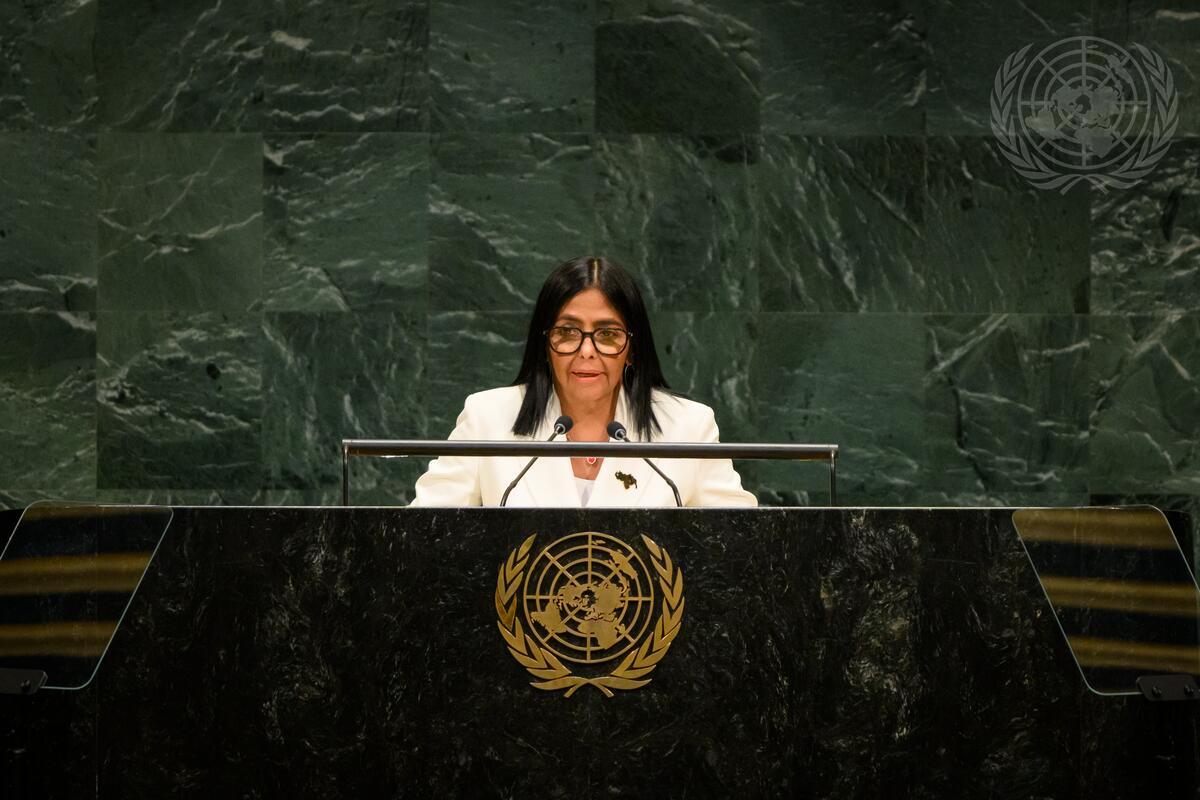
The resolution was adopted 6 October with 25 votes in favour, 5 against and 17 abstentions, successfully renewing both mandates under their original conditions and for a further two years.
Speaking on behalf of the resolution’s main sponsors, Chile’s representative said the resolution recognised the recent changes in Venezuela were ‘partial, conditional and reversible’, and that a renewed mandate for UN mechanisms was needed to support victims of human rights violations. Japan and Estonia also took the floor to support the resolution, with the latter expressing concern for the continued repression of political actors and human rights defenders.
Cuba and China spoke to oppose the text, both equating to ‘interference’. The Chinese delegation called for a vote. For their part, Venezuela’s representatives ‘took note’ of the resolution.
The final vote also showed a growing concern across regions, with two additional African States – Mauritius and Côte d’Ivoire – supporting the renewal.
In 2019, the Human Rights Council established the Fact-Finding Mission (FFM) on Venezuela to assess alleged human rights violations committed in the country since 2014. The mechanism is the only independent United Nations monitoring body with the mandate to investigate systematic violations and human rights abuses, and ensure accountability for perpetrators in Venezuela.
The resolution also extended for a further two years the mandate of the Office of the United Nations High Commissioner for Human Rights (OHCHR) to provide technical assistance, monitor the human rights situation in the country and to prevent further violations.
Both the FFM and the OHCHR mandates play distinctive yet complementary roles in documenting abuses in Venezuela and informing the international community, providing early warnings of renewed repression and maintaining pressure necessary to incentivise change.
Alongside Venezuela and international civil society organisations, ISHR campaigned for this renewal.
The resolution comes nine months after an unlawful military intervention by the United States removed Nicolás Maduro from power, prompting civil society to outline ten urgent demands for a genuine democratic transition and meaningful human rights change.
Yet, in its September report to the Human Rights Council, the FFM found that the country’s ‘repressive apparatus remains intact’ despite ‘limited improvements’, with ‘institutions responsible for repression, gross human rights violations and crimes against humanity’ largely untouched.
ISHR calls on all UN Member States to support the FFM and OHCHR mandates on Venezuela and to push for their full, safe and independent access to Venezuelan territory.