The Chinese government has made extensive use of its membership of UN human rights bodies and soared the presence of Chinese GONGOs to deter and prevent independent NGOs and human rights defenders from engaging with the UN and to retaliate against those who do so, ISHR found in a new report published today.
The report, ‘A healthy society should have more than one voice’, documents China’s sustained efforts since 2018 to restrict the space for independent civil society within the UN human rights system, including the Human Rights Council (HRC), the Special Procedures, the Treaty Bodies and the Universal Periodic Review (UPR). Interviews and extensive data compiled by ISHR point to the widespread use of deferrals of NGO applications at the UN Committee on NGOs, the exponential surge of Chinese GONGOs at the HRC and during China’s UPR and Treaty Body reviews, the weaponisation of procedural tactics to silence NGO speakers and prevent engagement with diplomats, and patterns of intimidation and reprisals committed against those seeking to cooperate with the UN, inside and outside UN premises.
The report has been featured prominently in a global investigation by the International Consortium of Investigative Journalists (ICIJ) also released today, and in major outlets including The Guardian, Le Monde, El País, The Washington Post, La Tribune de Genève and Tamedia.
Human rights defenders and civil society organisations are essential contributors to global human rights, sustainable development, and democratic accountability. Their participation at the UN provides critical expertise, strengthens international responses to human rights violations, and gives voice to victims and affected communities.
Under President Xi Jinping, the Chinese Party-State has severely restricted civil society space domestically, while expanding its global influence, seeking to reshape global discourse on human rights and silence dissenting voices. The UN, in particular its Geneva-based human rights bodies, is one of the last remaining avenues for Chinese human rights defenders to advocate, document, testify and raise concerns.
In its 57-page report, ISHR found that the Chinese government has led efforts seeking to prevent independent NGOs from getting accredited to the UN, accessing UN premises, speaking at the HRC or meeting diplomats. Beijing has further systematically retaliated against those engaging with UN human rights bodies, and sought to reduce the limited space for independent civil society groups. The report’s key findings include that:
- China remains the top obstructionist member of the UN Committee on NGOs, where it makes extensive use of questions to NGO applicants for consultative status, automatically triggering the deferral of the application. Over 2020-2024, 18% (747) of the total of questions to NGO applicants have been posed by China, with a surge of 28% in 2024. China has contributed to the long-term deferral of at least 15 NGO applicants whose applications have been protracted for eight years or more. China systematically blocks applications from NGOs that use ‘incorrect’ terminology on Taiwan, Hong Kong, Macau, or Tibet. Jointly with like-minded members of the so-called ‘Group of Friends of the UN Charter,’ China defers applications from NGOs working on ‘sensitive’ human rights concerns, impacting a wide range of human rights groups in the West and the Global South across all thematic areas, in particular organisations from countries whose governments have various degrees of political affinity with Beijing.
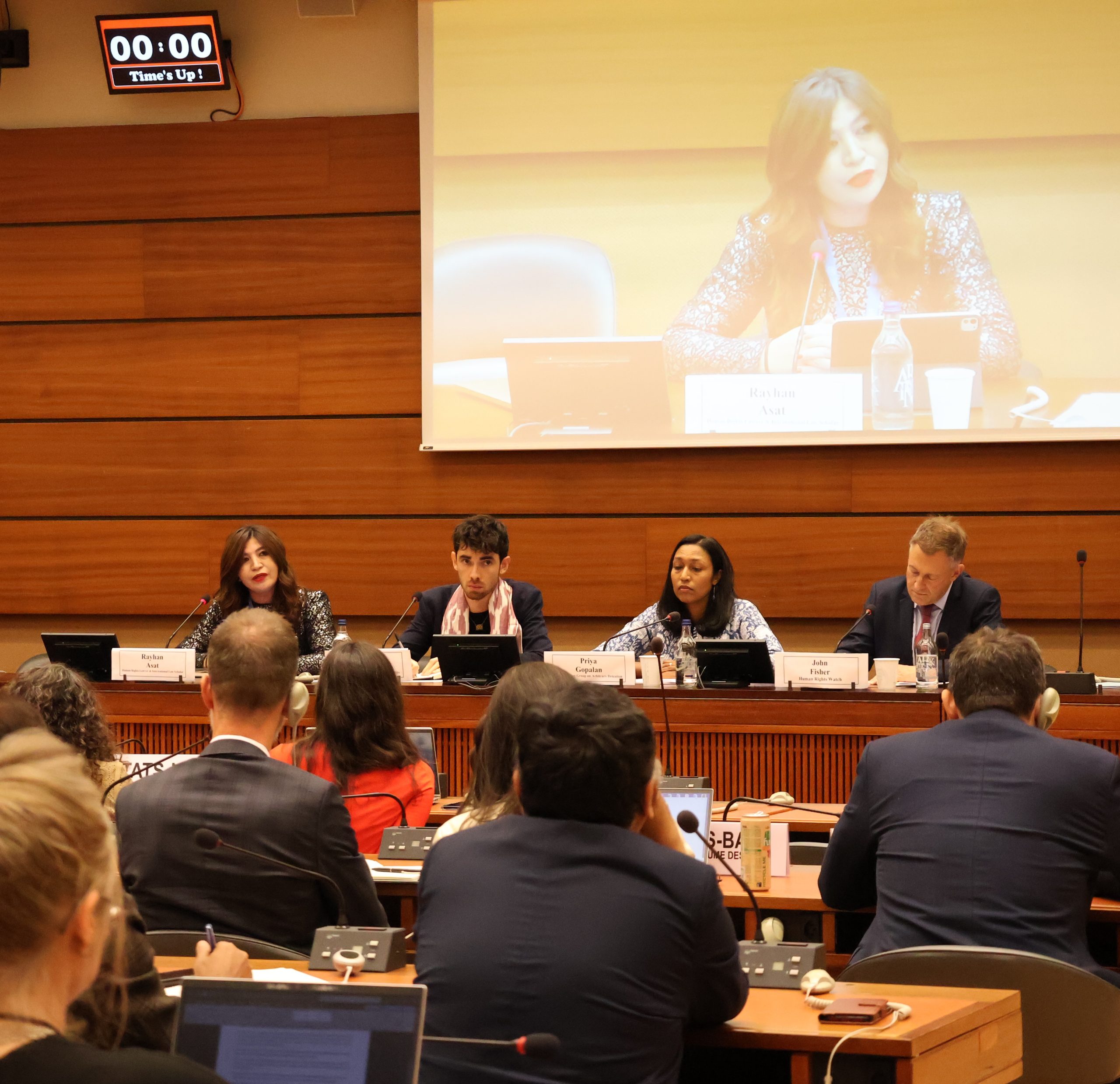
- The participation of Chinese GONGOs has grown exponentially since 2018 at the HRC and other UN human rights bodies, accompanying China’s increasing presence in these spaces after the US’ withdrawal from the HRC in 2018. With nearly a hundred accredited to the UN, GONGOs occupy an already limited space for civil society, displacing genuine independent voices, and instead amplifying Beijing’s human rights narratives, denying and deflecting criticism for UN-documented human rights violations. Oral statements by Chinese GONGOs at the HRC increased 16 times between 2018 and 2024: by 2024, roughly one in every 25 NGO statements heard at the HRC came from a Chinese GONGO. In some cases, GONGOs have also engaged in acts of intimidation and reprisal, seeking to shield the State from direct responsibility: this includes an incident with four GONGO representatives at ISHR’s office ahead of a closed-door meeting between human rights defenders and UN officials in March 2024.
- China ranks among the most frequent perpetrators of reprisals against individuals cooperating or seeking to cooperate with the UN, with 41 cases or situations documented in the UN Secretary-General’s annual reports on reprisals between 2010 and 2024. All cases remain unresolved, meaning that the Chinese government has not remedied any of them. Targets are often Uyghur and Tibetan activists, Hong Kong democracy advocates, or others promoting accountability for gross human rights violations; over two thirds are women. Often justified on national security grounds, these acts are punitive in nature and seek to send a chilling message to others considering engaging with the UN. They include surveillance and harassment inside UN premises, smearing of activists in UN debates and events, travel restrictions, and the targeting of family members. They result in increasing self-censorship, in particular since the adoption of overly broad national security laws in Hong Kong risking criminalising UN engagement, with 27% of cases in the Secretary-General’s report being anonymised due to fear of subsequent reprisals.
- China regularly employs procedural tactics to interrupt NGO speakers at the HRC, including through at least 22 points of order over 2021-2024. China also exerts pressure through diplomatic notes for other Member States not to meet with certain civil society actors, in particular Uyghur activists.
- China adopts an adversarial position in negotiations to strengthen UN mechanisms that address cases of reprisals for cooperation with the UN and safeguard civil society space.
-
These actions undermine the integrity and effectiveness of UN human rights mechanisms, set harmful precedents for other authoritarian-leaning States, and threaten to marginalise independent civil society voices globally, particularly in a shifting geopolitical environment where more States, including long-standing democracies, align with China’s practices.
A consistent and robust UN and diplomatic response to these acts is paramount to protect human rights defenders and uphold the credibility of UN human rights bodies. Various UN mechanisms and States have publicly and privately raised cases of reprisals committed by China, increasing the public cost of committing reprisals. Yet, sustained and long-term follow-up on cases by UN bodies needs to be further strengthened.
While China is the focus of this report, the issues addressed are systemic. Based on this report’s findings, ISHR puts forward a set of targeted recommendations to UN bodies and Member States, aimed at protecting civil society space from interference and restrictions. The recommendations are designed to improve UN processes and prevent any State from manipulating international mechanisms to suppress independent voices. The growing presence of GONGOs in particular poses complex challenges, as policy responses must differentiate between legitimate NGOs and State proxies without inadvertently restricting authentic civil society engagement.
ISHR’s recommendations include:
- reforming the Committee on NGOs to increase transparency, limit abuse of deferrals, and ensure fair access to UN bodies for independent NGOs
- strengthening protection mechanisms against reprisals, including rapid response to incidents inside UN premises, public accountability for perpetrators, and consistent long-term follow-up on unresolved cases
- curbing the influence of GONGOs by distinguishing clearly between independent and State-organised NGOs, and better documenting their presence and impact
- strengthening measures at the Human Rights Council and other UN bodies to make civil society participation safer, more inclusive, and less vulnerable to obstruction.
-
Author
Raphaël Viana David
Raphaël is ISHR's China and Latin America Programme Manager in our Geneva office. He joined ISHR in 2018.
Article also available in