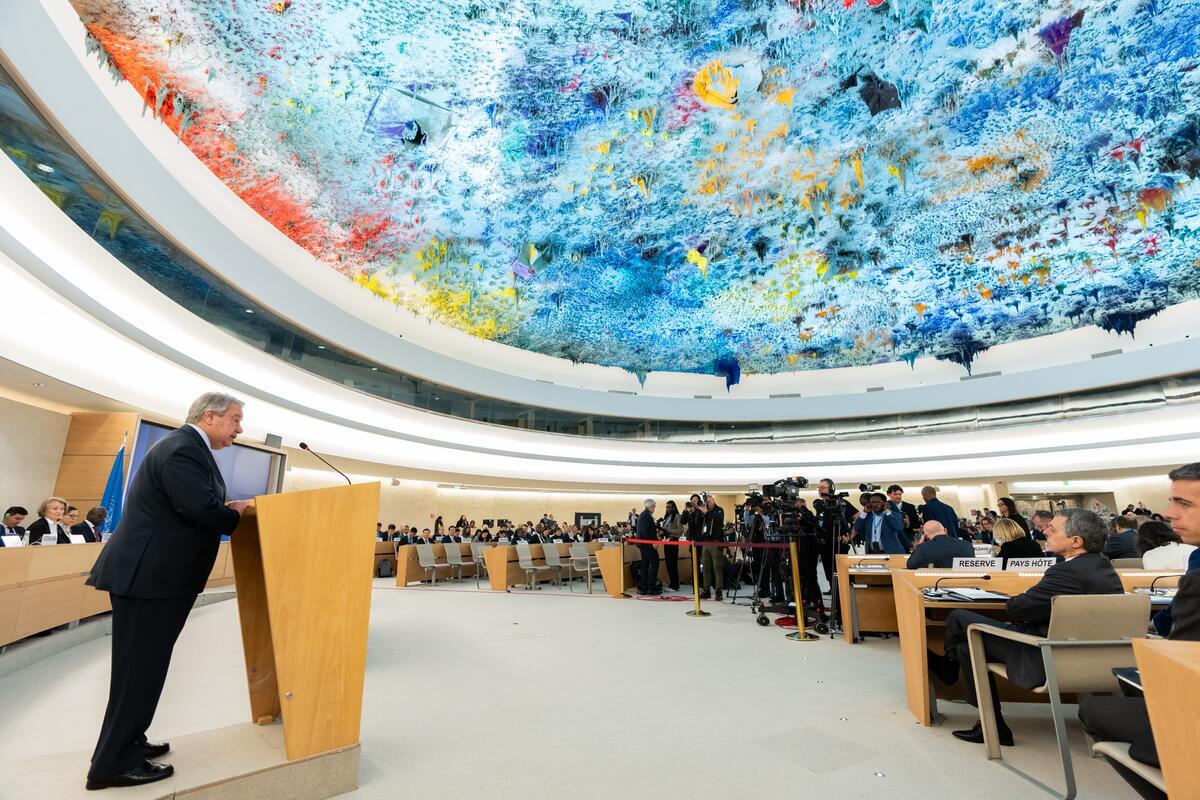
The UN Human Rights Council will hold its 60th regular session at Palais des Nations in Geneva from 8 September to 8 October 2025.
Stay up-to-date: Follow @ISHRglobal and #HRC60 on X and @ishr.ch on BlueSky, and look out for our Human Rights Council Monitor. During the session, follow the live-updated programme of work on Sched.
Click on the links below to browse through this full overview of the upcoming Council session:
Modalities of participation in HRC60
NGOs in consultative status with ECOSOC and national human rights institutions (NHRIs) with ‘A’ status can deliver their statements in person or via pre-recorded video statements during interactive dialogues, general debates and panels.
As the UN’s financial crisis continues to affect the Council’s work, it has been required to reduce meeting time. Due to cost-saving measures, the Council’s 60th session was shortened by 10%. The 60th session of the Council will be held in the Palais des Nations’ Assembly Hall from 8 September to 3 October, and subsequently in Room XVI from 6 to 8 October for the adoption of draft proposals.
Due to ongoing renovations under the Strategic Heritage Plan, NGO side events will continue to be allocated at a reduced level. Each NGO is allowed only one side event, and each event can last up to one hour. A calendar of NGO side events will be available on the HRC extranet and the app Sched.
The Information note for NGO engagement during the 60th session of the Human Rights Council is available here.
ISHR side events
- ‘The systemic nature of arbitrary detention in China: renewed evidence base demands renewed efforts at accountability’
- Date and time: Tuesday, 9 September 2025, 1-2pm, in Room VIII (Building A)
- Main organisers: ISHR, Network of Chinese Human Rights Defenders, Human Rights Watch, Amnesty International.
- ‘Women Human Rights Defenders: Documenting to Protect’
- Date and time: Wednesday 24 September 2025, 1-2 pm, in Room XI.
- This event is organised in the context of the Women Human Rights Advocacy Week, co-convened by IM-Defensoras, Regional Coalition of Women Human Rights Defenders in Middle East and North Africa (WHRD MENA), Women Human Rights Defenders International Coalition, National Network of Women Human Rights Defenders in Mexico, ISHR, Front Line Defenders, Peace Brigades International, Just Associates, Amnesty International, Urgent Action Fund and AWID.
#HRC60: Thematic issues
Here are some highlights of the session’s thematic discussions:
Issues on the agenda
At this 60th session, the Council will discuss a range of civil, political, economic, social and cultural rights and issues through dedicated debates with the:
- Special Rapporteur on the human rights to safe drinking water and sanitation
- Special Rapporteur on the negative impact of unilateral coercive measures on the enjoyment of human rights
- Special Rapporteur on truth, justice, reparation and guarantees of non-recurrence
- Expert Mechanism on the Right to Development and the Special Rapporteur on the right to development
- Special Rapporteur on contemporary forms of slavery, including its causes and consequences
- Working Group on Arbitrary Detention
- Independent Expert on the promotion of a democratic and equitable international order
- Working Group on Enforced or Involuntary Disappearances
- Working Group on the use of mercenaries as a means of violating human rights and impeding the exercise of the right of peoples to self-determination
- Special Rapporteur on the implications for human rights of the environmentally sound management and disposal of hazardous substances and wastes
- Office of the United Nations High Commissioner for Human Rights (OHCHR) on the Secretary-General’s analytical study on climate change
- Advisory Committee
- OHCHR on panel discussion on economic, social and cultural rights
- OHCHR on privacy
- Assistant Secretary-General on the Secretary-General’s report on cooperation with the United Nations (reprisals)
In addition, the Council will hold dedicated debates on the rights of specific groups including with the:
- Independent Expert on the enjoyment of all human rights by older persons
- Working Group on the rights of peasants and other people working in rural areas
- Special Rapporteur on the rights of Indigenous Peoples and the Expert Mechanism on the Rights of Indigenous Peoples
- Expert Mechanism to Advance Racial Justice and Equality in Law Enforcement (EMLER) and OHCHR on the promotion and protection of the human rights and fundamental freedoms of Africans and of people of African descent against excessive use of force and other human rights violations by law enforcement officers through transformative change for racial justice and equality
- Permanent Forum on People of African Descent
- Working Group of Experts on People of African Descent
The Council will also consider various other reports, see the full list here.
Panel discussions
During each Council session, panel discussions are held to provide States and NGOs with opportunities to hear from subject-matter experts and raise questions. Five panel discussions are scheduled for this upcoming session:
- Biennial panel discussion on unilateral coercive measures and human rights
Theme: Impact of unilateral coercive measures and overcompliance on the right to food and food security
- Panel discussion on combating discrimination, violence and harmful practices against intersex persons
- Biennial panel discussion on youth and human rights
Theme: Role of youth in fostering peaceful societies and creating an enabling environment for the enjoyment of human rights by all
- Annual half-day panel discussion on the rights of Indigenous Peoples
Theme: Rights of Indigenous Peoples in the context of a just transition to sustainable energy systems, including in relation to critical minerals
- Annual discussion on the integration of a gender perspective throughout the work of the Human Rights Council and that of its mechanisms
Theme: Strengthening gender perspectives in transitional justice processes
ISHR thematic priorities
Racial justice and equality for Africans and people of African descent
The Expert Mechanism to Advance Racial Justice and Equality in the context of Law Enforcement (EMLER) will present its report on Africans and people of African descent in the criminal justice system, and on its visit to Belgium in June 2025. These two reports will be presented alongside the report of the OHCHR on addressing the legacy of slavery, the slave trade, colonialism and subsequent discriminatory policies and systems based on race. In accordance with resolution 47/21, the Enhanced Interactive Dialogue will give priority to the participation of individuals and communities directly affected, including victims and their families.
The African Group will present its annual resolution ‘From rhetoric to reality: a global call for concrete action against racism, racial discrimination, xenophobia and related intolerance’. Historically, this resolution has highlighted the importance of the Durban Declaration and Programme of Action, while recognising that many people around the world, including Africans and people of African descent, continue to face racism, racial discrimination, hate speech, targeted violence, xenophobia and other related forms of intolerance.
We urge States to fully support this resolution, which has historically included language driven by civil society and people directly affected by racial police violence.
Environment and climate justice
Following the two landmark advisory opinions by the International Court of Justice and the Inter-American Court for Human Rights, we call on States to incorporate the findings and recommendations of these in negotiations, interactive dialogues and work of the Human Rights Council. Both rulings emphasise not only the need to step-up the efforts to adopt measures to address climate change, but also that this is a State obligation. Failure to take appropriate acts to protect the climate may constitute an internationally wrongful act which could be attributable to the States.
The Dominican Republic has announced the presentation of a resolution on rising sea levels and its impact on human rights. This is an opportunity for States to put human rights at the centre of the negotiations, particularly to incorporate the following points:
- a) recognise the impact of sea level rise in the enjoyment of various human rights, including economic, social and cultural rights and the right to a clean, healthy and sustainable environment;
- b) put an emphasis on the displacement of populations caused by the sea level rise;
- c) address the specific impacts on Indigenous Peoples, coastal communities and other vulnerable groups;
- d) recognise the vital and legitimate role of Environmental Human Rights Defenders;
- and e) welcome the findings of the Advisory Opinions delivered by the International Court of Justice and the Inter-American Court of Human Rights in the context of climate change.
During this session, the UN Secretary-General will present a report covering opportunities, best practices, actionable solutions, challenges and barriers relevant to the full realisation of human rights in the context of just transition.
There will be some relevant reports that will be presented at this Council that address climate and environmental justice.
- The Special Rapporteur on hazardous substances is presenting 24 guidelines on access to justice and effective remedies in the context of toxics. These guidelines look at barriers and obstacles that victims face and encourage States and businesses to enable and ensure justice and effective remedies.
- The Special Rapporteur on the rights to water and sanitation is presenting a report on the nexus between water and energy. This report includes the recognition of water as a common good and emphasises that current energy systems often violate human rights, degrade ecosystems and deepen social inequalities. The report also emphasises that the vast quantities of large consumers of energy like industrial activities impacts the capacity of energy production and in the enjoyment of other human rights like the right to a clean, healthy and sustainable environment and the right to adequate food.
- The Expert Mechanism of the Right to Development is presenting a report on climate Justice, Sustainability, and the Right to Development. The report considers that climate justice is a foundational framework for guiding climate action and a central objective in tackling the crisis. This includes incorporating this approach in litigation, climate finance while committing to a fair and equitable allocation of resources, responsibilities and benefits.
Finally, the Annual Panel on Indigenous Peoples will address the rights of Indigenous Peoples in the context of a just transition including in relation to critical minerals.
Reprisals
Ghana, Fiji, Hungary, Ireland and Uruguay will present a draft resolution on cooperation with the UN. ISHR urges all States to support the adoption of a Council resolution that strengthens the UN’s responses to reprisals, including by addressing the use of travel bans as a form of reprisal against human rights defenders.
On 24 September, the Assistant Secretary -General for Human Rights, Ilze Brands Kehris, will present the Secretary-General’s annual Reprisals Report to the Council in her capacity as UN senior official on reprisals. ISHR remains deeply concerned about reprisals against civil society actors who engage or seek to engage with UN bodies and mechanisms. We call for all States and the Council to do more to address the situation.
HRC60 is a key opportunity for States to raise concerns about specific cases of reprisals and demand that governments provide an update on any investigation or action taken toward accountability. An increasing number of States have raised concerns in recent sessions about individual cases of reprisals. States raising cases is an important aspect of seeking accountability and ending impunity for acts of reprisal and intimidation against defenders engaging with the UN. It can also send a powerful message of solidarity to defenders, supporting and sustaining their work in repressive environments.
This year, ISHR launched a campaign regarding four cases of reprisals.
ISHR urges States to raise these cases in their statements, all of whom are subject to travel bans:
- Loujain Al-Hathloul is a woman human rights defender from Saudi Arabia who has actively campaigned for women’s rights in the country. In 2018, she participated in the review of Saudi Arabia by the Committee on the Elimination of Discrimination against Women (CEDAW). Three months later, she was arbitrarily detained by the Saudi authorities. Released in 2020, she and some members of her family are still facing travel bans.
- Mohamed El-Baqer is a lawyer and human rights defender from Egypt. His organisation submitted reports for the Universal Periodic Review (UPR) of Egypt in 2019. He was arrested from the prosecution’s premises while carrying out his professional activities in 2019 and arbitrarily detained on terrorism and national security charges. Released in 2023, he is still on a terrorist list preventing him from travelling and exercising civil work.
- Anexa Alfred Cunningham is a Miskitu Indigenous leader, woman human rights defender, lawyer and expert on Indigenous Peoples rights from Nicaragua. In July 2022, after participating in a session of UN Expert Mechanism on the Rights of Indigenous Peoples (EMRIP) where she sat as one of the experts, Nicaraguan authorities denied her entry back into her own country. She has remained stranded in Geneva since then.
- Kadar Abdi Ibrahim is a human rights defender and journalist from Djibouti. He travelled to Geneva in 2018 to participate in Djibouti’s UPR process. Days after his return to his country, intelligence service agents of the Service de documentation et de sécurité (SDS) raided his house and confiscated his passport. Kadar has been unable to leave his country since then.
In addition, we urge States to raise and follow up on cases from our 2022, 2023 and 2024 campaigns, as well as individual cases of reprisals in the country-specific debates taking place at this session. Further information on these cases can be found here. During the organisational meeting held on 25 August, the President of the Council stressed the importance of ensuring the safety of those participating in the Council’s work, and the obligation of States to prevent intimidation or reprisals.
In the margin of the session, ISHR will co-sponsor a side event organised by MENA Rights Group and Global Center on Cooperative Security, titled ’15 years of reprisals in the MENA region: trends and abuses in the name of security and counter-terrorism’. The event will take place on 25 September at 2pm.
Human Rights Council elections
Elections at the Human Rights Council are coming up in October 2025 at the United Nations General Assembly, in New York. This year, 14 countries are running for 14 seats. The process is therefore not competitive. On 4 September 2025 (15h-17h30 CET), ISHR and Amnesty International are organising a Pledging Event. All candidates and civil society are invited to participate. In this event, civil society can directly and constructively engage with candidate States by asking them questions. State representatives will be asked to respond publicly during the event. Candidates are also expected to elaborate on their human rights pledges and commitments. ISHR campaigns for all candidate States to voluntarily commit to improving the human rights situations both at home and abroad, as well as to enhancing their interaction with the Council. We also want UN Member States to cast informed votes and vote only for candidates who uphold the highest standards in the promotion and protection of human rights and who cooperate fully with the UN. Learn more about our #HRCelections2025 campaign.
On 12 March 2025, Secretary-General António Guterres launched the UN80 Initiative that aims to update the UN’s structures, priorities, and operations for the 21st century. ISHR and partners call on the Secretary-General and the High Commissioner for Human Rights to:
- (1) make all proposals of reform transparent and public. Civil society needs to understand the measures proposed and be given a seat at the decision-making table;
- (2) ensure that decisions for reform are in line with the expectations, needs and demands of human rights defenders, victims and survivors, and that they improve the effectiveness, reach, and responsiveness of UN human rights mechanisms.
ISHR and 16 other civil society organisations have put together a set of principles, criteria and concrete proposals that should guide the reform process. Visit our campaign page to learn more.
#HRC60: Country-specific issues
Country-specific issues on the agenda
The High Commissioner will provide an oral update to the Council on 8 September 2025. The Council will consider updates and reports, and it is expected to consider resolutions addressing a range of country situations, in some instances involving the renewal of the relevant expert mandates. These include:
- Enhanced Interactive Dialogue on reports of High Commissioner and Independent Investigative Mechanism for Myanmar
- Interactive Dialogue on the report of the OHCHR on Sri Lanka
- Enhanced Interactive Dialogue on Afghanistan
- Interactive Dialogue on the report of the Independent international Fact-Finding Mission for Sudan
- Enhanced Interactive Dialogue on the Democratic Republic of the Congo
- Interactive Dialogue with Group of Independent Experts on Belarus (oral update)
- Interactive Dialogue on the comprehensive report of the Special Rapporteur on the situation of human rights in Burundi
- Interactive Dialogue with the Commission of Inquiry on Ukraine and Interactive Dialogue on the High Commissioner oral update on the findings of the OHCHR report on the situation of human rights in Ukraine
- Interactive Dialogue on the report of the High Commissioner on Nicaragua and oral update by the Group of Experts on Nicaragua (GHREN)
- Oral update of the Commission of Inquiry on Syrian Arab Republic
- Enhanced Interactive Dialogue on High Commissioner report on Democratic People’s Republic of Korea
- Interactive Dialogue with the Fact-Finding Mission on the Bolivarian Republic of Venezuela
- Interactive Dialogue on the report of the Special Rapporteur on the situation of human rights in the Russian Federation
- Presentation of the High Commissioner’s report on implementation of HRC res. 31/36 (UN database of businesses involved in the Israeli settlement enterprise)
- Interactive Dialogue with the High Commissioner on Haiti with the participation of the independent human rights expert
- Interactive Dialogue with the Independent Expert on the Central African Republic
- Interactive Dialogue with the Independent Expert on Somalia
- Interactive Dialogue on technical cooperation in Libya
- Interactive Dialogue with the Special Rapporteur on Cambodia and presentation of the Secretary-General’s report
- Presentation of the High Commissioner’s report on cooperation with Yemen
ISHR country-specific priorities
Afghanistan
ISHR calls on States to renew the mandate of the UN Special Rapporteur on Afghanistan and adopt a resolution at this 60th session to establish an independent accountability mechanism on Afghanistan. Afghan and international civil society organisations have emphasised the urgent need for a mechanism with the mandate to investigate and collect, preserve and analyse evidence of grave violations and abuses in Afghanistan, with a view to advancing accountability. Such a mechanism could be a key tool in addressing the entrenched impunity at the heart of the current crisis, advancing accountability, and supporting access to justice, truth and reparation for victims. It would be distinct and complementary to the vital mandate of the UN Special Rapporteur on Afghanistan, and would also complement and support ongoing or future efforts at the International Criminal Court, the International Court of Justice, and at the national level, including through the use of universal (or other form of extraterritorial) jurisdiction in the courts of third countries.
Occupied Palestinian Territories
HRC60 will mark two years of Israel’s genocide in Gaza. States’ complicity in the commission of these crimes have continued to shock the human conscience, with ongoing failure to end the crimes committed against the Palestinian people.
ISHR reiterates its calls to States to heed to recommendations of experts, UN agencies, OHCHR, and the International Court of Justice (ICJ), by taking long overdue political and economic measures, including sanctions against Israel, and imposing a two-way arms embargo. States should center a rights-based approach focusing on realising justice and reparations for the Palestinian people. States should also take immediate measures to protect the UN and multilateral institutions, as well monitoring and accountability mechanisms – including the Special Rapporteur on the oPt, the Commission of Inquiry on Israel and Palestine, the ICJ and the International Criminal Court – under sustained and increasing attack by Israel and its supporters, including the United States.
Palestinian civil society has called on States to commit to supporting the Hague Group’s July 2025 initiative, which set out a list of ten practical measures for States to put an end to the genocide and others crimes against humanity committed by Israel against the Palestinian people.
States should also send a strong message of support to UNRWA ahead of the renewal of its mandate in the 80th session of the UN General Assembly, including through political and financial support to ensure it continues to implement its mandate fully. UNRWA cannot be replaced with parallel or alternative pathways such as the Gaza Humanitarian Fund.
Sudan
ISHR joins dozens of NGOs in urging States at HRC60 to renew the Fact-Finding Mission for Sudan for at least two years. Sudanese civil society has documented the ‘dire humanitarian crisis in Sudan and the multifaceted challenges faced by civilians amidst the ongoing conflict’ and how ‘conflict-related sexual violence has become alarmingly widespread in Sudan’. As documented by Sudanese Women’s Rights Action, ‘the recent surge of violence in North, West, and South Kordofan has intensified a humanitarian catastrophe, but for women and girls, the crisis cuts even deeper, where homes were burnt and entire communities displaced, and thousands face heightened risks of sexual violence, forced marriage, and life-threatening shortages of reproductive health care. The hunger crisis in South Kordofan and the Nuba Mountains has now reached an acute level. Approximately half of Kadugli’s population has left the city, while thousands remain stranded due to road insecurity and high transportation costs. The majority of those trapped are female-headed households, who are disproportionately affected by rising prices and limited access to food. The displaced face new hardships as they search for food in the war-torn Kordofan region, where fighting rages on every front and total closure is enforced by the various competing forces. This leaves the population of South Kordofan – especially women – without options, surrounded by death and hunger, as all routes to safer places, whether within or outside the country, are blocked’.
Situations of concern that should be on the Council’s agenda
China
Since 2018, all UN human rights bodies have documented human rights violations by the Chinese government that are widespread and systematic in nature, and made hundreds of recommendations to address them (compiled by ISHR here). This includes:
At the Council’s 59th session, in June, High Commissioner Volker Türk underscored China’s ‘lack of progress on much-needed legal reform to ensure compliance with international human rights law’ and ‘also regret[ted] that there has not yet been a resolution to the individual cases [the OHCHR] ha[s] raised.’
States should urgently echo in national and joint statements such concerns, renew the call for the immediate implementation of recommendations from the OHCHR Xinjiang report and all recommendations by Treaty Body and Special Procedures. This includes recommendations to promptly release all those arbitrarily detained, clarify the status and whereabouts of those disappeared, and fully review laws and policies on counterterrorism, national security and minority rights.
Since his last statement on the matter in August 2024, High Commissioner Türk has not updated the Council on implementation of his Office’s Xinjiang report. To mark three years since the report’s release, ISHR calls on States to urge the High Commissioner to clarify steps taken, and to be taken, to follow-up on his Office’s Xinjiang report, including clear, sustained and public calls for its implementation by China and a written assessment of the report’s implementation by the Office.
Finally, States should demand the prompt release of arbitrarily detained human rights defenders, including feminist activist Huang Xueqin, Martin Ennals Award laureate Yu Wensheng, lawyer Ding Jiaxi and legal scholar Xu Zhiyong, lawyer Xie Yang, citizen journalist Zhang Zhan, Uyghur doctor Gulshan Abbas, Hong Kong lawyer Chow Hang-tung and publisher Jimmy Lai, and the 11th Panchen Lama Gedhun Choekyi Nyima.
Occupied Western Sahara
Across the occupied territory of Western Sahara, Sahrawi human rights defenders continue to face systematic reprisals for their peaceful activism and engagement with international mechanisms. Between May 2023 and April 2025, credible reports detail at least a dozen cases of targeted reprisals, including physical assaults, arbitrary detention, judicial harassment, surveillance, and travel bans imposed on defenders and their families. Particularly concerning are the continuing violations against the Gdeim Izik group, who remain imprisoned despite long-standing findings of arbitrary detention, as well as the case of Sahrawi student Al-Hussein Al-Bachir Ibrahim, whose detention was recently found to be arbitrary by the UN Working Group on Arbitrary Detention, noting both due process violations and degrading prison conditions. These practices form part of a broader environment of repression and lack of accountability under Moroccan control, marked by restrictions on freedom of association, assembly, and expression.
We urge Council to press Morocco to end reprisals against Sahrawi defenders, ensure access to international human rights monitoring in Western Sahara, and implement the recommendations of UN Special Procedures and treaty bodies without delay.
United States of America
Together with partners, ISHR is concerned about the deteriorating situation for human rights and the rule of law in the United States of America (USA). The Trump Administration’s announcement that the USA will not participate in its planned UPR, a crucial process through which States can be held accountable for their human rights records by their peers and by civil society, should be condemned by the Human Rights Council. Both in response to the USA situation, and in order to avoid a domino effect, it is important that other human rights bodies – including Special Procedures and the High Commissioner – increase monitoring, reporting on and scrutiny of the USA.
#HRC60: Council programme, appointments and resolutions
During the organisational meeting held on 25 August, the President of the Council presented the programme of work. It includes 5 panel discussions. States also announced at least 33 proposed resolutions. Read here the reports presented this session.
Resolutions to be presented to the Council’s 60th session
At the organisational meeting on 25 August the following resolutions were announced (States leading the resolution in brackets):
- Human rights to safe drinking water and sanitation (Germany and Spain) – mandate renewal
- Promotion of a democratic and equitable international order (Cuba)
- Working Group on the use of Mercenaries (Cuba) – mandate renewal
- The question of the death penalty (Belgium, France, Mexico, Mongolia, Republic of Moldova, Switzerland)
- A world of sports free from racism, racial discrimination, xenophobia and related intolerance (Brazil, African Group)
- The right of everyone to the enjoyment of the highest attainable standard of physical and mental health (Brazil) – mandate renewal
- The role of freedom of opinion and expression in women’s empowerment (Brazil)
- Human rights and Indigenous Peoples (Guatemala and Mexico) – mandate renewal
- Promoting and protecting economic, social and cultural rights within the context of addressing inequalities (China)
- Working Group on arbitrary detention (France) – mandate renewal
- Technical assistance and capacity-building for Yemen in the field of human rights (Bahrain on behalf of the Arab Group)
- Cooperation with Georgia (Georgia)
- Advisory services and technical assistance for Cambodia (Japan) – mandate renewal
- Rising sea levels and the impact on human rights (Dominican Republic, Malta, Cape Verde, Cyprus)
- Enhancement of technical cooperation and capacity building in the field of human rights (Brazil, Honduras, Indonesia, Morocco, Norway, Qatar, Singapore, Thailand, Turkey)
- From rhetoric to reality: a global call for concrete action against racism, racial discrimination, xenophobia and related intolerance (Ghana on behalf of African group)
- Technical assistance and capacity-building in the field of human rights in the Democratic Republic of the Congo (Ghana on behalf of African Group)
- Right to development (Uganda on behalf of the Non-Aligned Movement) – mandate renewal
- Role of prevention in the promotion and protection of human rights (Australia, Hungary, the Maldives, Morocco, Poland, Ukraine, Uruguay)
- Human rights situation in the east of the Democratic Republic of the Congo (Democratic Republic of the Congo)
- The situation of human rights in the Russian Federation (Benelux together with 26 European states) – mandate renewal
- Impact of drug policies on human rights (Colombia on behalf of a group of countries)
- Promoting reconciliation, accountability and human rights in Sri Lanka (Canada, Malawi, Montenegro, North Macedonia, United Kingdom)
- Human rights situation in Sudan (Germany, Ireland, Netherlands, Norway, United Kingdom) – mandate renewal
- Assistance to Somalia in the field of human rights (Somalia, United Kingdom)
- Contemporary forms of slavery (Australia, United Kingdom) – mandate renewal
- Promoting international cooperation to support national mechanisms for implementation, reporting and follow-up (Brazil and Paraguay)
- Preventable maternal mortality and morbidity and human rights (Colombia, Estonia, New Zealand)
- Promoting and protecting human rights of children during and after conflict and justice and redress for victims (Costa Rica and Qatar)
- Cooperation with the United Nations, its representatives and mechanisms in the field of human rights (Fiji, Ghana, Hungary, Ireland, Uruguay)
- Special Rapporteur on Afghanistan (European Union) – mandate renewal
- Special Rapporteur on the human rights situation in Burundi (European Union) – mandate renewal
- The human rights of older persons (Argentina, Brazil, Gambia, Philippines, Slovenia) – mandate renewal
Furthermore, according to the voluntary calendar for resolutions, it is possible that more resolutions could also be presented at this session. Read the calendar here.
Adoption of Universal Periodic Review (UPR) reports
During this session, the Council will adopt the UPR working group reports on Kyrgyzstan, Kiribati, Guinea, Lao PDR, Spain, Lesotho, Kenya, Armenia, Guinea-Bissau, Sweden, Grenada, Türkiye, Guyana, Kuwait, and to be confirmed for Nicaragua. ISHR supports human rights defenders in their interactions with UPR processes. We publish and submit briefing papers regarding the situation facing human rights defenders in some States under review and advocate for the UPR to be used as a mechanism to support and protect human rights defenders on the ground. This session of the Council will provide an opportunity for Guinea to accept recommendations made in relation to human rights defenders, as proposed in ISHR’s briefing paper.
Appointment of mandate holders
The President of the Human Rights Council will propose candidates for the following mandate:
- Mandate of Independent Expert on the situation of human rights in the Central African Republic
In view of the pending appointments, it is relevant to recall that, in appointing mandate holders, the President of the Council is required to give particular attention to the need to avoid actual or perceived conflicts of interest on the part of candidates. Mandate holders should be genuinely committed to the independence and effectiveness of the special procedures system, and have a demonstrated commitment to civil society engagement and participation.
Read here the three year programme of work of the Council with supplementary information.
Read here ISHR’s recommendations on the key issues that are or should be on the agenda of the UN Human Rights Council in 2025.