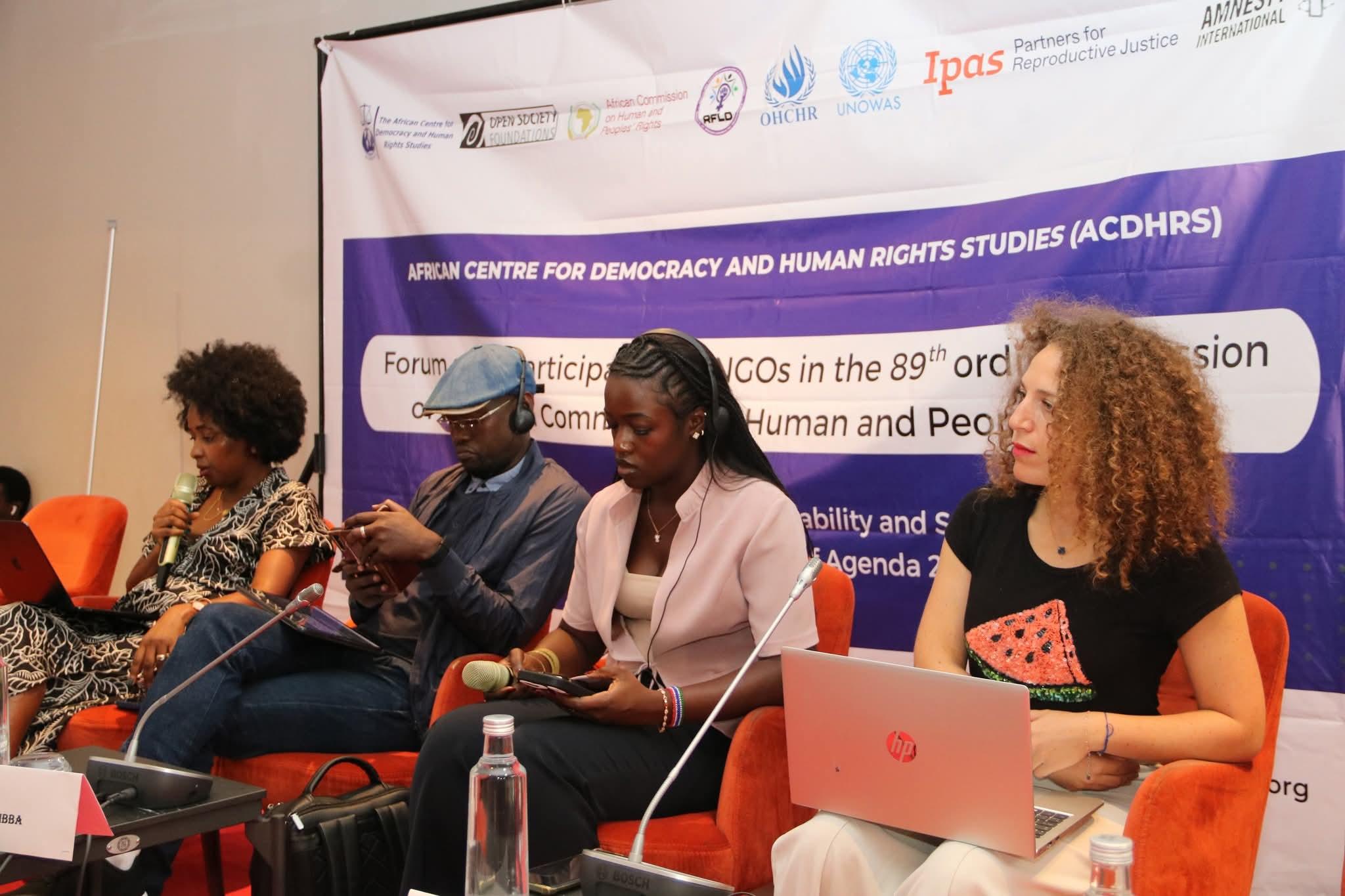
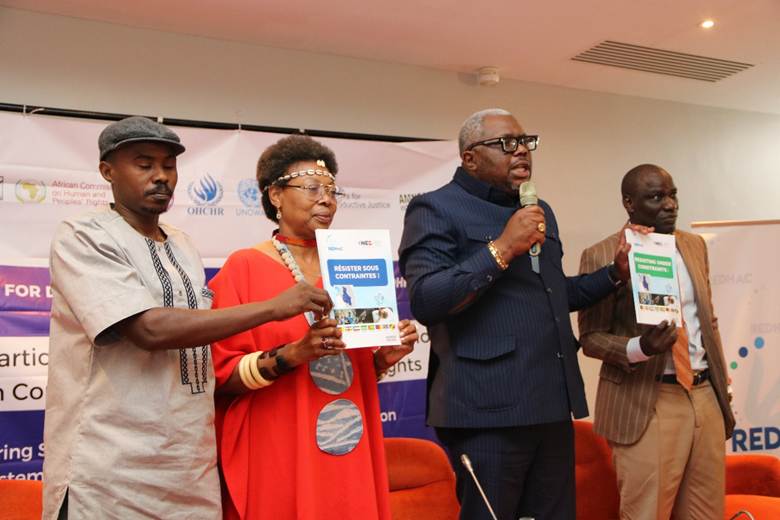
The discussion, titled “From Restrictive Laws to Transnational Repression: Protecting Human Rights Defenders in Africa,” was the first ever panel on the topic of transnational repression and featured Dr. Aua Baldé, Member of the UN Working Group on Enforced or Involuntary Disappearances; Ralmeg Gandaho, President of Changement-Social (Bénin); and Basma Mostafa, Director of Programs at the Law and Democracy Support Foundation and affected by transnational repression. Ms Mostafa was unable to attend in person due to visa issues; her statement was read on her behalf by Salomé Boucif of the International Service for Human Rights (ISHR). The panel was moderated by Manyima Dibba (Committee for Justice, as main organiser).
This discussion builds also on ISHR’s ongoing work on transnational repression. In June, ISHR convened a retreat for UN human rights experts that culminated in a landmark statement by over 130 UN Special Procedures mandate holders and Treaty Body members calling for a decisive international response to transnational repression. During the 89th Ordinary Session of the ACHPR, ISHR further called on the Commission to adopt a resolution on transnational repression and to carry out a comprehensive continent-wide study examining its nature, scale, patterns, methods, perpetrators, affected populations and impact on the enjoyment of human rights.
A wave of restrictive laws affecting human rights defenders
The panel opened from a clear premise: a conducive national legal framework is a precondition for the safe and effective work of human rights defenders, as affirmed by Dr Aua Baldé. Yet across Africa, the opposite trend is now dominant.
In Angola, a law on the status of non-governmental organisations promulgated in 2025 allows the State to monitor, suspend and financially restrict civil society organisations. In Zimbabwe, the Private Voluntary Organization Act adopted in 2025 confers sweeping discretionary powers on the executive to overregulate and interfere in the governance and operations of non-governmental organisations. And in Uganda, the Protection of Sovereignty Act signed into law in May 2026 creates broad controls over who may receive foreign funding and who may be labelled a “foreign agent.”
Ralmeg Gandaho, speaking from the experience of defenders in West Africa and particularly Benin, illustrated how such frameworks translate into daily intimidation, criminalisation and surveillance of those who document violations and hold power to account.
Exile is not safety
A central thread of the discussion was that crossing an international border does not guarantee safety. For Ms Mostafa, transnational repression “should not be understood simply as a collection of isolated incidents. It is a governance strategy used by some States to extend control beyond their territory.”
Drawing on the work of the Law and Democracy Support Foundation with exiled defenders, journalists and political activists, she identified several recurring patterns: proxy punishment and reprisals against family members; the weaponisation of legal and counter-terrorism frameworks, including politically motivated prosecutions and convictions in absentia; the misuse of administrative and consular measures such as travel bans and the refusal to renew documents; digital transnational repression and more.
Her account of the case of Egyptian activist Mariam Abdelbasette illustrated how these practices intersect: her husband was reportedly deported from Oman to Egypt following an alleged INTERPOL-related procedure without meaningful due process and subsequently disappeared, while she herself faced travel restrictions, politically motivated terrorism-related accusations, threats of deportation and sustained intimidation of her and her family.
The chilling effect
The panel stressed that the target is not only the individual defender. The broader objective is to create fear and silence entire communities, to make people think twice before speaking, organising, documenting violations, engaging with the media or cooperating with the United Nations. When a journalist sees a colleague’s family arrested, the message reaches hundreds of journalists; when an activist’s relatives are detained, it reaches an entire exile community. Self-censorship becomes a survival strategy, undermining freedom of expression, independent journalism and cooperation with international human rights mechanisms.
Dr. Aua Baldé underlined that the cross-border nature of these threats challenges conventional approaches to human rights protection, which are typically organised around a single jurisdiction. She emphasised that States must not be allowed to evade their human rights obligations by facilitating, outsourcing or benefiting from acts of repression carried out beyond their borders.
A protection gap
The panel identified a significant protection gap: while awareness of transnational repression is growing, protection mechanisms have not kept pace. Many host countries still approach the issue primarily as a security matter rather than a human rights one; recognition remains inconsistent, reporting mechanisms fragmented, and access to protection difficult. Responses too often focus only on the individual in exile while overlooking the relatives facing retaliation inside the country of origin.
Equally important, the panel highlighted the challenge of representation. As Ms Mostafa put it, “Nothing about targeted communities should be discussed without targeted communities.” Exiled defenders, journalists, activists and diaspora organisations must take part in designing policies, protection programmes and accountability mechanisms.
Recommendations
The panel called on the African Commission and the UN human rights system to:
- Adopt a dedicated resolution formally recognising transnational repression as a distinct and growing human rights challenge in Africa;
- Establish a Joint Task Force on Transnational Repression bringing together the relevant ACHPR special mechanisms — on human rights defenders, freedom of expression, refugees and asylum seekers, reprisals and enforced disappearances — and UN human rights mechanisms, to ensure a coordinated and victim-centred response;
- Undertake a comprehensive continental study on transnational repression in Africa, examining patterns such as proxy punishment, digital repression, forced return, deportation, the misuse of counter-terrorism frameworks and cross-border security cooperation;
- Pay greater attention to the targeting of family members and proxy punishment, one of the most widespread and least addressed forms of transnational repression in the region;
- Design protection mechanisms with the meaningful participation of affected communities, guided by the principle that nothing about targeted communities should be discussed without targeted communities.
The panel concluded that when repression crosses borders, protection and accountability must cross borders too. Regional and international institutions must work together, including under the Addis Ababa Roadmap on cooperation between the ACHPR and UN Special Procedures, to ensure that defenders do not lose access to protection simply because their cases extend beyond a single country.