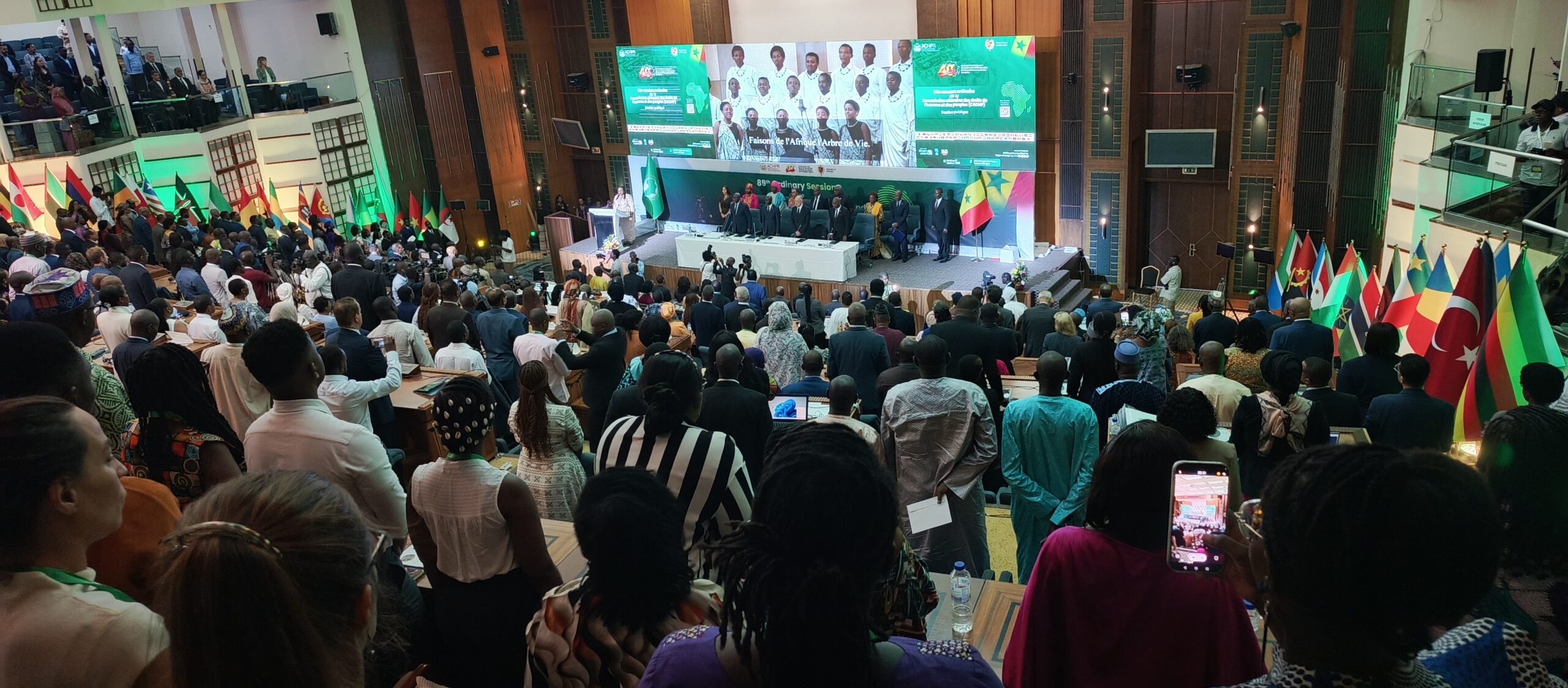
This 89th public session was, as usual, preceded by the NGO Forum also held in Dakar, Senegal. The private session of the ACHPR took place from 21 September to 1 October 2026 (online). During its private session, the African Commission adopted, among others,:
- Progress report on the implementation of follow-up measures from the 88th Ordinary Session.
- Report on applications for observer and affiliate status.
The public session (in-person) was centred on the African Union (AU) theme of the year 2026 titled “Assuring Sustainable Water Availability and Safe Sanitation Systems in Africa”. In total, this session welcomed 1 601 participants including 118 representing the ACHPR including the Commissioners, Secretariat of the ACHPR, translators and interpreters, and support teams, 175 representatives of States Parties to the African Charter, 14 representatives of organs of the African Union, 96 representatives of National Human Rights Institutions (NHRI), 77 representatives of international organisations, 946 representatives of non-governmental organisations, and 62 representatives of the media.
During this session, the African Commission granted observer status to six NGO.
At the opening ceremony of this special anniversary session, eleven speakers took the floor to express their solidarity with this celebration, present the situation of human rights on the continent from different perspectives and address recommendations accordingly. Hon. Commissioner Idrissa Sow took that opportunity to remind the attendees that this session is happening at the intersection of the celebration of the 45th anniversary of the adoption of the African Charter, the 40th anniversary of its entry into force and the 20th anniversary of the African Youth Charter. Noting the degradation of human rights on the continent and insisting on the importance of implementing and preserving the rights enshrined in the African Charter, the Chairperson reminds the participants that development and human rights cannot be separated; consequently, the respect of human rights should not be put on hold in any circumstances.
1. Situation of human rights in Africa
On the situation of human rights in Africa, State parties, NHRI, United Nations Special Procedures and Agencies, International organisations and NGO delivered oral statements, including ISHR. Its statement described the situation of human rights in Cameroon, Guinea, Zambia. The statement also called attention on the increasing transnational repressions preventing African HRD to engage with regional and international human rights protection mechanisms and urge the ACHPR to adopt a resolution to carry out a comprehensive continental study on transnational repression in Africa, examining, amongst other things, its nature, scale, patterns, methods, perpetrators, the populations affected, and its impact on the enjoyment of human rights.
2. Panel discussions and and launches
On the Panels, the African Commission had four panels.
- Advancing Women and Girls’ Rights Through Litigation: Launch of the Tripartite Study on Challenges Before AU Human Rights Organs
The panel proceeded with the official launch of the tripartite study on the challenges posed by the defence of the rights of women and girls before the human rights bodies of the African Union (ACHPR, African Court and CADEBE). The study highlights a significant lack of access to regional litigation whilst emphasising the potential of strategic litigation, particularly in relation to the protection of the rights of girls and women. The panel concluded with a call to action in favour of utilising these methods and disseminating the study.
- Celebrating 65 Years of the Convention on the Reduction of Statelessness: Advancing the Protocol to the African Charter on Human and Peoples’ Rights on Specific Aspects of the Right to a Nationality and the Eradication of Statelessness in Africa
This panel commemorated the 65th anniversary of the Convention on the Reduction of Statelessness and aimed to reignite discussions on combating statelessness in Africa, which deprives millions of people of a legal identity, nationality and access to education, healthcare and employment. The panel also referred to the AU Protocol of February 2024 on the right to a nationality and the eradication of statelessness, which remains relatively unknown and whose ratification and implementation are struggling to gain traction. The panellists therefore called on states to ratify this Protocol.
- The impact of water and basic sanitation on the living conditions of prisoners in African prisons and Launch of the Newsletter on Human Rights and Policing
Whilst the theme of the African Union for this year is access to water and sanitation, this panel discussed access to these services in one of the most challenging environments: places of detention, which are often characterised by extreme overcrowding, inadequate sanitary facilities, a lack of drinking water, and the use of buckets. The panel therefore provided an opportunity to analyse the challenges of accessing water and sanitation in prisons and to highlight the responsibilities of states in these circumstances.
- Study on the Impact of Climate Change on Human and Peoples’ Rights in Africa
The panel discussion focused on the extractive industries and the elimination of all forms of exploitation in Africa’s international economic relations, in light of Article 21(5) of the African Charter and Resolution 634 of the ACHPR. It is based on the observation that extractive operations, characterised by an imbalance of power between multinational corporations and host states, often cause environmental degradation and infringe on the rights of communities without delivering the expected economic transformation. It aims to follow up on the proposal for a binding African legal instrument on transnational corporations and to launch a study on the impact of climate change on human and peoples’ rights in Africa.
3. States periodic review
During this session, the African Commission reviewed the periodic reports of Guinea-Bissau, Mauritius and Zambia.
- The Republic of Guinea-Bissau
This review happened on 17 October 2026. The delegation of the State party presented the report covering 1988–2025 under the African Charter, and the periodic report under the Maputo Protocol covering 2010–2025. During the interactive session, the chairperson of the Working Group on Extractive Industries, Environment and Human Rights Violations inquired on the rights of citizens to seek remedies from companies. The Special Rapporteur on Human Rights Defenders and Focal Point on Reprisals in Africa, then, questioned the applicable regime regarding freedom of assembly, the willingness to repeal defamation law and to adopt a national law on the protection of defenders.
In their preliminary response, the delegation mentioned that although the right to assembly is subject to a notification regime, certain conditions must be respected.
- The Republic of Mauritius
The State party was reviewed on 15 October. The review was related to the 11th periodic report under the African Charter covering the period 2019-2024.
During the interactive session, the chairperson of the Working Group on Extractive Industries, Environment and Human Rights Violations inquired on the kind of principles, guidelines and precautions enshrined in the offshore petroleum act of 2021 to avoid environmental harm, and the measures adopted in response to environmental threats. In their response to the questions of this mechanism, the delegation of the State party mentioned the provisions of the offshore petroleum act of 2021 that oversee petroleum activities, compliance mandate, fight against corruption; the environment protection Act of 2024 that establishes environmental standards and policies and actions plan and programmes.
On the protection of defenders and their working space, the Special Rapporteur on Human Rights Defenders and Focal Point on Reprisals in Africa questioned the measures toward the adoption of a specific defenders law and a new law on freedom of association.
The Special Rapporteur on Freedom of Expression and Access to Information decriminalisation of defamation inquired on the conformity of the restrictions on freedom of expression with article 9 of the African Charter and the measures for the effective protection of journalists, media practitioners and whistleblowers.
The review was held on 17 October 2026. The state report includes its 8th periodic report on the implementation of the African Charter, 1st periodic report on the implementation of the Maputo Protocol, and its initial report on the implementation of the Kampala convention, covering the period 2020-2025.
On the protection of defenders and their working space, the Special Rapporteur on Human Rights Defenders and Focal Point on Reprisals in Africa questioned the measures toward the adoption of a specific defenders law and a new law on freedom of association and NGO and the amendment of the public order Act. The SR further inquired on the reasons for the cancellation of RightsCon 2026.
The chairperson of the Working Group on Extractive Industries, Environment and Human Rights Violations furthermore questioned the existence of provisions requiring environmental assessments for human rights and social impacts from industries projects.
In its preliminary response, Zambia mentioned that public demonstrations are under the notification regime. Regarding the review of NGO Act and the amendment of the public order Act, the delegation indicated that this is being done in a participatory dynamic of all stakeholders and in compliance with international standards.
4. Activity Reports of Commissioners and Special Mechanisms
On the activity reports, the 11 Commissioners presented their inter-sessional activities reports. Of these reports, ISHR delivered statements following the presentation of two reports.
- Special Rapporteur on refugees, asylum seekers, internally displaced persons and migrants in Africa
The statement delivered by Sara Branco called to strengthen accountability for xenophobic and racist migration policies and practices.
- Special Rapporteur on human rights defenders and reprisals in Africa
The statement delivered by Lidawh-wè Dontema called for reform legislation that makes the existence of associations subject to discretionary authorisation without the possibility of appeal, and replaces it with a system of simple registration, as provided for by international standards.
5. Joint Special Mechanisms Forum
In the context of the celebration of the 45 years of adoption of the African Charter and 40 years of its entry into force, the ACHPR organised this joint special mechanisms forum and a high level dialogue to discuss the effectiveness of current measures for the protection of human and peoples’ rights in Africa.
6. Side events
During this session, ISHR organised or co-sponsored in total five side events.
- Protecting our environment, our land and our digital space in Africa
This event organised by ISHR and co-sponsored by DefendDefenders and Front Line Defenders was an opportunity for defenders to formulate recommendations for the protection of environment, land, digital and women rights in their respective countries.
- Defending the Defenders : Confronting reprisals against Environmental Human Rights Defenders in Africa
This event organised by Zimbabwe Lawyers for Human Rights (ZLHR) and co-sponsored by ISHR discussed the strategies to protect Environmental Human Rights Defenders in Africa from reprisals.
- Diasporic and African perspectives on reparations for the Transatlantic Trade in Enslaved Africans and colonialism
This event organised by ISHR and co-sponsored by Peregum Institute discussed the reparation to African and people of African descent for the Transatlantic Trade in Enslaved Africans and colonialism from different perspectives.
- Shrinking of civic space in the Sahel: what are the consequences for journalists and civil society
The event was organised by Observatoire pour la protection des Défenseurs des Droits Humains (OMCT, FIDH), and Reporters without borders, and co-sponsored by ISHR. It served as a platform to call attention to the attacks against journalists in the Sahel and Guinea.
- Protecting civic space and strengthening the resilience of human rights defenders in west Africa
This event organised by West African Human Rights Defenders Network (WAHRDN) and co-sponsored by ISHR called for a solidarity toward defenders.
During the session, the African Commission considered the following Resolutions:
The 89th session was closed on 21rst October 2026, the date of the 40th anniversary of the African Charter. At the closing, the African Commission communicated that the Republic of Mozambique proposed to host the next public Ordinary Session in the first half of 2027.